
AI for Biotech Documentation: Practical Use Cases
The Growing Role of AI in Biotechnology
Biotechnology businesses handle research findings, laboratory data, quality reports, and regulatory records as part of their routine work. AI in Biotechnology is helping companies handle these records more effectively, while AI in Biotech Documentation is transforming how documents are drafted, managed, updated, and reviewed.
Whether it is a research facility or a pharmaceutical production unit, maintaining proper documentation is essential. Yet, tasks such as preparing reports, recording information, revising documents, and managing compliance often take up significant time. AI can help simplify these activities, enabling professionals to dedicate more time to research, quality, and process improvement.
Why Documentation Matters in Biotechnology
Accurate documentation is necessary throughout biotechnology and pharmaceutical operations. Experiments, production activities, quality inspections, and other processes need to be recorded properly. These records support traceability, ensure consistency, help meet regulatory expectations, and support better decision-making.
Employees in many organizations continue to create reports, maintain spreadsheets, revise SOPs, and manage files manually. As the number of documents increases, handling these activities can become increasingly demanding.
The growing use of AI in Pharmaceutical Industry operations is helping companies explore ways to automate repetitive activities, handle information better, and improve document-related workflows. AI tools can assist in drafting content, finding relevant records, and following standardized document formats.
Practical Use Cases of AI in Biotech Documentation
1. Automating GMP Documentation
Good Manufacturing Practice (GMP) records need to be maintained with care to ensure accuracy and consistency. Manufacturing departments regularly handle batch records, equipment maintenance logs, cleaning documentation, deviation reports, and similar records.
Using AI Document Generation, teams can prepare documents based on available information rather than creating every file manually. AI can help structure content, draft sections, populate predefined formats, and maintain uniformity across documents.
For instance, a manufacturing employee can use AI to arrange process-related details into a standard report format. The document can then be checked, corrected, and approved by the concerned team.
Pharma Documentation Automation can help reduce the effort involved in routine writing and formatting, while retaining the necessary human checks.
2. Simplifying Laboratory Documentation
Research laboratories produce different types of records, such as experimental notes, test results, research protocols, observations, and reports. Managing all this information manually can be challenging when several projects are running simultaneously.
AI for Laboratory Documentation can help researchers organize notes, prepare report drafts, summarize findings, and arrange information into predefined structures. It can also help convert rough observations into organized content, subject to verification.
For example, a researcher can use AI to arrange experiment notes under headings such as objective, procedure, observations, and results. This can make report preparation easier and reduce the time spent on formatting.
AI in Laboratory Management can further assist with document retrieval and organization, helping laboratory teams find relevant information more conveniently.
3. Supporting Quality Assurance and Quality Control
Quality Assurance (QA) and Quality Control (QC) departments handle several records to support product quality and operational standards. These include inspection reports, CAPA records, deviation documentation, validation reports, and audit-related files.
AI in Quality Control and AI in Quality Assurance can assist with drafting reports, organizing findings, summarizing records, and creating documents with consistent layouts. AI can also help employees search existing information more efficiently.
For example, a team preparing a quality review report can use AI to arrange findings, observations, corrective measures, and follow-up actions into a structured document.
AI is a support tool for quality teams and does not replace their expertise, verification, or approval responsibilities.
4. Making Pharmaceutical Document Management Easier
Pharmaceutical and biotech companies deal with large collections of documents across multiple departments. Locating specific records, checking document versions, and keeping files properly organized can take time and effort.
Pharmaceutical Document Management can be improved with AI-assisted tools that help classify documents, extract information, summarize content, and generate new records.
Similarly, Biotechnology Document Management can benefit from automation when teams across research, manufacturing, quality, and regulatory departments need organized information.
AI can simplify document-related activities and reduce repetitive tasks. At the same time, companies need to follow appropriate practices for document control, access permissions, version tracking, and audit trails.
5. Generating SOPs, Reports, and Other Documents
SOPs, technical reports, work instructions, and internal records are regularly prepared or revised in biotechnology organizations. Creating these documents manually can be time-consuming, particularly when specific templates and formats need to be followed.
AI-based tools can help draft documents using existing information, instructions, and predefined templates. Employees can review the content, make necessary changes, and finalize the documents.
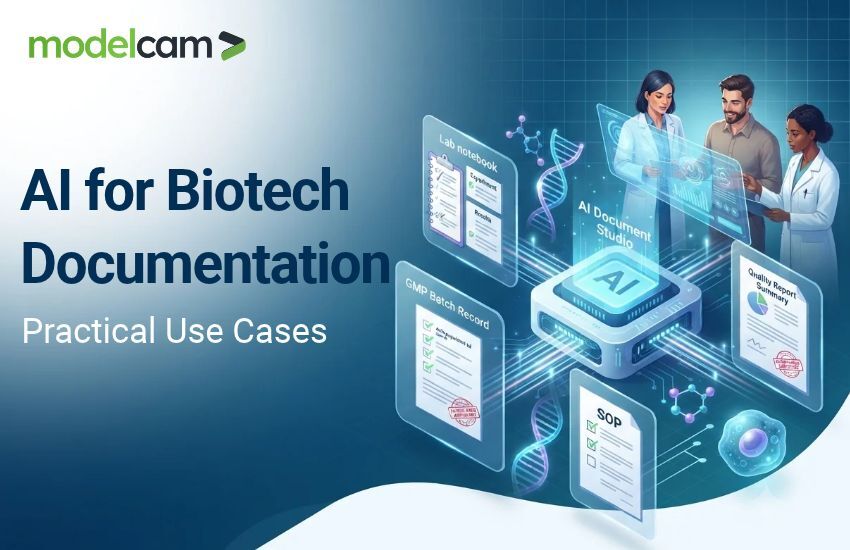
Solutions such as Modelcam's AI Document Studio can support this process. With SmartInput and AI-powered document generation, the platform is designed to simplify document preparation and help businesses generate GMP and other business documents across various industries.
By using AI Document Generation, teams can reduce time spent on routine drafting and focus more on reviewing documents and improving their workflows.
6. Using AI for Data Analysis and Documentation
Biotechnology companies generate considerable amounts of research, operational, and quality data. Converting this information into useful reports and summaries often requires time and effort.
AI can assist with Data Analysis by organizing information, summarizing results, highlighting patterns, and preparing reports using available data. For example, laboratory teams can use AI to organize experiment observations into summaries that can be reviewed by researchers.
AI in business extends beyond customer support and sales functions. General AI in Business applications can also help with laboratory activities, research, quality operations, and internal processes.
AI-driven solutions and Data Automation can make information handling more efficient, reduce repetitive work, and help organizations use their data more effectively.
Benefits of AI in Pharma Documentation
Implementing AI in Pharma Documentation can help businesses in several ways:
- Less manual effort: AI can help automate repetitive writing, formatting, summarization, and data entry.
- Consistent document formats: Standard templates and AI-generated drafts can help maintain uniformity.
- Quicker documentation: Employees can prepare initial drafts faster and focus on reviewing them.
- Simpler information retrieval: AI can assist in locating, organizing, and summarizing records.
- Streamlined operations: AI-driven tools can support documentation across laboratory, manufacturing, quality, and administrative teams.
The actual benefits depend on the AI tool, the information it works with, and the processes used to verify its output.
What to Consider Before Implementing AI
Before adopting AI, biotech companies should consider their documentation workflows, data protection requirements, and operational needs. Research, quality, and manufacturing records may contain sensitive information, so choosing tools with appropriate security measures is important.
AI-generated content should also be checked by qualified professionals before it is approved or used in regulated operations. AI can assist with documentation, but it should not replace established quality and compliance practices.
Selecting suitable Laboratory Documentation Software or an AI-powered document generation platform can help businesses introduce automation while keeping their existing workflows manageable.
Conclusion
AI in Biotechnology is helping organizations rethink how they prepare, organize, and maintain documents. From laboratory records and GMP Documentation to quality reports and SOPs, AI can simplify several routine documentation activities across the biotech and pharmaceutical sectors.
By adopting suitable AI tools, businesses can improve document-related workflows, reduce repetitive tasks, and make better use of their employees' time without compromising the review and security processes they rely on. AI in Pharmaceutical Industry is not just about technology adoption; it is also about making everyday operations simpler and more efficient.