
From Scattered Files to a Company Knowledge Hub: How AI Can Connect Your Business Documents
About CompanyGPT
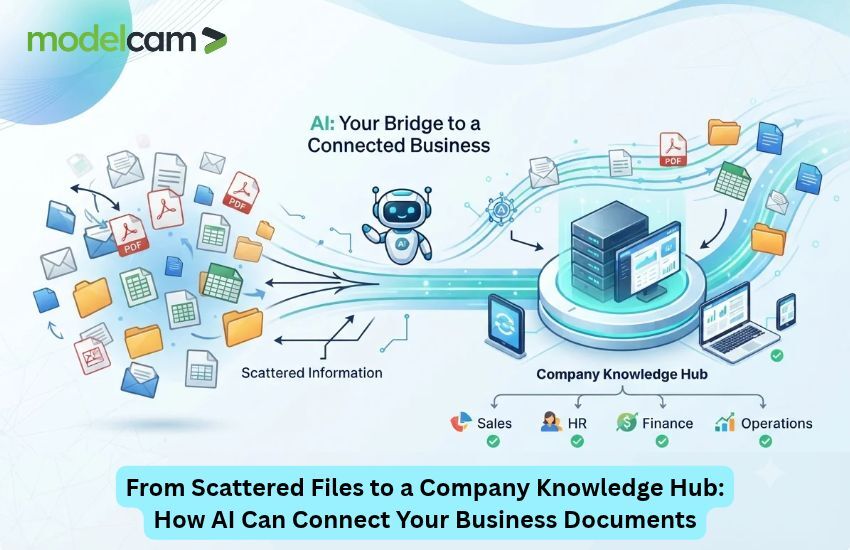
A company's important information is not always easy to find. It may be spread across emails, PDF reports, spreadsheets, shared folders, and different departmental systems. CompanyGPT helps businesses move towards a more connected work environment by bringing AI into daily operations and making better use of existing business information.
When employees spend valuable time looking for files, searching old emails, or contacting other departments for information, overall productivity can suffer. The issue is not necessarily a shortage of information but the difficulty of finding the right details at the right time.
For more information, explore our comprehensive blog, “What is CompanyGPT? A complete guide to AI for modern businesses!”
Why Scattered Business Documents Create Problems
As businesses expand, the amount of information they handle also increases. Sales teams manage customer records and proposals, finance teams maintain invoices and reports, HR handles employee information, and operations teams manage process documents and work updates.
When documents are spread across multiple locations, finding the latest version or getting the complete picture can become difficult. Employees may also repeat data entry, while important discussions and decisions get lost in lengthy email conversations.
Some common challenges include:
- Spending too much time looking for files across different systems.
- Repeating tasks because existing information is difficult to locate.
- Delays when departments depend on information from other teams.
- Confusion caused by outdated or duplicate documents.
- Loss of valuable business knowledge when experienced employees leave.
A connected AI company knowledge base can help overcome these issues by making company information easier to access, understand, and use.
How AI Can Connect Your Business Documents
AI is not limited to storing documents in one location. When properly configured, it can help employees search for relevant information, understand document contents, generate summaries, and manage routine activities more efficiently.
For instance, an employee responding to a customer enquiry may need details from an old proposal, a product document, and previous email discussions. Rather than checking each source separately, an AI-powered workflow can bring relevant information together, based on available integrations and access permissions.
This is where AI for company documents and AI document intelligence can make a difference. They help businesses extract useful information from different documents and make it easier for employees to find what they need.
A properly designed enterprise AI platform can further connect information sources and simplify knowledge sharing across departments.
Turning Scattered Files into a Company Knowledge Hub
A company knowledge hub is more than a collection of stored documents. It provides employees with an organized way to find relevant information and use it in their daily responsibilities.
AI can make this possible in several ways:
1. Access Information More Quickly
Employees no longer need to spend excessive time browsing multiple folders or going through lengthy email conversations. An AI assistant can help retrieve relevant details from connected sources, depending on the available integrations and permissions.
2. Make Large Documents Easier to Understand
Business documents such as contracts, reports, technical manuals, and company policies often contain extensive information. AI can summarize important points, highlight relevant sections, and make these documents easier to review. Employees should verify critical details using the original documents.
3. Minimize Repeated Queries
Employees frequently seek answers to common questions about company policies, business processes, products, and customer information. A connected knowledge source can help them find reliable information independently instead of repeatedly approaching colleagues.
4. Strengthen Collaboration Between Departments
When employees can access relevant information with the right permissions, coordination between teams becomes easier. Sales, finance, operations, and customer support teams can work with shared information and better understand ongoing activities.
These capabilities make AI for business operations more useful and open up opportunities for business process automation, especially in tasks that involve regularly searching for and sharing information.
How CompanyGPT Connects Business Workflows
CompanyGPT from Modelcam introduces role-based AI employees to help businesses manage their daily activities. Rather than depending only on a general AI chat interface, companies can assign specific roles to AI employees, set their responsibilities through duty rosters, and monitor their activities using daily work logs.
For instance, a sales AI employee can help manage customer enquiries, prepare proposals, and collect relevant information. Similarly, an operations AI employee can assist with regular operational tasks. Their responsibilities can be defined according to business requirements and available system integrations.
This gives businesses an opportunity to use AI employees for business and implement AI automation for business in a more organized manner. They can start with roles that involve repetitive tasks and consume a significant amount of employee time.
Modelcam also provides workflow packs for EPC and manufacturing companies. CompanyGPT supports desktop, cloud, and on-premise deployment options, allowing businesses to choose an environment based on their data requirements.
Why Data Privacy and Control Are Important
Business documents often contain sensitive information, including customer records, financial details, employee information, technical documents, and confidential project data. Before adopting an AI solution, companies must consider how their information is handled, where it is processed, and who has permission to access it.
Businesses that require greater control over their information can consider private AI for business and on-premise AI for business solutions. CompanyGPT provides on-premise deployment along with desktop and cloud options.
Choosing secure AI for business also involves setting proper access permissions, establishing clear usage guidelines, and reviewing important AI-generated information. AI can support employees in their work, but checking the accuracy of critical information remains essential.
How Different Departments Can Benefit from AI
A connected company knowledge system can make everyday tasks easier for different departments:
- Sales: Access product details, previous proposals, and customer information to respond to enquiries more effectively. CRM AI and sales automation tools can provide additional support when integrated with existing systems.
- HR: Find company policies, employee onboarding details, and internal process documents more easily.
- Finance: Access invoice information, financial reports, and related documents for quicker review.
- Operations: Retrieve work instructions, process documents, and departmental updates without unnecessary delays.
- Customer Support: Refer to product details and previous customer interactions to deliver more consistent support.
These use cases demonstrate how AI tools for business can simplify routine activities. The actual benefits depend on the quality of documents, available integrations, user permissions, and how workflows are configured.
How to Build a Smarter Company Knowledge System
Businesses do not need to replace all their existing systems to create a company knowledge hub. A better approach is to first identify where employees spend the most time searching for information.
Begin with a small collection of important documents and select one repetitive workflow to improve. Make sure the information is accurate, establish suitable access permissions, and define how employees should check AI-generated responses.
Once the system is in use, track useful performance measures such as document search time, repeated data entry, response time, and manual effort. Employee feedback can help identify areas for improvement before introducing the solution across more departments.
The purpose of enterprise AI solutions is not just to introduce additional software. It is to help businesses use their existing information more effectively and make everyday work easier.
Make Your Business Knowledge More Accessible
Scattered documents can delay decisions, increase repetitive work, and make important company information difficult to access. By connecting information sources and introducing role-based workflows, AI can help organizations create a more organized way to manage business knowledge.
Through CompanyGPT, Modelcam brings role-based AI employees, defined responsibilities, daily work logs, and flexible deployment options into business operations. For organizations considering AI for businesses, it offers an approach to improving information access, strengthening team coordination, and supporting more efficient workflows.
Ultimately, a company knowledge hub is not about storing more documents. It is about helping employees find the right information and use it when it matters most.