
How Manufacturers Can Use AI to Find Answers Hidden in Technical Documents
Let’s Start
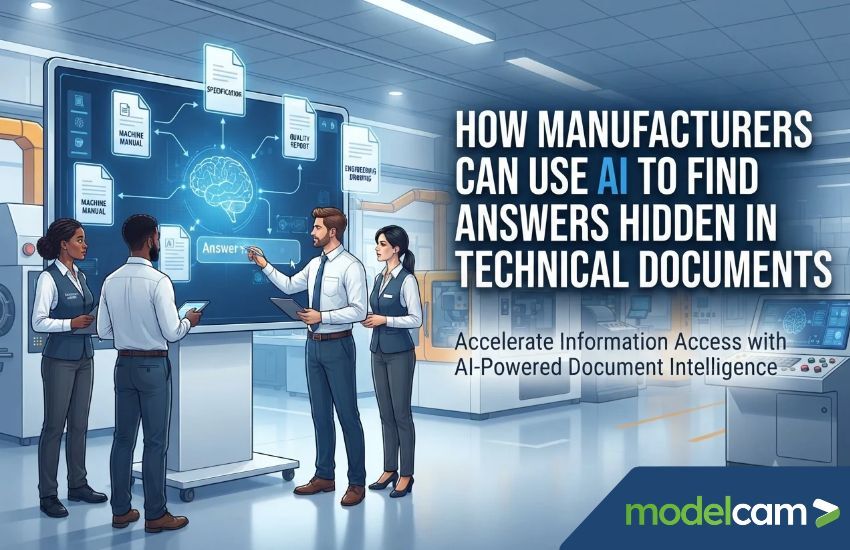
Picture a production manager searching through an old machine manual for the correct operating setting. An engineer needs to find a component specification from an earlier project, while the quality team is reviewing multiple reports to identify the reason behind a recurring issue.
The required information may already be available within the company. The challenge is finding it quickly when it is needed.
Manufacturing businesses handle different types of technical documents, such as product specifications, machine manuals, engineering drawings, maintenance records, quality reports, and standard operating procedures (SOPs). Manually searching through these files can consume valuable working hours.
This is where AI for business can help. Solutions such as CompanyGPT from Modelcam Technologies allow manufacturers to explore how AI employees can work with company documents and systems, making important business information easier to access.
Why is it Difficult to Find Information in Technical Documents?
Technical documents hold important business knowledge, but accessing the right information can often be challenging. Different departments may keep their files in separate folders, shared drives, email accounts, or document management platforms.
Employees may regularly encounter challenges such as:
- Going through multiple folders to locate a particular specification.
- Spending time reading lengthy manuals to find particular instructions.
- Relying on experienced team members for technical details.
- Finding and verifying the latest document versions.
- Repeating searches because relevant information is difficult to locate.
- Collecting details from different departments to complete a task.
For instance, a maintenance engineer may need to refer to a machine's servicing instructions. When these details are buried inside a lengthy manual, locating the correct information can become time-consuming.
An AI company knowledge base can make relevant business information easier to find. Rather than depending entirely on manual searches, employees can ask questions in simple language and access relevant details from connected information sources.
How AI Helps Manufacturers Access Information Faster
Conventional document searches often rely on file names, keywords, and folder locations. However, employees may not always remember the exact file name or technical terms used in a document.
AI-powered document intelligence provides another way to access information. Depending on the connected documents and system capabilities, employees can interact with business information more naturally.
For example, an engineer may want to check the material specification used for a particular component. Instead of opening several files and searching through them individually, the engineer can ask a relevant question through an AI-powered interface.
This is where AI document intelligence becomes useful. It offers businesses a more convenient way to access information and reduces the effort involved in everyday document searches.
For manufacturing companies, AI for company documents can improve access to information across engineering, production, maintenance, quality, and other departments.
Practical Ways Manufacturers Can Use AI with Technical Documents
AI can assist manufacturing teams with several routine activities that involve finding and using information from company records.
A. Locating Product Specifications
Engineering teams frequently work with material specifications, component details, product requirements, and previous design records.
An AI-powered assistant connected to relevant documents can help employees find these details without opening multiple files manually. This is especially useful when referring to earlier projects or checking technical information during product development.
B. Finding Machine Manuals and Maintenance Records
Maintenance teams regularly refer to equipment manuals, servicing instructions, inspection reports, and maintenance histories.
With an AI-assisted workflow, employees can search for relevant information without repeatedly going through lengthy documents. This can help technicians locate useful references when troubleshooting equipment or preparing for routine maintenance.
However, important maintenance instructions must always be verified against approved manuals and established safety procedures.
C. Analyzing Quality Reports
Quality departments manage various records, including inspection reports, non-conformance records, corrective action documents, and audit reports.
AI can help teams find relevant documents, gather details from different records, and create summaries for review. This makes it easier to look back at previous quality concerns and access the information needed for further analysis.
D. Finding Standard Operating Procedures
Standard Operating Procedures (SOPs) provide instructions for carrying out different manufacturing activities. Employees regularly refer to them when performing production, inspection, packaging, and equipment-related tasks.
An AI assistant can help employees find the required sections in SOPs, as long as the relevant approved documents are connected to the system. However, employees must always refer to the latest authorized procedures instead of depending only on AI-generated responses.
E. Sharing Information Across Departments
Important technical information is used by several departments, not just engineering. Procurement teams need supplier specifications, production teams require process instructions, and sales teams may look for product-related details.
An enterprise AI solution can make relevant information more accessible to employees across different roles, helping reduce repeated communication and unnecessary delays between departments.
Why Manufacturers Should Choose Private and Secure AI
Manufacturing documents may include sensitive business details such as product designs, production methods, supplier information, pricing, and internal procedures.
Sharing such files with unsuitable public AI platforms may expose businesses to data security and confidentiality risks. Therefore, manufacturers need to understand how their information is handled, who can access it, and what security measures are in place.
Private AI for business gives organizations the option to select deployment models that align with their information security requirements.
For example, on-premise AI for business allows companies to run an AI solution within their own IT infrastructure. This can be useful for manufacturers working with confidential engineering files and production data.
CompanyGPT offers desktop, cloud, and on-premise deployment options, giving businesses flexibility in choosing where their AI solution operates and how their data is managed.
Therefore, deployment flexibility is an important factor to consider when selecting enterprise AI solutions.
How CompanyGPT Helps Manufacturing Teams
CompanyGPT from Modelcam Technologies brings a role-based AI employee concept to everyday business operations.
Rather than functioning only as a general chatbot, CompanyGPT provides a named AI colleague for an assigned role. Every AI employee has specific responsibilities, follows a duty roster, and records completed activities in a daily work log.
For manufacturing companies, this approach can help manage regular activities through clearly defined roles and workflows.
For instance, businesses can explore AI assistance for handling technical information, accessing departmental records, and managing routine coordination. These workflows can be configured according to the company's systems and information requirements.
CompanyGPT also provides a Manufacturing workflow pack, which Modelcam's engineers install and configure on plant systems.
Some of its key features include:
- Role-based AI employees: Assign individual AI colleagues to different business functions.
- Defined responsibilities: Set specific duties for every AI employee.
- Daily work logs: Track and review the activities completed by AI employees.
- Flexible deployment: Select desktop, cloud, or on-premise options.
- Manufacturing workflow support: Configure AI employees to suit manufacturing operations.
These features make CompanyGPT an option worth considering for manufacturers planning to adopt AI business automation through structured workflows.
What Should Manufacturers Check Before Implementing AI?
Adopting AI in manufacturing involves more than choosing the right software. Companies should first identify where their information is stored and understand which employees need access to it.
A few important steps to consider include:
- Identify information sources: Make a list of relevant manuals, specifications, reports, and business systems.
- Review document quality: Find duplicate files and separate outdated documents from current versions.
- Assign user roles: Identify which employees require access to specific information.
- Manage access permissions: Keep confidential business information protected from unauthorized access.
- Verify AI responses: Cross-check important technical information with approved documents.
- Begin with one workflow: Select a department or regular activity before expanding AI implementation.
Following a structured approach can help businesses introduce AI for business operations while keeping existing processes organized. It can also provide a starting point for implementing broader AI business solutions across different departments.
Conclusion
Manufacturers already have valuable technical information stored in their documents and business systems. Making this knowledge easy to access and use is the real challenge.
With suitable AI tools for business, employees can reduce the time spent searching for documents and focus more on engineering, production, quality, and customer-related activities.
CompanyGPT by Modelcam Technologies brings role-based AI employees into business workflows, supported by manufacturing-specific deployment and flexible hosting options. Manufacturers looking to make better use of their existing knowledge can consider AI for businesses as a step towards more connected and informed operations.
Explore CompanyGPT by Modelcam Technologies to learn how AI employees can become part of your manufacturing workflows.