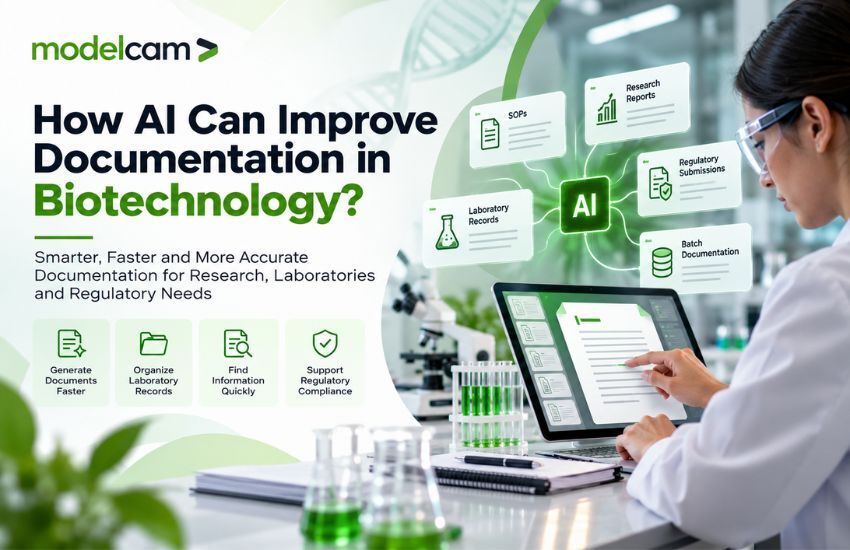

Due to advanced automation in factories around the world and the quick adoption of AI in manufacturing, manufacturing is about to enter its most revolutionary phase in decades. Smart manufacturing, where machines learn, adapt, and maximize output with little human intervention, has developed from what started out as basic automation. This change is altering everything in the industry, including supply chain orchestration, quality control, customer experience, and product design and operations, thanks to artificial intelligence.
Through sophisticated engineering automation, design intelligence, and production-ready digital workflows, companies like Modelcam Technologies have expedited this transformation. AI becomes a strategic catalyst rather than merely a technological advancement as firms pursue agility, speed, and cost reduction.
This blog examines how AI is changing the modern industry and how the most significant developments are redefining Industry 4.0.
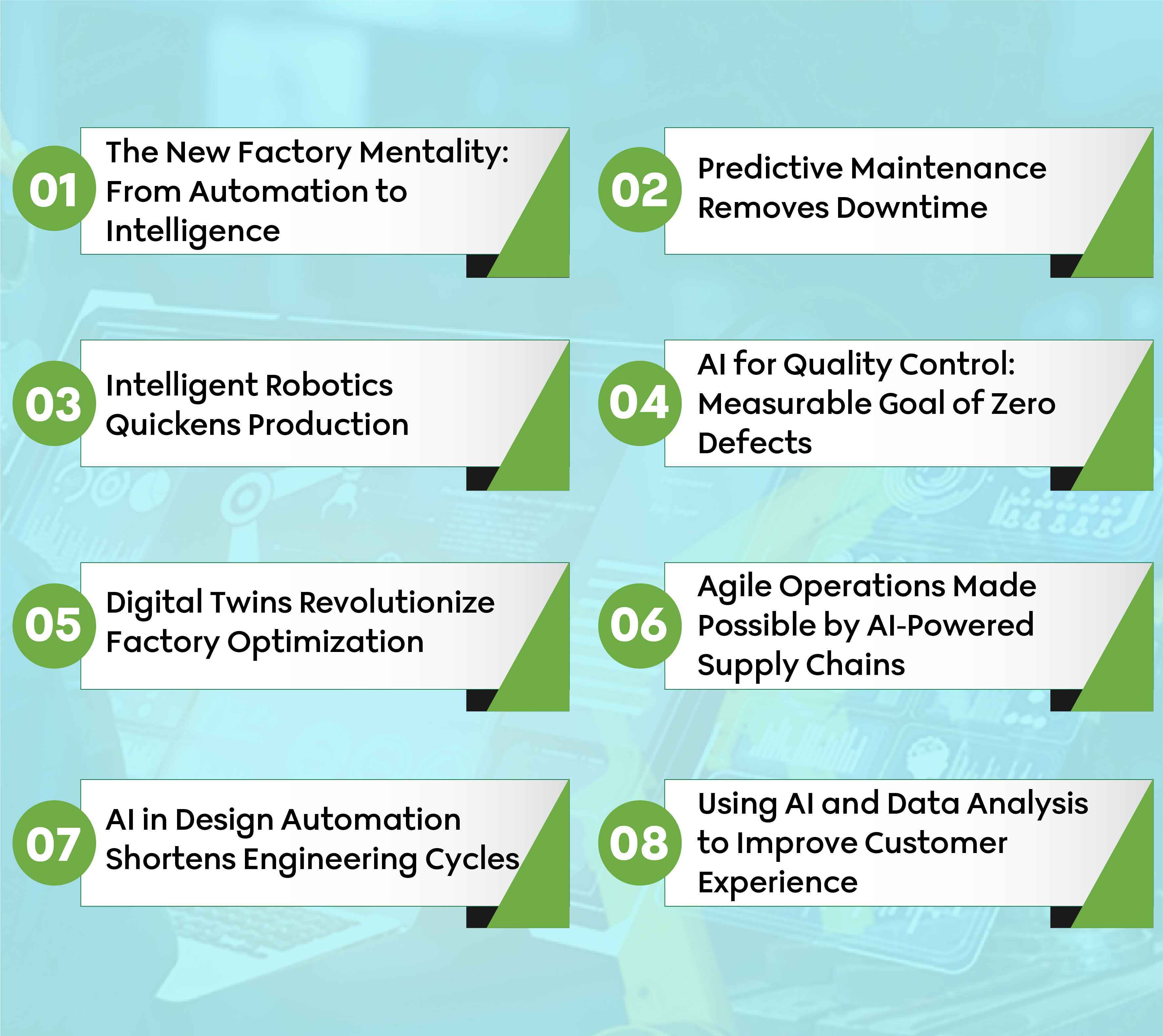
Manufacturers were able to replace monotonous operations with machines thanks to traditional automation. AI automation, on the other hand, introduces decision-making intelligence into the industrial setting.
Modern machines can recognize trends, anticipate faults, self-adjust parameters, and optimize operations via AI-driven production. Manufacturers can now transition from reactive to proactive, self-learning systems thanks to this change.
Making the shift to Industry 4.0 is now essential for gaining a competitive edge. Robotics, data analytics, and industrial IoT sensors are used in AI-powered smart factories to create fully integrated systems that continuously optimize themselves.
One of the main causes of manufacturing revenue loss is unexpected machine failure. Businesses may now anticipate problems before they arise because of machine learning in manufacturing and industrial IoT sensors.
In order to identify irregularities, predict component failures, and plan maintenance without compromising production, predictive maintenance makes use of both historical and current data. This greatly increases machine life, minimizes malfunctions, and avoids production losses.
Modelcam's internal resources, including AI manufacturing applications, benefits of AI in industry, and AI case studies in factories, offer validated, industry-grade examples of real-world success for businesses looking for evidence-based implementation tactics.
The days of traditional robots are rapidly coming to an end. In production settings, a new generation of AI-powered intelligent robotics offers flexibility, accuracy, and independence.
Robots with AI capabilities today can:
Use computer vision to identify component variances in manufacturing
Adapt handling and placement to the properties of the object.
Collaborate with people
Increase assembly precision and decrease flaws
Manufacturers benefit from increased safety, decreased manual labor, and faster production as these capabilities grow. This encourages AI to significantly reduce production costs, especially in high-volume and precision-driven industries.
Find out more about how smart automation enhances production speed, read our blog post, “AI in Manufacturing: How Smart Automation Is Transforming Production Lines”!
One of the most important foundations of smart manufacturing is consistent product quality.
AI-powered visual inspection systems are now faster and more accurate than human inspectors. AI for quality control detects flaws that are unseen to the human eye using computer vision, picture recognition, and deep learning.
Among the main benefits are:
Inspection in real time
Automated detection of anomalies
Increased consistency in quality
Reduced rates of rejection
Decisions pertaining to quality are made more quickly, accurately, and based on data when real-time analytics are included into production lines.
The use of digital twins - virtual copies of machinery, production lines, or entire factories - is a significant advancement in AI in business and manufacturing.
Manufacturers can use digital twins to:
Model changes in production
Modifications to the test design
Identify operational bottlenecks
Accurate performance predictions can enhance industrial optimization.
Digital twins decrease downtime through simulation-led planning and offer a comprehensive view of plant-level performance when combined with AI-driven solutions and industrial IoT sensors.
Modern supply chains must contend with demand fluctuations, complicated logistics, and instability. AI-powered supply chain solutions driven by AI apply predictive intelligence to logistics, inventory control, and procurement.
Among the capabilities are:
Precise demand projections
Route optimization
Purchase order decisions made automatically
Evaluations of supplier risk
Reduction of inventory costs
This leads to increased delivery reliability, reduced waste, and quicker fulfillment when combined with data automation and AI-driven analytics.
AI in design automation, which speeds up engineering, simulation, and design processes, is one of the most revolutionary uses of AI.
In this area, Modelcam Technologies shines, allowing:
Automated generation of CAD models
Intelligence from parametric design
Integration of design rules
Optimization based on simulation
This enhances accuracy in early design cycles and significantly cuts down on engineering time. By guaranteeing that all project stakeholders use a single, AI-enhanced design intelligence, it also improves cooperation.
Customer experience in manufacturing is becoming more closely linked to product responsiveness, delivery speed, and dependability. Manufacturers can foresee client wants, assess usage patterns, and provide customized solutions with AI-led customer data analysis.
AI-powered enhancements to the consumer experience consist of:
Improved customization of products
Quicker cycles of response
Models of predictive services
Additionally, manufacturing teams may manage leads, cultivate customer connections, and improve sales performance through data-driven insights with the use of CRM systems powered by customer relationship management (CRM) AI and sales automation tools.
Autonomous factories, where machines make independent micro-decisions, will become more common during the next ten years.
Variations in supply chains are automatically corrected
Real-time quality adjustment takes place.
Robots and human teams work together harmoniously.
AI-powered systems constantly improve everything.
This future is based on the growth of automation, smart manufacturing, and artificial intelligence in manufacturing, where factories become dynamic, self-learning ecosystems.
AI is now a key factor in manufacturing competitiveness rather than just an experimental technology. Manufacturers are quickly embracing highly scalable, data-driven capabilities, from intelligent robotics and predictive maintenance to AI-driven production and design automation. Businesses that use AI will outperform rivals who continue to use traditional methods while cutting expenses, increasing productivity, and improving product quality.
Today's factories are embarking on a new era of intelligence, resilience, and growth because of technological innovators like Modelcam Technologies, which enable next-generation engineering workflows and automation solutions. Artificial intelligence in industry is changing manufacturing now, and this change is permanent. It is no longer about the future.
Let’s connect: www.modelcamtechnologies.com
Email: sales@modelcamtechnologies.com
Mobile no : +91 8237016167
Modelcam Technologies provides a wide variety of Services from ART to PART from Concept Design to Industrial Modeling and Analysis for final Manufacturing.
©Copyright 2026. All rights reserved by Modelcam Technologies Private Limited PUNE.