AI in manufacturing is changing how producers create, make, and deliver goods; it is no longer just a futuristic idea. By 2026, AI in manufacturing will be a crucial component of increasing output, cutting expenses, and assisting companies in maintaining their competitiveness in a market that is changing quickly.
Manufacturing firms are constantly under pressure to fulfill shifting consumer demands, maintain quality, boost productivity, and cut downtime. Traditional methods are no longer adequate on their own. This is the area where artificial intelligence in manufacturing is having a big impact. AI is assisting firms in making quicker and more intelligent decisions through intelligent production planning, predictive maintenance, and quality inspection.
The main advantages of AI in manufacturing that every company should be aware of in 2026 will be discussed in this blog.
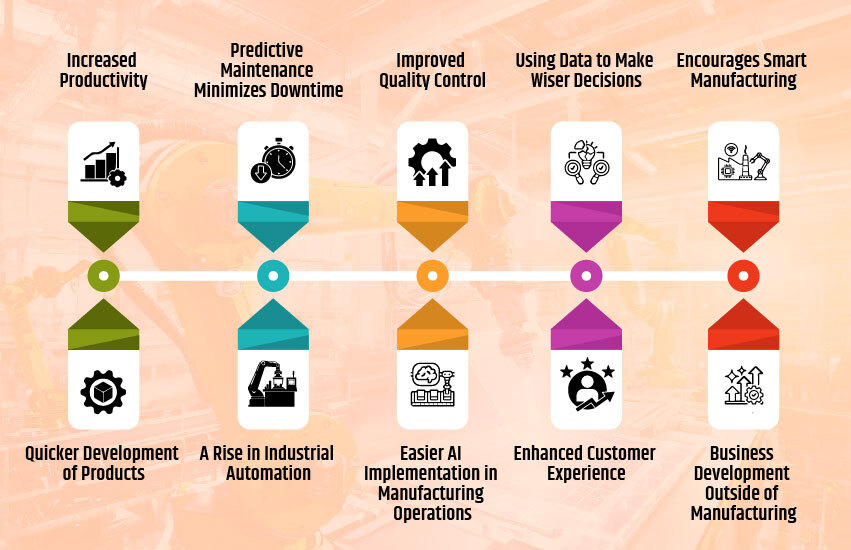
Increased operational efficiency is one of the main benefits of artificial intelligence in manufacturing. Real-time machine, production line, and workflow monitoring is made possible by AI-powered solutions, which can spot inefficiencies before they become serious problems.
AI Manufacturing Solutions can evaluate thousands of production data points in a matter of seconds, in contrast to conventional systems. This enables producers to increase overall production, minimize idle time, and maximize machine use.
AI, for instance, can help businesses deliver goods more quickly by autonomously modifying production schedules based on machine availability and consumer demand.
For more information, you can check out our blog, “7 Ways Smart Factories Are Boosting Productivity in 2026”!
One of the main problems in production is unexpected machine failures. In addition to halting output, equipment failures raise the cost of repairs.
AI uses sensors and production data to continuously check machine health with predictive maintenance. AI anticipates possible problems ahead of time and notifies maintenance staff rather than waiting for a machine to malfunction.
Predictive maintenance can drastically cut unscheduled downtime and maintenance costs by up to 30%, according to industry reports.
This makes AI Applications in Manufacturing extremely beneficial for companies trying to increase production continuity and equipment dependability.
For every manufacturer, maintaining a constant level of product quality is crucial.
AI-powered vision systems and machine learning algorithms are used by modern quality control automation to examine goods while they are being produced. Tiny flaws that would be hard for the human eye to notice can be found by these systems.
AI conducts real-time inspections rather than post-production inspections, enabling manufacturers to address problems right away.
Consequently, companies encounter:
Reduced rates of rejection
Decreased wasting of materials
Increased customer satisfaction
Enhanced uniformity of the product
This is one of the factors contributing to the growing popularity of AI solutions for manufacturing across various industries.
Every day, manufacturing produces enormous volumes of production data. But gathering data on its own is insufficient.
AI uses sophisticated data analysis to turn unprocessed data into insightful knowledge. Manufacturers are better able to predict demand, track equipment performance, spot production patterns, and maximize inventory.
Managers can rely on AI-driven advice backed by real-time data rather than making decisions based on conjecture.
Organizations can enhance planning and lower operational risks by using this data-first strategy.
Smart Manufacturing, which combines automation, intelligent software, and networked machinery, is the way of the future for production.
By evaluating data from sensors, robotics, ERP systems, and industrial machinery, AI serves as the brains of smart factories.
Manufacturers can increase productivity while lowering operating costs by using intelligent resource allocation, automated monitoring, and more intelligent production planning.
The increasing use of AI in Industry 4.0, where digital technologies are transforming contemporary manufacturing settings, is further supported by this.
It is anticipated that manufacturers would introduce new items more quickly than in the past.
AI assists engineering teams in assessing production viability, analyzing client requirements, and refining product designs prior to manufacturing.
Businesses can cut down on development time and prevent expensive production problems by spotting design defects early.
In order to enable engineers to evaluate production processes virtually before putting them into practice on the factory floor, many firms also integrate AI with simulation technologies like Digital Twin in Manufacturing.
Faster and less risky invention is the outcome of this.
To increase productivity, consistency, and worker safety, manufacturers are spending more on industrial automation.
Compared to conventional automation systems, AI-powered robots are more accurate at doing repetitive operations like assembling, packaging, welding, and material handling.
AI-enabled systems, in contrast to traditional automation, are able to learn from production data and adjust to changing circumstances.
AI is a crucial component of industrial facilities that are prepared for the future because of its adaptability.
A lot of companies think that implementing AI is costly and difficult. However, AI Implementation in Manufacturing is now much easier.
Manufacturers of all sizes may incorporate AI into their current production systems without completely replacing their infrastructure thanks to cloud-based platforms, cognitive analytics tools, and industry-specific software.
Businesses can begin with tiny AI initiatives and progressively grow, regardless of the objective - predictive maintenance, production planning, inventory management, or quality inspection.
Producing goods is no longer the main aspect of manufacturing. Providing a great customer experience is now just as crucial.
Through customer data analysis, AI assists manufacturers in understanding consumer preferences, allowing them to more precisely predict demand and deliver goods on schedule.
Additionally, AI facilitates improved communication across the supply chain, individualized services, and quicker reaction times.
AI is a worthwhile business investment since satisfied customers frequently return.
AI has advantages that go beyond manufacturing processes.
AI is currently being used by many manufacturers to enhance internal procedures, automate administrative work, and improve customer connections.
Businesses may enhance forecasting, streamline departmental decision-making, and automate repetitive processes using data automation with AI-Driven Solutions.
Customer Relationship Management (CRM) AI and Sales Automation Tools are also helping sales teams by tracking leads, managing customer interactions, and increasing conversion rates.
This illustrates how AI adds value not only on the manufacturing floor but throughout the entire company.
Every year, manufacturing becomes more competitive. Smarter technologies are needed due to complex supply chains, rising production costs, and rising customer demands.
Today, companies who invest in AI software for the manufacturing industry are better equipped to increase productivity, cut waste, improve product quality, and make wise judgments.
Businesses that put off implementing AI may find it difficult to compete with manufacturers who are already streamlining operations with intelligent technologies.
By providing cutting-edge manufacturing solutions that boost productivity, automation, and operational efficiency, companies like Modelcam Technologies are assisting businesses in embracing digital transformation.
In 2026, the use of AI in industry is still expanding. AI is assisting companies in increasing productivity while lowering operating costs through a variety of applications, including Smart Manufacturing, Industrial Automation, Digital Twin in Manufacturing, Predictive Maintenance, and Quality Control Automation.
Adopting the appropriate AI Manufacturing Solutions is becoming a competitive requirement as manufacturing continues to change. Investing in intelligent manufacturing technology now will position your company for long-term success, regardless of whether you are developing your first AI project or enhancing current capabilities.
Let’s connect: www.modelcamtechnologies.com
Email: sales@modelcamtechnologies.com
Mobile no : +91 8237016167
Modelcam Technologies provides a wide variety of Services from ART to PART from Concept Design to Industrial Modeling and Analysis for final Manufacturing.
©Copyright 2026. All rights reserved by Modelcam Technologies Private Limited PUNE.