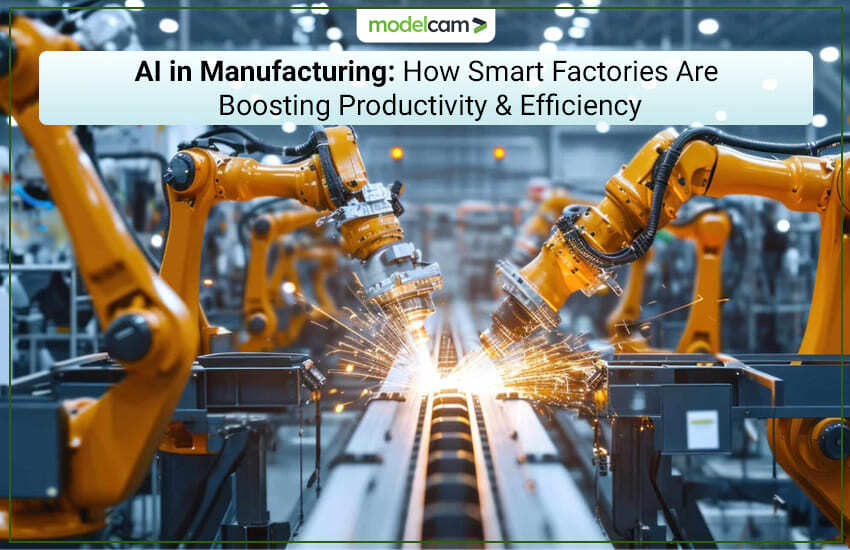
AI in manufacturing is causing an important change in the global manufacturing scene. Manufacturers are using intelligent technology, such as autonomous production systems and predictive analytics, to boost productivity, reduce waste, and boost profitability. Adoption of AI in manufacturing is becoming strategically necessary as competition heats up and customer expectations change.
Businesses that use AI are moving toward smart factories, which are driven by data automation, real-time analytics, and AI-based decision-making. With cutting-edge engineering and digital solutions catered to contemporary industrial demands, companies such as Modelcam Technologies are facilitating this transition.
The application of machine learning, computer vision, sophisticated data analysis, and automation technologies to streamline industrial operations is known as artificial intelligence in manufacturing. AI systems, in contrast to conventional automation, constantly enhance performance over time by learning from data trends.
In the age of smart manufacturing, systems communicate easily, machines are networked, and predictive intelligence - rather than reactive problem-solving - directs operations. These Industry 4.0 AI solutions combine cloud computing, IoT sensors, robotics, and AI-driven analytics to build production ecosystems that are incredibly flexible and efficient.
The way manufacturing facilities function is being redefined by the emergence of AI in smart factories. Connected devices and real-time data streams are used by smart factories to track performance, identify irregularities, and make choices on their own.
AI is changing factory processes in the following ways:
Monitoring manufacturing in real time
Workflow optimization and intelligent scheduling
Quality inspections that are automated
Systems for predictive maintenance
Optimization of energy usage
Businesses may increase operational precision and drastically reduce manual involvement by utilizing manufacturing automation using AI. Collaborative cobots and AI-powered robots assist human operators, increasing output without sacrificing security.
How AI improves manufacturing efficiency in quantifiable terms is a question that many industry leaders ask.
The clever use of data holds the solution. Large datasets produced by supply networks, production lines, and equipment sensors are analyzed by AI systems. Manufacturers can foresee problems, find bottlenecks, and optimize workflows with the use of sophisticated data analysis.
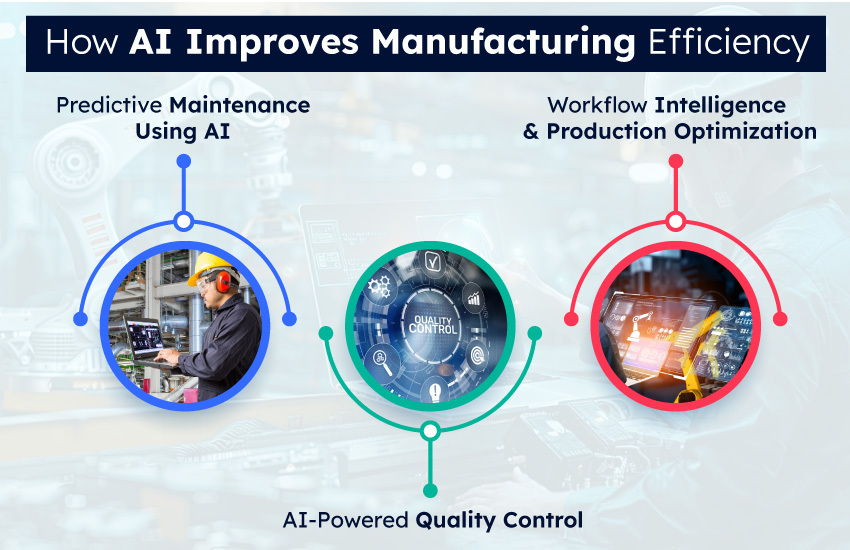
Important factors that drive efficiency include:
Unexpected equipment failures can raise operating expenses and stop output. Predictive maintenance using AI anticipates equipment breakdowns before they happen by utilizing sensor data and machine learning models. This feature benefits manufacturers:
Minimize manufacturing downtime
Reduced maintenance costs
Increase the longevity of machinery
Businesses use proactive maintenance techniques driven by AI-generated insights in place of reactive fixes.
Conventional inspection techniques take a lot of time and are prone to human mistakes. With quality control using AI, computer vision systems are able to identify minute flaws in real time, guaranteeing constant product standards.
By reducing the number of faulty outputs, this increases customer satisfaction in addition to production efficiency. AI-powered quality systems continuously increase the accuracy of inspections by learning from past defect data.
Dynamic scheduling and resource allocation are made possible by AI powered manufacturing. To optimize throughput, algorithms examine production variables like personnel distribution, material availability, and machine capacity.
As a result, companies see quantifiable AI in manufacturing productivity improvement, waste reduction, and overall equipment effectiveness (OEE).
For more understanding on how AI in manufacturing increases manufacturing efficiency, read our blog, “Boosting Productivity with AI in Manufacturing”!
Scalable and integrated solutions are necessary for modern manufacturers. All-inclusive AI solutions for manufacturing companies consist of:
Using digital twins to validate and simulate
AI-powered CAD personalization
Integration of advanced robotics
Analytics for the supply chain
Dashboards for real-time performance
These AI-powered technologies build smooth production ecosystems by fusing digital innovation with engineering know-how. AI in Manufacturing Solutions by Modelcam Technologies, which emphasize engineering efficiency, digital optimization, and intelligent production workflows, can be investigated by organizations looking to transform.
India is embracing AI-enabled industrial transformation at a rapid pace. The demand for AI in manufacturing India is increasing as businesses strive to cut costs and compete globally.
Government programs encouraging digital transformation and Industry 4.0 adoption are speeding up the deployment of smart factories. Indian producers are spending more money on:
Intelligent manufacturing systems
Automation systems powered by AI
Optimizing the supply chain intelligently
Models of energy-efficient production
India is now positioned as a competitive center for industrial innovation driven by AI.
AI in business contributes strategically to improving customer experience and revenue growth, in addition to operational gains.
Analysis and Personalization of Customer Data
Manufacturers are using customer data analysis to gain a deeper understanding of product usage patterns, demand trends, and post-purchase needs. Analytics powered by AI allow:
Precise demand projections
Personalized product setups
Quicker order fulfillment
Manufacturers may enhance communication, automate follow-ups, and fortify long-term relationships by incorporating AI into Customer Relationship Management (CRM) AI solutions.
Revenue Optimization & Sales Automation
Contemporary factories serve as revenue generators in addition to being places of production. Sales automation tools and AI-powered analytics work together to estimate demand, optimize pricing, and match production plans to market demands.
Businesses align industrial production with sales pipelines using AI-driven insights, which lowers the cost of keeping inventory on hand and boosts profitability.
Large amounts of data are produced by smart factories' machines, sensors, and business systems. Without the need for human interaction, data automation guarantees that this information is gathered, analyzed, and transformed into insights that can be put to use.
With cutting-edge AI-driven solutions, manufacturers:
Track performance in real time
Quickly identify inefficiencies
Make strategic judgments supported by facts
When AI and data automation are combined, a self-learning ecosystem is produced in which systems continuously improve themselves for better results.
Unplanned downtime is one of the main production pain factors. Early warning indicators like temperature swings, vibration abnormalities, or inconsistent performance are picked up by AI systems.
Businesses that use AI technologies can:
Minimize manufacturing downtime
Boost the effectiveness of production
Enhance the cycles of maintenance
Reduce waste and redoing
Higher profitability and operational resilience are directly correlated with these quantifiable gains.
Deeper integration throughout the value chain is key to the future of AI in manufacturing. Industrial skills will be further improved by emerging technologies like generative AI, edge computing, enhanced robotics, and AI-powered simulation tools.
Important upcoming trends consist of:
Production lines that operate on their own
Digital twins powered by AI for design validation
Extremely customized production
Energy-efficient and environmentally friendly smart factories
Global productivity benchmarks are being redefined by the use of AI in manufacturing to revolutionize industrial operations. Manufacturers can work more intelligently, quickly, and effectively thanks to artificial intelligence (AI), from quality control and predictive maintenance to sales automation and customer experience optimization.
Businesses can attain long-term competitiveness and sustainable growth by deploying Industry 4.0 AI solutions, adopting Smart Manufacturing, and integrating Artificial intelligence in manufacturing.
Manufacturers who want to speed up this transition should investigate cutting-edge engineering and digital solutions like AI in Manufacturing Solutions by Modelcam Technologies, which include automation, data analysis, and AI-driven intelligence into scalable industrial frameworks.
The challenge now is not whether to employ AI in a rapidly changing industrial ecosystem, but rather how quickly enterprises can put it into practice to achieve operational excellence and quantifiable productivity improvements.
Let’s connect: www.modelcamtechnologies.com
Email: sales@modelcamtechnologies.com
Mobile no : +91 8237016167
Modelcam Technologies provides a wide variety of Services from ART to PART from Concept Design to Industrial Modeling and Analysis for final Manufacturing.
©Copyright 2026. All rights reserved by Modelcam Technologies Private Limited PUNE.