CAD Automation Services are helping businesses create goods more quickly, cut down on expensive errors, and increase overall efficiency in today's cutthroat manufacturing sector. CAD automation in manufacturing has emerged as a useful tool for optimizing design and engineering processes as firms are under growing pressure to produce high-quality goods in shorter amounts of time.
Imagine having to manually create hundreds of product variations. Days or even weeks may pass. Many repetitive processes can be finished in a matter of minutes with automation, freeing up engineers and designers to concentrate on creative work rather than mundane tasks.
CAD automation is the process of automating repetitive design activities in CAD systems using software tools, rules, and scripts. Automation manages comparable drawings, assembly, and design adjustments based on predetermined characteristics rather than making them by hand.
Manufacturers can produce precise models, drawings, and documentation with little manual intervention thanks to design automation. As a result, design time is shortened and project consistency is increased.
Manufacturers may tailor their CAD environments, automate workflows, and increase engineering efficiency with the help of companies like Modelcam Technologies, which offer specialist CAD Automation Services.
Complex designs, numerous product variations, and stringent quality standards are common in manufacturing projects. Production delays, higher expenses, and unhappy customers can result from even minor manual mistakes.
This is the area where CAD automation in manufacturing is quite beneficial.
Typical difficulties that manufacturers encounter include:
Repetitive design tasks
Manual data entry errors
Long design cycles
Inconsistent documentation
Difficulty managing multiple product variations
Businesses can overcome these obstacles and increase operational efficiency by putting automation solutions into place.
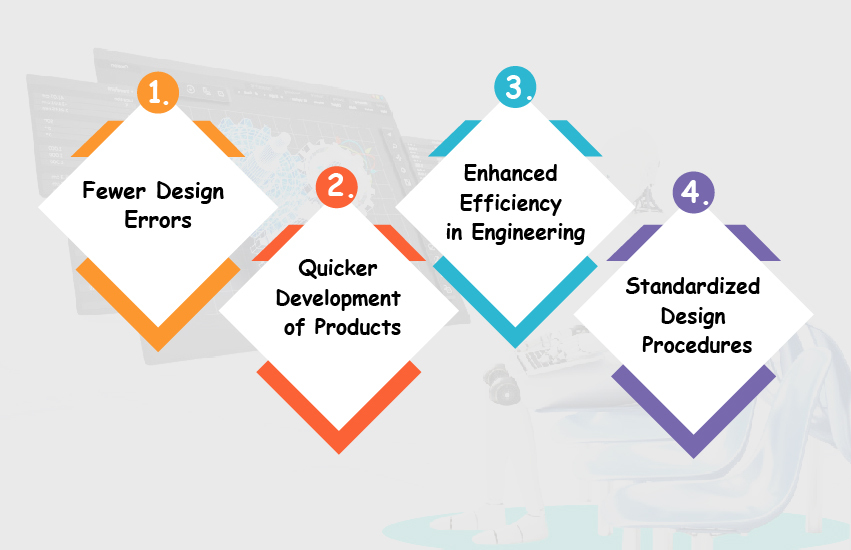
One of the main reasons for design changes and production delays is human error. Automated systems adhere to predetermined guidelines, guaranteeing precision and uniformity during the design phase.
For instance, automation can automatically produce accurate measurements and specifications based on customer requirements if a manufacturer creates bespoke industrial equipment with hundreds of configuration possibilities.
This minimizes expensive rework and drastically lowers errors.
In contemporary production, speed is crucial. A product's competitive advantage increases with its speed of concept to production.
Repetitive tasks like sketching, updating assemblies, making bills of materials, and providing documentation can be automated with CAD Workflow Automation.
According to industry research, engineering teams can automate repetitive operations to cut design time by as much as 30-50%. The productivity improvements might be significant, even though actual outcomes differ.
Instead of concentrating on tedious drawing tasks, engineering automation enables engineers to concentrate on creativity and problem-solving.
Teams may quickly and accurately create new designs by using automated templates and rules-based systems, rather than spending hours altering current designs.
In addition to helping firms finish multiple projects with the same team, this enhances resource use.
Maintaining quality across several projects requires standardization.
Manufacturers can create templates, automatic rules, and design standards unique to their firm using CAD Customization. This guarantees that all designs, regardless of the creator, adhere to the same standards.
Better compliance, more consistency, and enhanced departmental cooperation are the outcomes.
Eager to know about more benefits of CAD automation? Then, dive into our blog post, “Top 5 Benefits of CAD Automation”!
AI is starting to play a significant role in engineering and industrial processes as technology advances.
The potential of AI-driven technologies to improve design automation is being investigated by numerous businesses. Manufacturers can enhance productivity and optimize workflows by integrating automation with intelligent decision-making capabilities.
AI, for instance, can help find design trends, provide suggestions for enhancements, and speed up repetitive engineering activities.
Manufacturing is not an exception to how businesses are changing due to the increasing use of AI in business.
Large volumes of useful data are produced by contemporary automation solutions. Manufacturers can learn more about design performance, project schedules, and resource usage through efficient data analysis.
Businesses can use this data to find bottlenecks and make ongoing process improvements.
To gather, arrange, and handle engineering data more effectively, many businesses are now investing in data automation. Automated analytics and reporting provide more reliable data for decision-making while requiring less manual labor.
Customers of today need personalized solutions and quicker responses. The entire customer experience may be directly impacted by product design delays.
Manufacturers may respond to consumer demands faster and provide customized goods with shorter lead times by automating design processes.
For example, automation can produce updated drawings and specifications nearly instantly in response to a customer's request for a new machine component, enabling sales and engineering teams to submit quotes and approvals more quickly.
This enhanced responsiveness fosters confidence and improves consumer relationships.
Automation has advantages outside of technical departments.
To build a connected digital workflow, many firms combine enterprise software with CAD systems. The design, production, and sales teams can communicate more effectively as a result.
For instance, companies can handle client demands more efficiently by integrating CAD automation with Customer Relationship Management (CRM) AI systems. By directly incorporating customer specifications into design workflows, accuracy can be increased and manual data entry can be minimized.
In a similar vein, engineering systems and sales automation tools can collaborate to speed up order processing and quotation creation.
Businesses can increase overall organizational efficiency with the use of these connected workflows.
Implementing software alone is not enough for successful automation. Each manufacturer has its own procedures, goods, and objectives.
A knowledgeable partner can offer customized CAD customization solutions that meet certain operating needs. The appropriate knowledge guarantees the highest return on investment, from automated design generation to process optimization.
Businesses should seek out suppliers with solid backgrounds in workflow integration, engineering software, and manufacturing.
Automation will remain a key component of product development as manufacturing becomes more digital.
Design automation, engineering automation, AI-driven solutions, and advanced analytics are all working together to help manufacturers increase productivity, improve quality, and expedite delivery.
Businesses who adopt automation now are setting themselves up for long-term success in a market that is becoming more and more competitive.
Manufacturers are always searching for methods to cut expenses, enhance quality, and speed up product development. By removing tedious activities, cutting down on errors, and speeding up design, CAD automation services offer a workable option.
Businesses may increase customer happiness, streamline operations, and free up engineering teams to concentrate on innovation with the increasing use of CAD automation in manufacturing. Automation is influencing factory design in the future, whether via CAD workflow automation, data automation, or new AI-driven technologies.
Manufacturers can maintain their competitiveness and achieve long-term, sustainable growth by investing in the appropriate automation strategy now.
Let’s connect: www.modelcamtechnologies.com
Email: sales@modelcamtechnologies.com
Mobile no : +91 8237016167
Modelcam Technologies provides a wide variety of Services from ART to PART from Concept Design to Industrial Modeling and Analysis for final Manufacturing.
©Copyright 2026. All rights reserved by Modelcam Technologies Private Limited PUNE.