CAD automation services are revolutionizing how companies handle engineering workflows, produce drawings, and design products. You may be wasting time, money, and effort if your team continues to use manual CAD design.
Imagine working on the same drawing over and over again, making the same changes, and correcting the same mistakes each time a client asks for a minor adjustment. Although it can appear to be a typical step in the design process, these tedious duties are actually costing your company far more than you may realize.
Manufacturers and engineering firms are constantly under pressure to complete projects more quickly without sacrificing quality. Consumers anticipate bespoke goods, precise designs, and faster turnaround times. CAD Automation Services can help organizations stay ahead in this situation. Engineers can concentrate on creativity by automating repetitive design activities rather than spending hours on them.
In order to determine which method saves more time, lowers expenses, and boosts overall productivity, we will compare CAD automation vs manual design in this article.
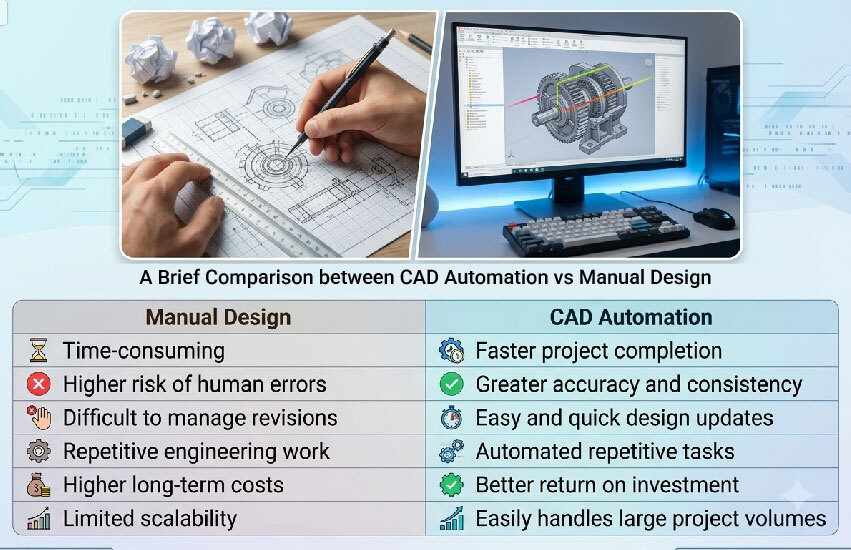
The conventional method of manual CAD design involves engineers or designers creating each drawing, updating dimensions, changing components, and creating documentation by hand.
Although this approach gives you total control over every design, there are a few drawbacks:
Manual design frequently becomes a hindrance rather than a benefit for companies handling numerous product variations.
Design automation automates repetitive CAD activities using intelligent workflows, customized tools, and scripts. Automated systems produce models, drawings, and documentation in a matter of minutes rather than having to start from scratch every time.
CAD Workflow Automation allows companies to:
Automation solutions are tailored through CAD Customization to meet the engineering specifications and design standards of each business.
This method enhances uniformity across projects while also saving time.
When estimating design costs, many companies just compute personnel pay. However, there are a number of unstated costs associated with manual design that have a direct impact on profitability.
Engineers frequently dedicate hours to generating identical product variations, renaming files, or revising designs.
Although they are necessary, these jobs don't really advance engineering.
Engineering automation enables engineers to concentrate on resolving challenging design problems by automating monotonous tasks.
Even seasoned designers may inadvertently utilize out-of-date files, forget updates, or enter wrong proportions.
A minor error could result in material waste, manufacturing delays, or unhappy customers.
By adhering to established guidelines and regulated procedures, automation greatly lowers these risks.
In production, product modifications are frequent. A buyer could ask for a new configuration, size, or material.
With manual design, more engineering hours are needed for each revision.
On the other hand, automated systems require only a few clicks to produce updated designs.
Companies that use CAD automation in manufacturing frequently see increased operational efficiency and quicker project completion.
Among the main advantages of cost savings are:
By removing tedious activities, automated workflows enable engineering teams to finish projects considerably more quickly.
Several studies in the industrial sector have shown that engineering automation can reduce repetitive design time by up to 50% for suitable workflows. The productivity improvements might be substantial, even though the actual outcomes vary based on the project.
Every drawing adheres to company standards thanks to automation.
While cutting down on pointless modifications, this consistency enhances communication between the design, production, and quality teams.
Businesses can use automation to boost productivity with current teams rather than employing more designers for repetitive tasks.
This results in reduced operating expenses and improved use of engineering resources.
The incorporation of AI is making modern automation solutions even more intelligent.
These days, a lot of companies are investigating AI-driven solutions that can help engineers make better decisions, identify design inconsistencies, and optimize workflows.
AI serves as a strong helper that manages repeated analysis and makes wise recommendations, but it does not take the job of engineers.
In a similar vein, businesses are using AI to automate routine tasks that go beyond engineering, increasing team productivity and efficiency.
Automation has advantages that go far beyond CAD.
To make information management across divisions easier, many firms increasingly integrate engineering automation with data automation.
For instance:
The engineering, sales, and customer support departments work together more effectively because of these AI-driven solutions, which ultimately improve the customer experience.
Businesses become quicker, more precise, and more customer-focused when several departments collaborate using linked automated systems.
The long-term savings from automation frequently exceed the implementation costs, notwithstanding the initial outlay.
Today's manufacturers are required to produce customized goods more quickly than in the past.
It gets harder to rely only on manual design as product complexity rises.
CAD automation in manufacturing is being used by manufacturing companies because it enables them to:
Businesses can increase operations without sacrificing high design quality by using customized automation solutions.
For more understanding, explore our comprehensive blog post, “Why Your Engineering Team Needs CAD Automation Today”!
It is now more important to consider whether companies can afford not to automate than whether they should.
Manual design is still useful, particularly for really special or one-of-a-kind engineering tasks. However, automation provides a definite benefit for businesses managing repetitious designs, product setups, and frequent updates.
Businesses may decrease expensive errors, remove repetitive operations, increase productivity, and provide better results faster by investing in CAD Automation Services. CAD automation is becoming a crucial component of contemporary production when combined with technologies like artificial intelligence (AI), engineering automation, and intelligent business processes.
Businesses that use automation now are better positioned to satisfy expanding consumer demands, boost productivity, and maintain their competitiveness in a world that is becoming more and more digital.
Let’s connect: www.modelcamtechnologies.com
Email: sales@modelcamtechnologies.com
Mobile no : +91 8237016167
Modelcam Technologies provides a wide variety of Services from ART to PART from Concept Design to Industrial Modeling and Analysis for final Manufacturing.
©Copyright 2026. All rights reserved by Modelcam Technologies Private Limited PUNE.