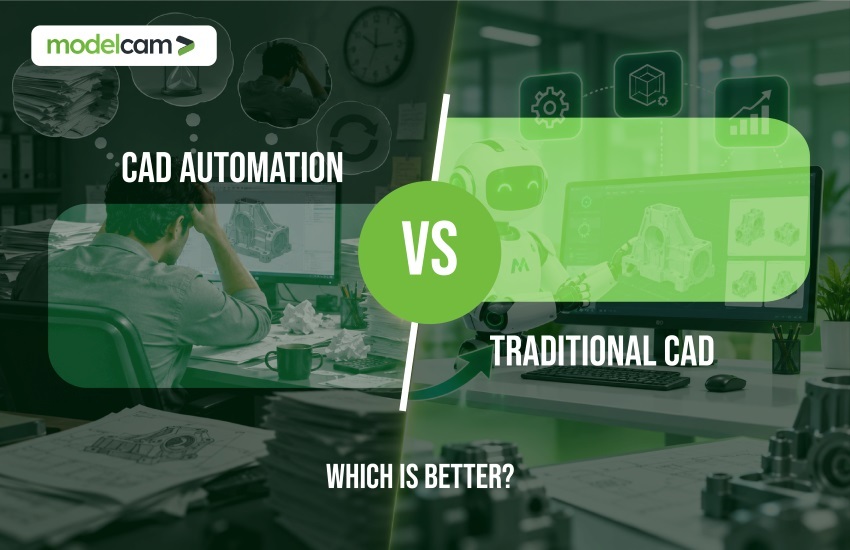
For engineering organizations hoping to function more swiftly, wisely, and efficiently in today's competitive industrial sector, CAD automation services are increasingly essential. Businesses are constantly under pressure to expedite the delivery of customized products, increase accuracy, and shorten design times. Herein lies the significant impact of CAD Automation in Manufacturing.
Imagine your engineering team spending hours making repeating drawings, manually revising dimensions, or fixing mistakes in design that should have been prevented. There is less time for creativity and less production due to these monotonous chores. Businesses can streamline processes, cut down on manual labor, and assist engineers in concentrating on high-value tasks by utilizing Design Automation and Engineering Automation.
The practice of automating repetitive operations within CAD software using software tools, scripts, and intelligent systems is known as CAD automation. Instead of constantly creating identical designs by hand, automated systems generate models, drawings, assembly, and reports based on preset principles.
Companies like Modelcam Technologies provide advanced CAD automation services that help manufacturing and engineering firms reduce operational inefficiencies and boost production.
For example, if a company regularly produces machine part designs with little alteration, automation systems can generate them automatically in a couple of minutes.
Speed is one of the main advantages of CAD workflow automation. Repetitive jobs like these are common in traditional engineering processes:
Creating similar drawings
Changing the proportions
Changing assemblies
Bill of Materials (BOM) generation
Compared to human approaches, automation solutions can finish these jobs far more quickly.
Industry study indicates that design automation can reduce repeated engineering labor by roughly 30 to 50 percent. Project delivery times can be greatly shortened with even modest increases in design speed.
Engineering teams may manage more projects without hiring more staff if CAD workflow automation is implemented properly.
Errors are more likely when drafting by hand. Rework, extra expenses, and production delays might result from a tiny mistake in component arrangement or measurements.
This is the point at which CAD customization becomes quite beneficial. Automated systems assist teams maintain consistency across projects by adhering to predetermined engineering rules and standards.
Automation, for instance, can guarantee:
Accurate measurements
Standardized elements
Appropriate layer configurations
Precise file naming schemes
Businesses can enhance design quality and lower expensive manufacturing defects by decreasing manual input.
Instead of doing the same drafting chores every day, highly trained engineers should dedicate their time to tackling hard technical challenges.
Businesses enable engineers to concentrate on the following by putting Design Automation and Engineering Automation into practice:
Product innovation
Performance optimization
Problem-solving
Custom engineering solutions
Employee happiness and overall productivity both increase as a result.
These days, a lot of companies are implementing AI-driven technology to help engineering teams even more. These technologies help speed up decision-making, automate computations, and suggest design enhancements.
Today's manufacturing sectors need:
Quicker delivery of products
Customization of products
Reduced operating expenses
Increased standards of quality
This is one of the factors contributing to the growing significance of CAD automation in manufacturing.
For instance, businesses that manufacture specialized industrial equipment frequently require several product variations for several clients. Making each variation by hand requires a significant amount of engineering time.
Automation allows parameter-based designs to automatically produce several design iterations. This enables companies to enhance the whole customer experience and react to client needs more quickly.

In the future, engineering will be more heavily reliant on AI and data automation technology.
AI is currently revolutionizing engineering processes in business. AI-powered systems are capable of automating repetitive engineering decisions, analyzing design history, and spotting trends.
For instance:
AI is able to suggest optimal design configurations.
Workflow bottlenecks can be found using data analysis tools.
Businesses can learn about product preferences by analyzing customer data.
These technologies produce engineering solutions that are more intelligent and effective when combined with CAD automation. Businesses that engage in AI-driven solutions are frequently better equipped to handle upcoming industry difficulties.
See our blog post, "AI + CAD Automation: The Future of Engineering Design," for additional details!
Typically, engineering projects involve several departments, including:
Design
Manufacturing
Purchasing
Quality Control
Sales
By standardizing technical data and producing reports automatically, CAD automation enhances communication.
Automated systems are able to produce:
Technical illustrations
BOM reports
Documents for manufacturing
Instructions for assembly
This lessens the delays caused by inaccurate or missing information.
Some companies even combine automation systems with AI platforms for customer relationship management (CRM) and sales automation tools. This facilitates the rapid generation of client-specific proposals and product configurations by sales teams.
Customer satisfaction and engineering efficiency both increase as a result.
Long-term cost savings is one of the main motivations for businesses to invest in CAD automation services.
Automation aids in lowering:
Repetitive labor costs
Design rework
Manufacturing errors
Project delays
Automation can result in significant long-term savings even though it involves an initial investment.
For instance, the annual productivity gains become substantial if an engineering team uses automation to save even 10 hours per week.
These savings directly increase profitability and operational effectiveness in fiercely competitive industries.
Project complexity and workload rise in tandem with the expansion of engineering firms. Managing a lot of designs by hand becomes challenging and ineffective.
Businesses can expand operations without correspondingly hiring more engineers thanks to engineering automation.
Automated systems benefit businesses by:
Take on more significant & larger projects
Provide designs more quickly
Uphold standards of quality
Assist with international activities
For manufacturing firms that deal with a high degree of product diversity and frequent design revisions, this scalability is particularly crucial.
Maintaining uniformity across engineering projects is a significant benefit of CAD customization.
In different organizations, engineers may employ different naming schemes, templates, or drafting methods. Confusion and more revision effort may result from this.
Automation aids in standardization:
Making templates
Design guidelines
Structures of layers
Resources for libraries
Formats for documentation
This guarantees that all projects adhere to the same engineering requirements.
Additionally, standardization enhances cooperation between manufacturing teams, worldwide headquarters, and suppliers. Project management and upholding quality compliance become simpler.
Every day, modern engineering teams produce vast amounts of operational and technical data. Much of this data is left unutilized in the absence of appropriate systems.
Businesses may make quicker and more intelligent decisions by integrating CAD systems with Data Automation, AI, and Analysis.
For instance:
AI-powered solutions are able to anticipate design problems prior to manufacturing.
Analyzing consumer data can reveal market patterns.
Project tracking and planning can be enhanced by automated reports.
These technologies assist companies in cutting waste, increasing productivity, and producing superior goods.
In order to develop more intelligent engineering environments, many firms are now utilizing AI in business processes. Businesses are using these AI-driven solutions to stay competitive in today's manufacturing sectors.
Consider a company that manufactures customized conveyor systems.
Prior to automation:
Each drawing was made by engineers by hand.
The creation of the BOM takes several hours.
Complete modifications were necessary for minor design adjustments.
Following the use of CAD automation:
Automatic design generation
Instantaneous creation of BOMs
Design changes happened considerably more quickly
The business increased customer happiness, decreased engineering workload, and accelerated delivery.
This is one of the reasons why more companies are currently implementing CAD automation in manufacturing.
Today's engineering teams are under more pressure than ever to provide precise designs quickly. The needs of modern manufacturing cannot be met by traditional manual techniques.
For this reason, CAD automation services are becoming essential for manufacturing and engineering firms. Automation helps businesses run more effectively and competitively by increasing productivity, lowering errors, and enabling AI-driven workflows and better decision-making.
Businesses who invest in CAD Automation in Manufacturing, Design Automation, and Engineering Automation will be better positioned for long-term growth, innovation, and success as technology advances.
Let’s connect: www.modelcamtechnologies.com
Email: sales@modelcamtechnologies.com
Mobile no : +91 8237016167
Modelcam Technologies provides a wide variety of Services from ART to PART from Concept Design to Industrial Modeling and Analysis for final Manufacturing.
©Copyright 2026. All rights reserved by Modelcam Technologies Private Limited PUNE.