
As smart factory technology becomes the foundation of Industry 4.0, the industrial sector is undergoing a fundamental transformation. Businesses are quickly implementing AI-enabled, data-driven solutions to boost productivity, save downtime, and spur innovation. The Digital Twin, a virtual depiction of actual assets, processes, or entire factories that replicates real-world operations in real time, is one of the most significant facilitators of this shift.
This blog describes digital twin technology, how it functions in contemporary manufacturing, and why it is crucial for companies looking to create robust, intelligent, and connected smart factories.
A digital twin is a dynamic digital duplicate of a physical system, process, or item that continuously gathers data from corporate systems, equipment, and sensors. Manufacturers can model, evaluate, and improve real-world operations without interfering with production by using digital twin technology.
These virtual models develop in tandem with their physical counterparts in the context of digital twin in manufacturing. Manufacturers benefit from real-time visibility, predictive insights, and automated decision-making capabilities throughout the production floor when AI Digital Twin and IoT are connected.
For more understanding, read our comprehensive blog post, “Digital Twin Technology: The Bridge Between Physical and Virtual Worlds”!
A digital twin for smart factories creates a real-time digital environment of manufacturing activities by combining data analytics, AI models, and industrial IoT sensors. Machine performance, production flows, energy usage, and quality measurements are all reflected in this environment.
A Smart Factory Digital Twin uses the following to function:
Real-time sensor and machine data
Advanced models for data analysis and simulation
AI-driven optimization and prediction algorithms
Manufacturers may test scenarios, find inefficiencies, and proactively fix problems before they affect production by utilizing Digital Twin with real-time data.
A methodical strategy is necessary for the successful Digital Twin implementation. Adoption of technology by manufacturers must be in line with operational objectives and digital maturity.
Important actions consist of:
Establishing goals like throughput optimization, quality enhancement, or predictive maintenance
Choosing Digital Twin software that works with current CAD, PLM, and MES systems
Data communication through the integration of Industrial IoT Digital Twin topologies
Using AI models to enable AI powered Digital Twin capabilities
Businesses like Modelcam Technologies facilitate this process by coordinating manufacturing digital transformation activities with technical knowledge.
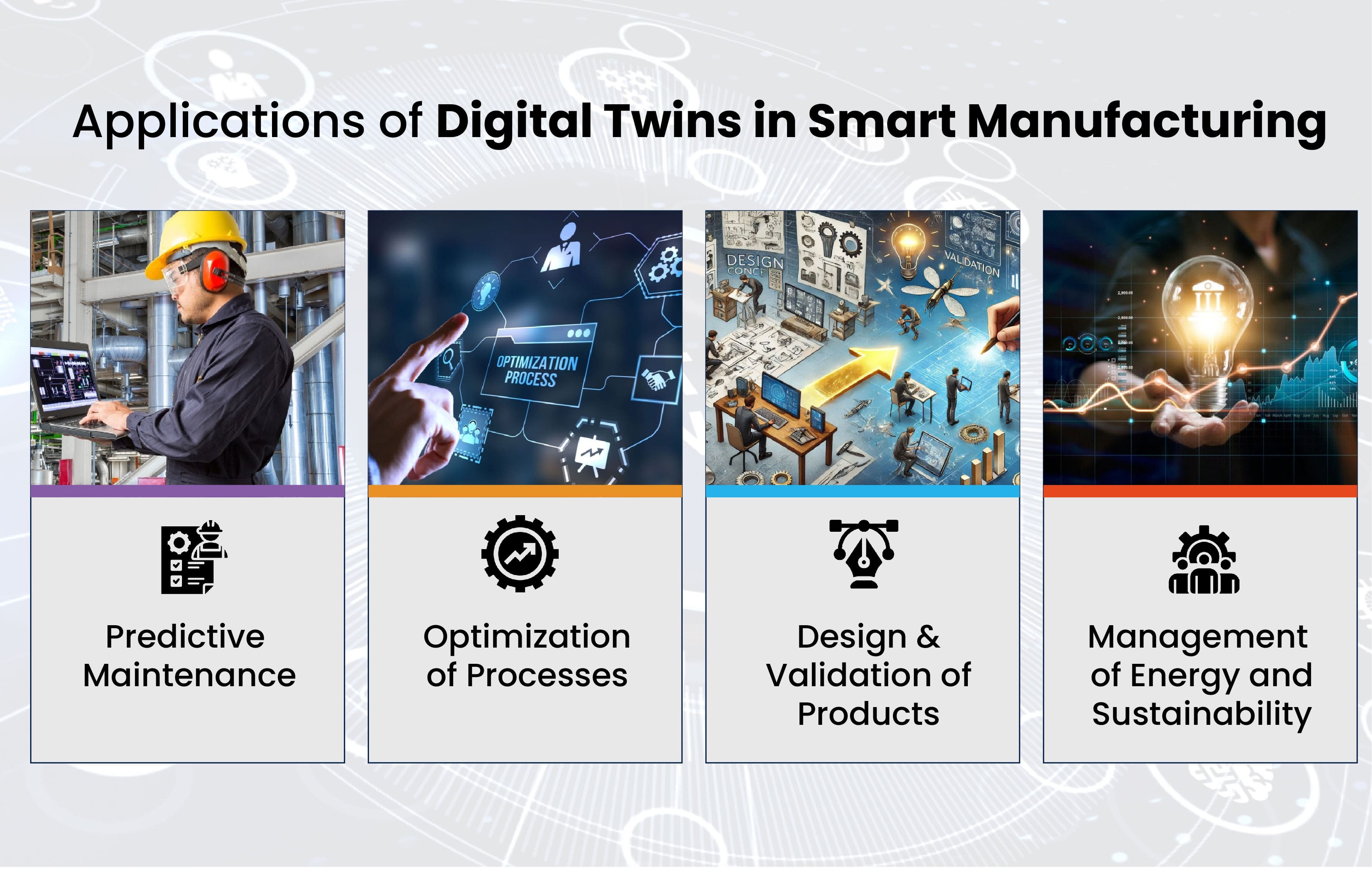
Digital twin applications are valuable across the whole manufacturing lifecycle.
Digital twins use AI in manufacturing to evaluate machine activity and forecast errors before they happen, saving maintenance costs and downtime.
Production line simulation is made possible by smart manufacturing with Digital Twin, which enhances cycle times, material flow, and resource efficiency.
Engineers may test designs virtually with Digital Twin solutions, reducing the need for physical prototyping and speeding up innovation.
A Digital Twin in Manufacturing supports sustainable production initiatives by tracking emissions and energy use.
Manufacturers gain from the use of digital twins on both an operational and strategic level.
Among the main benefits are:
Increased productivity and decreased waste
AI-driven insights enable quicker decision-making
Enhanced quality control through continuous monitoring
Improved cooperation between management, operations, and engineering
These advantages help enterprises maintain their competitiveness in a market that is becoming more and more digital as part of Digital Twin Industry 4.0.
The true strength of modern digital twins lies in the intersection of IoT and AI. Autonomous optimization is made possible by AI-powered Digital Twin systems that learn from both history and current data.
AI in smart factories enables digital twins to:
Identify irregularities and forecast results
Use data automation to automate remedial activities.
Improve Customer Experience with Reliable Quality
Manufacturers obtain a unified view of assets, processes, and performance when AI Digital Twin and IoT are integrated.
A Smart Factory Digital Twin is an essential part of more comprehensive manufacturing digital transformation initiatives, not a stand-alone solution. To provide enterprise-wide intelligence, digital twins easily interface with ERP, PLM, CRM, and analytics platforms.
Organizations can improve responsiveness and profitability by matching industrial output with market demand through the integration of production data with customer data analysis.
Beyond the factory floor, digital twins are increasingly impacting corporate outcomes. Manufacturers can learn more about client preferences, order fulfillment, and demand forecasts by integrating Sales Automation Tools with Customer Relationship Management (CRM) AI.
By coordinating production planning with sales pipelines, this connection facilitates AI in business, allowing for quicker go-to-market strategies and higher customer satisfaction.
Traditional methods of monitoring and making decisions are no longer adequate as factories get increasingly complex. Manufacturers can transition from reactive to predictive and autonomous systems with the help of digital twin technology.
By implementing Digital Twin solutions, businesses can:
AI-Powered Scalable Solutions
End-to-end operational visibility
Data intelligence-driven continuous improvement
As a result, the Digital Twin for Smart Factories is a fundamental building block for sustained expansion.
An important step toward intelligent, networked, and adaptable production environments is the emergence of digital twin in manufacturing. Digital twins enable manufacturers to maximize performance, lower risks, and boost competitiveness with real-time insights, AI-powered forecasts, and smooth system integration.
Investing in digital twin technology is now necessary as smart manufacturing develops. Businesses that adopt this change now will be at the forefront of AI in factory operations in the future.
Let’s connect: www.modelcamtechnologies.com
Email: sales@modelcamtechnologies.com
Mobile no : +91 8237016167
Modelcam Technologies provides a wide variety of Services from ART to PART from Concept Design to Industrial Modeling and Analysis for final Manufacturing.
©Copyright 2026. All rights reserved by Modelcam Technologies Private Limited PUNE.