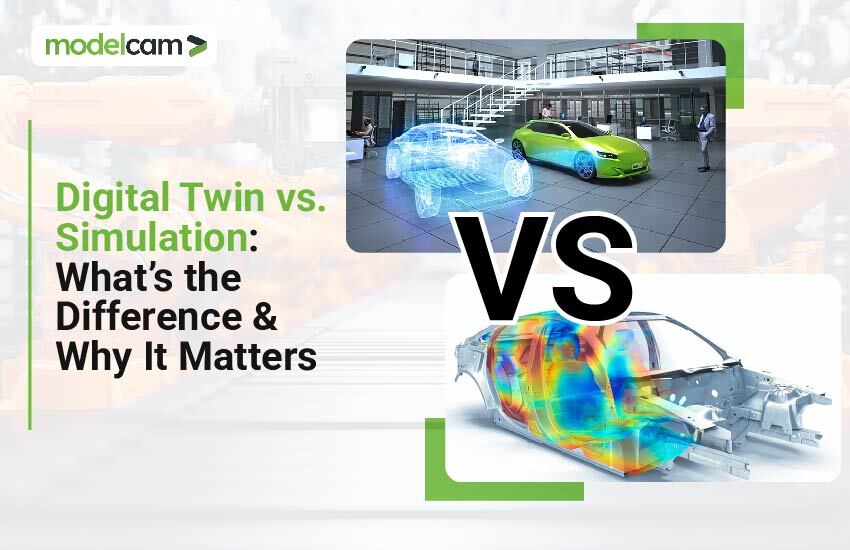
Businesses are quickly implementing cutting-edge digital tools to stay competitive in the drive for speedier innovation and smarter factories. However, a lot of executives still mistake digital twin technology for conventional simulation. Both are effective, but they are not the same, and knowing the difference can have a big impact on long-term ROI, product development, and operational efficiency.
Choosing between simulation and a digital twin strategy can determine how well manufacturers adopting Smart Manufacturing, Industry 4.0, and AI-driven transformation maximize productivity, cut downtime, and enhance customer experience.
Companies like Modelcam Technologies, with expertise in Digital Twin Solutions, CAD, PLM, and AI-driven systems, are helping businesses bridge this gap and implement future-ready technologies that deliver measurable growth.
Simulation is a virtual model used to test how a product, process, or system behaves under certain conditions.
Examining cooling systems' airflow
Assessing the stress of a machine under load
Estimating the effectiveness of an assembly line
Creating prototypes prior to production
For many years, simulation has been an essential engineering tool. Prior to actual implementation, it assists manufacturers in lowering design risks and enhancing decision-making.
Scenario-based or static
Mostly utilized in testing or design
Limited integration of real-time data
Predicts outcomes based on predefined variables
In simple terms, simulation answers:
"What might occur?"
For example, engineers might simulate machine performance during product development using CAD and Digital Twin tools individually, but the model might not update continuously after deployment.
By producing a dynamic, real-time virtual reproduction of a real product, machine, or process, digital twin technology goes beyond simulation.
To replicate real-world performance, it continuously gathers real-time data from sensors, IoT devices, and linked applications.
Synchronization in real time
Constant observation
Predictive analytics
AI-powered insights
Integration of lifecycle management
To put it briefly, a digital twin responds to:
“What’s happening now, what lies ahead, and how can we make the most of the opportunities?”
For businesses pursuing Digital Twin Industry 4.0 projects, this makes Digital Twin in Manufacturing an essential technology.
For instance, a plant that uses Digital Twin Software can increase production efficiency, automate maintenance cycles, forecast problems, and monitor equipment health in real time - all from a single intelligent environment.
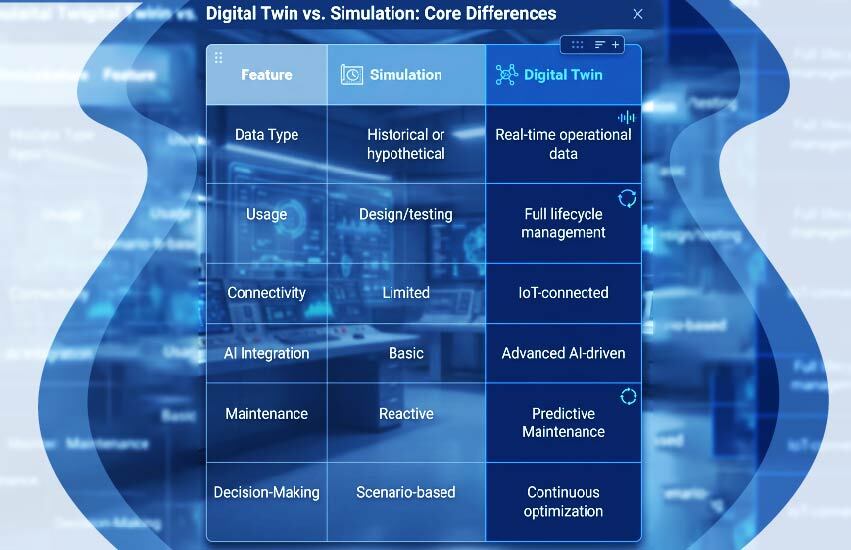
Simulation is similar to evaluating a car design in a virtual laboratory.
A digital twin that continuously reports performance is similar to having a live virtual counterpart of every car on the road.
As production becomes more data-intensive, digital twin applications become more and more essential.
Digital twin can minimize unplanned downtime by almost 50% and maintenance costs by up to 30%, according to industry estimates.
Increased effectiveness of operations
Improved predictive maintenance
Decreased downtime
Quicker product innovation
Improved analysis of customer data
Better supply chain visibility
Enhanced sustainability
Apart from the above benefits, there are many other benefits of digital twin technology. To know more, check out our blog link, “Top Benefits of Digital Twin Technology for Smart Manufacturing”!
Digital twin enhances cooperation across product design, production, sales, and service teams for companies that use PLM and digital twin together.
For businesses striving for complete digital transformation, digital twin services are becoming more and more important.
Digital twin has evolved from monitoring tools to sophisticated corporate systems thanks to AI.
Identify irregularities
Estimate the requirement for maintenance
Automate production decisions
Boost AI for customer relationship management (CRM)
Improve tools for sales automation
Enhance the customer experience
You can explore our insightful blog post, “How Digital Twin and AI Are Redefining Smart Manufacturing,” to learn more about how these technologies work together to transform modern manufacturing.
AI in business, for instance, enables digital twin to evaluate machine behavior and provide sales teams with performance indicators, potential for predictive service, and enhanced customer assistance.
As a result, the relationship between operations and revenue creation is strengthened.
Modelcam Technologies assists manufacturers in transitioning from static simulations to intelligent digital ecosystems as a pioneer in Digital Twin Implementation, Digital Twin Software, and AI-powered engineering solutions.
Integration of CAD and PLM
AI-powered solutions
Systems for predictive maintenance
Automation of data
Intelligent manufacturing techniques
Optimization of the product lifecycle
Modelcam helps manufacturers increase productivity, save operating costs, and accelerate innovation by merging Digital Twin Solutions with AI and software customization.
Creating Product Designs
Prototype testing
Assessing one-time situations
Conducting preliminary engineering analysis
Managing operations in real time
Monitoring equipment
Making manufacturing more efficient
Enabling predictive maintenance
Driving Industry 4.0 transformation
The majority of contemporary firms begin with simulation, but the future lies in digital twin technology.
While simulation is still useful, today's manufacturers may benefit from deeper, smarter, and more scalable advantages thanks to digital twin technology.
Digital twin are becoming necessary rather than optional as companies shift toward Smart Manufacturing, AI integration, and operational excellence.
Businesses may increase efficiency, make better investments, and future-proof operations by knowing the difference between simulation and digital twin systems.
Businesses may effectively implement digital twin services, AI-driven systems, and digital transformation tactics that promote long-term company growth with reliable partners like Modelcam Technologies.
The true question in today's cutthroat economy is no longer:
"Do we need to adopt a digital twin?"
It is:
"How quickly can we put them into practice?"
Let’s connect: www.modelcamtechnologies.com
Email: sales@modelcamtechnologies.com
Mobile no : +91 8237016167
Modelcam Technologies provides a wide variety of Services from ART to PART from Concept Design to Industrial Modeling and Analysis for final Manufacturing.
©Copyright 2026. All rights reserved by Modelcam Technologies Private Limited PUNE.