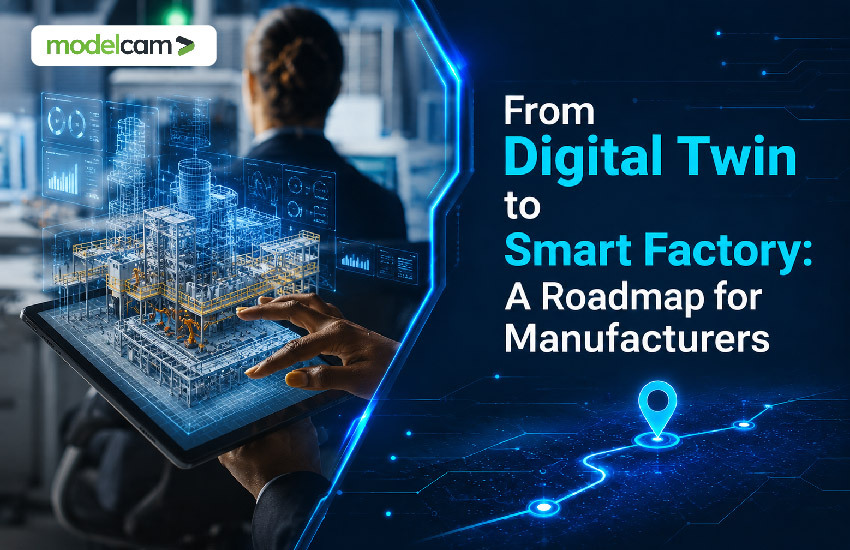
The way manufacturers plan, produce, monitor, and enhance their operations is being transformed by digital twin technology. More significantly, digital twin technology can serve as the cornerstone for the transition from networked machinery to a genuinely intelligent factory.
Faster production is no longer the main goal of manufacturing. Better visibility, fewer unplanned malfunctions, quicker decision-making, consistent quality, and flexible manufacturing are all necessary for manufacturers. This is the point at which digital transformation becomes crucial.
A digital twin is a virtual representation of a machine, process, production environment, or real asset. When this model is integrated with real-time data, IoT, modeling, analytics, and AI, manufacturers are able to comprehend current conditions, predict potential future developments, and test improvements before implementing them in real-world settings.
However, putting in place a digital twin does not make manufacturing smart.
A defined roadmap is necessary for manufacturers.
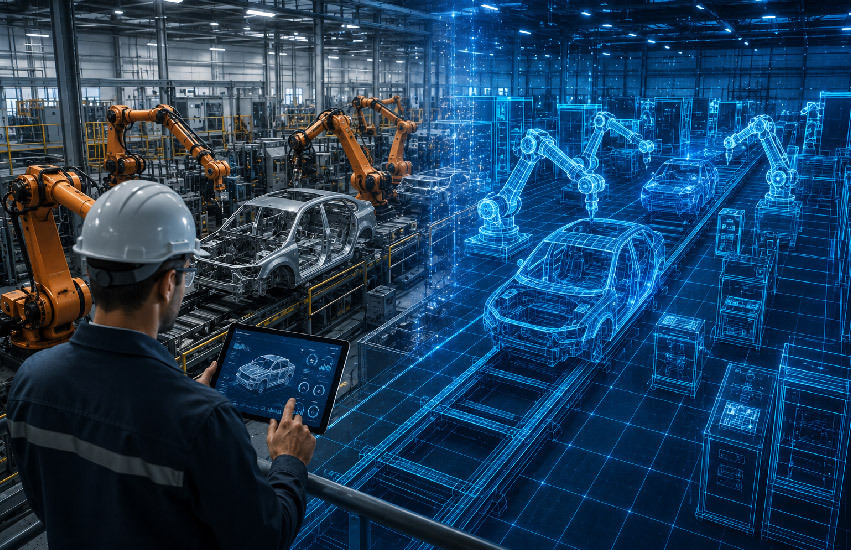
Digital Twin in Manufacturing is a dynamic digital version of a physical machine, facility, production line, or product.
A digital twin can continuously receive operational data from linked systems and equipment, in contrast to a static 3D model. This enables producers to keep an eye on performance, evaluate data, model situations, and streamline procedures.
For instance, sensors can record a machine's temperature, vibration, pressure, speed, and energy usage. After that, this data can be examined to spot unusual activity or potential equipment issues.
Because of this, Digital Twin Applications are helpful for industrial planning, product development, production, quality, and maintenance.
Manufacturers want trustworthy digital data before deploying sophisticated Digital Twin Solutions.
Engineering and product data come first.
Proper management is required for CAD models, BOMs, requirements, drawings, revisions, production data, and product modifications. This is where the combination of PLM and digital twin, as well as CAD and digital twin, becomes useful.
While PLM assists in managing product information and modifications throughout the lifecycle, CAD provides the product definition. When combined, they can offer a solid basis for developing a more cohesive digital image.
For this reason, a producer shouldn't approach the digital twin as a distinct technological endeavor. Whenever feasible, it should be integrated with current technical and business systems.
Connecting tangible assets to the digital environment is the next stage.
Real-time data from machinery and manufacturing systems can be gathered via sensors and industrial IoT devices. Temperature, vibration, pressure, machine status, energy usage, production rates, and other operational characteristics are examples of this data.
As a result, the data flow needed for Digital Twin Industry 4.0 projects is created.
But merely gathering a lot of data is insufficient. Manufacturers must determine what information is important, where it comes from, how it should be stored, and how it will be used.
Data automation and analysis become crucial in this situation.
Manufacturers can do more than just keep an eye on equipment once the digital twin is linked to real-time data.
Predictive maintenance is one of the most useful benefits of digital twin technology.
Manufacturers can use past and current data to spot trends that might point to a future issue rather than waiting for a machine to malfunction. Unusual vibration in a motor, for example, may be a sign of bearing wear. Before there is an unplanned production halt, maintenance workers can look into the problem.
AI offers an additional level of intelligence in this situation.
Large amounts of operational data may be examined, patterns and anomalies can be found, and predictive choices can be supported by AI-driven analytics. Before making improvements to the actual factory, digital twins can also be utilized to model various production situations.
The digital representation and data are provided by a digital twin. AI can assist in transforming that data into insights that can be put to use.
AI can help manufacturers with:
AI and digital twins are especially pertinent to smart manufacturing.
For more information, you can read our blog post, "How Digital Twin is Transforming Smart Manufacturing"!
Manufacturers can progressively shift their queries from "What is happening on the production line?" to "Why is it happening?" "What is likely to happen next?" and "What should we change?"
A crucial step toward a smart factory is the transition from visibility to prediction and optimization.
A smart factory is more than just a factory with networked equipment.
It is a setting where linked information may be used by engineering, production, maintenance, quality, supply chain, and business systems.
Digital twin software, PLM, IoT, AI, analytics, and automation can all collaborate in this situation.
For instance, production teams may keep an eye on procedures, maintenance teams can check equipment health, engineering teams can assess designs using digital models, and management can use operational information to improve planning.
A more interconnected environment for making decisions is the outcome.
In order to assist businesses in connecting engineering and operational processes as part of their digital transformation journey, Modelcam Technologies focuses on technologies including artificial intelligence (AI), digital twin, PLM, CAD customization, engineering design, and manufacturing solutions.
On the first day, manufacturers do not have to build a digital twin of the whole factory.
Starting with a targeted use case is a superior strategy.
For instance, a business might start with one crucial machine and employ predictive maintenance on the twin. Once the procedure is successful, it can be extended to an entire building, a production line, a process, or a product.
This facilitates the management of Digital Twin Implementation and enables businesses to assess outcomes prior to scaling.
Data quality, cybersecurity, integration, expertise, cost, and change management are additional factors that manufacturers should take into account. These are typical difficulties encountered while putting digital twin methods into practice.
Connected data is valuable beyond manufacturing.
In the future, supply chain choices, service operations, product enhancements, and customer experience can all benefit from digital twin data.
Product performance data, for instance, can assist service personnel in determining possible service needs and understanding how equipment is being used. Manufacturers can learn more about how their products are used and what customers need when they combine this information with customer data analysis.
AI in business, sales automation, and customer relationship management (CRM) AI can all help corporate operations. These apps can join a larger, interconnected digital environment, even albeit they differ from a manufacturing digital twin.
Purchasing a single piece of software is not enough to go from a digital twin to a smart factory. It involves gradually integrating data, systems, individuals, and procedures.
The roadmap can be summed up as follows:
Digital Model → Connected Data → Real-Time Monitoring → AI-Driven Analysis → Prediction → Optimization → Smart Manufacturing
The most prosperous producers won't only gather more information. They'll use that information to make smarter choices.
The technology underpinnings can be supplied by digital twin services and digital twin solutions, but the true value lies in how well manufacturers integrate them with CAD, PLM, IoT, AI, analytics, and current workflows.
Thus, the smart factory is not a far-off place. Beginning with a digital representation, it gradually transforms into a linked, predictive, and constantly improving production environment.
Manufacturers can start with a single, well defined digital twin use case and expand from there if they want to increase productivity, decrease downtime, streamline procedures, and make decisions more quickly.
Let’s connect: www.modelcamtechnologies.com
Email: sales@modelcamtechnologies.com
Mobile no : +91 8237016167
Modelcam Technologies provides a wide variety of Services from ART to PART from Concept Design to Industrial Modeling and Analysis for final Manufacturing.
©Copyright 2026. All rights reserved by Modelcam Technologies Private Limited PUNE.