The use of AI in pharmaceutical R&D is affecting the analysis done by researchers. Additionally, it is changing paperwork, which is one of the less obvious but very time-consuming aspects of pharmaceutical research.
Pharmaceutical R&D teams handle a wide range of documents, including quality records, experimental data, formulation details, and assay validation reports. Accurate data collection, uniformity, adherence to regulations, and the preparation of records for evaluation are all requirements for researchers. Manually completing all of this can take up important time that could be spent on actual scientific work.
Manual efforts can be reduced to a great extent with the help of AI for pharmaceutical R&D documentation. AI may assist researchers in organizing data, creating organized documentation, and locating missing facts while maintaining control over human specialists with the correct tools.
There are several phases, teams, and experiments involved in pharmaceutical research. Documents that need to be prepared, examined, updated, and stored can be produced at any step.
As an example, an R&D team may be tasked with developing a new formulation. They may need to document:
Information from notes, spreadsheets, and lab records is frequently copied into predetermined formats during the manual preparation of these papers. Inconsistent documentation can cause delays during internal reviews or audits, even in cases where the scientific work is outstanding.
Several phases of the documentation workflow can be aided by contemporary AI techniques. An efficient system can help users enter the correct information before making a document, rather than just producing text.
AI software for pharmaceutical R&D can use structured inquiries to efficiently gather essential project context. The information can then be used by the system to produce a document using a format that has been predetermined.
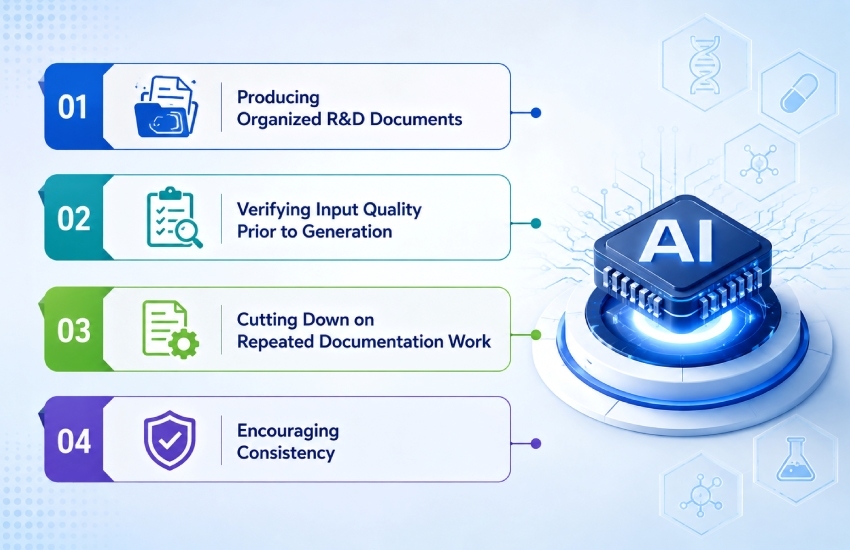
Pharmaceutical document automation can benefit from this strategy in a number of ways.
Different documentation forms are needed for different types of study. An assay validation report is not the same as a formulation development report. AI may generate structured drafts for many use cases using document-specific templates and inputs. As a result, researchers don't have to start every document from scratch.
Poor inputs can result in poor outputs, which is one of the problems with AI-generated documents.
For this reason, input validation is especially helpful in AI-powered pharmaceutical documentation. Before creating a document, Modelcam's SmartInputTM assesses inputs for specificity, coherence, completeness, and regulatory context. Additionally, it uses minimal input requirements and, in cases when crucial information is lacking, it can ask focused follow-up questions.
Rather than depending on a generic AI-generated document, this approach encourages researchers to provide adequate context.
Automating routine formatting tasks enables R&D professionals to focus their efforts on research, experimentation, and scientific decision-making.
AI document automation for pharma can cut down on tedious tasks like information organization, standard section creation, and first draft preparation. The resulting document can then be reviewed by researchers, who can subsequently add scientific details and make any necessary adjustments.
Removing researchers from the documentation process is not the goal. Its purpose is to lessen the administrative burden associated with it.
The structure, vocabulary, and degree of depth of documentation produced by various scholars can differ.
AI can assist in standardizing document organization and format. This becomes especially helpful for companies managing several projects at once.
An AI system, for instance, can assist in ensuring that each formulation development report produced by many teams adheres to the required format and contains the pertinent elements.
Information gathered from testing, analysis, and experiments is crucial to pharmaceutical research and development. By assisting teams in organizing and interpreting data prior to it being included in official documentation, AI can support data analysis and data automation. AI shouldn't be seen as a stand-alone scientific decision-maker, though. Results, interpretations, and conclusions still need to be confirmed by researchers and certified experts.
When using AI in business, especially in regulated areas, this distinction is crucial. Workflows powered by AI should complement human competence rather than take the place of scientific and regulatory accountability.
Another important factor for pharmaceutical companies is data confidentiality.
Research teams may deal with proprietary formulas, product specifications, batch information, and other private information. Without the proper safeguards, sending such data to an external AI system may raise security and compliance issues.
Anonymized placeholders are the foundation of Modelcam's AI Document Studio. Examples like "Product X," "Batch ABC-001," and "Analyst Y" can be entered by users, but the created document workflow does not contain the actual sensitive information. According to the platform, private data stays on the user's device.
In order to assist users in identifying sections that need finalization, the created papers also indicate placeholders that must be changed prior to filing.
When documentation automation is seen as a component of a larger digital workflow, the usefulness of AI increases.
Laboratory systems, quality systems, document repositories, and other corporate apps may already be in use by a company. These systems can be enhanced by AI-driven solutions that require less manual paperwork.
For general AI in business, the same more general idea holds true. While specialized apps cater to the requirements of particular sectors, AI can help other departments with repetitive information processing.
Pharmaceutical research and development will continue to produce vast amounts of data. The capacity to transform such data into comprehensible, organized, and review-ready documentation will become more crucial as research procedures grow more data-driven.
AI can help with structure, consistency, and first-draft generation for anything from a preliminary research note to a formulation development report or assay validation report.
However, successful implementation calls for much more than just incorporating AI into an already-existing procedure. Organizations require human oversight, clear review procedures, and suitable data controls.
Modelcam Technologies specializes in AI-driven solutions that assist companies in automating processes and making better use of data. With a GMP-aware workflow centered on structured inputs and document creation, its AI Document Studio expands this strategy into lab and pharmaceutical documentation.
The ultimate goal of AI document automation for pharma is not to reduce the level of attention that researchers put into their job. The goal is to help them devote more time to science and less time to tedious paperwork.
If you streamline documentation it will help reduce manual effort, improve productivity, and maintain human oversight throughout the research process for pharmaceutical R&D teams.
Let’s connect: www.modelcamtechnologies.com
Email: sales@modelcamtechnologies.com
Mobile no : +91 8237016167
Modelcam Technologies provides a wide variety of Services from ART to PART from Concept Design to Industrial Modeling and Analysis for final Manufacturing.
©Copyright 2026. All rights reserved by Modelcam Technologies Private Limited PUNE.