
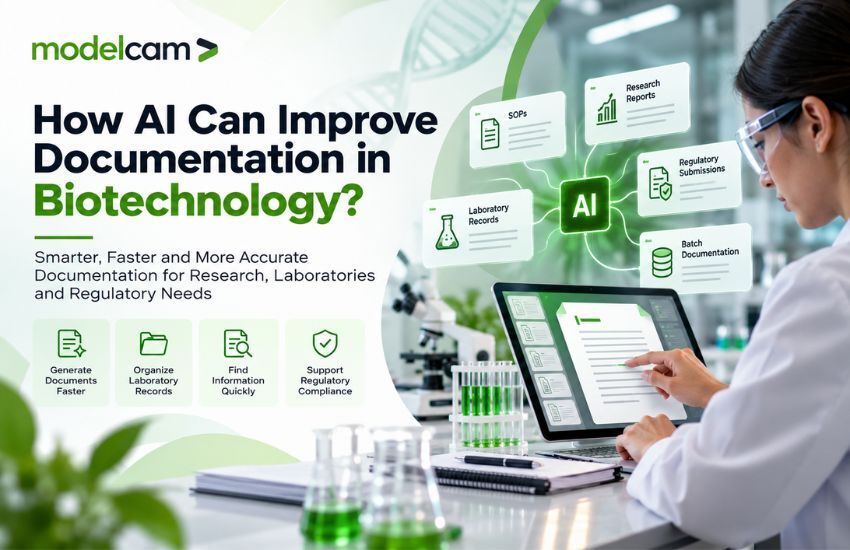
In biotechnology, innovative research is only useful when it is backed by clear and reliable documentation. AI in biotechnology is helping laboratories and biotech companies create, organize, and manage documents more efficiently while keeping human review an essential part of the process.
From research notes and laboratory records to SOPs, reports, and regulatory submissions, biotech organizations handle large amounts of information every day. Managing all these records manually can be time-consuming and may increase the possibility of errors. AI-powered documentation solutions can streamline these workflows and improve document management.
Documentation is a critical part of biotechnology workflows. Researchers need to maintain records of experiments, methods, observations, results, and conclusions. Laboratories also need consistent records, while organizations may have to maintain detailed documents for audits, quality checks, and regulatory requirements.
As biotechnology processes become more advanced, the amount of information teams need to manage continues to grow. This may include research reports, laboratory documentation, technical records, batch details, validation documents, and quality-related records.
Relying heavily on manual documentation can lead to several challenges:
A well-designed AI documentation solution can help overcome these challenges while allowing researchers and documentation teams to spend more time on important scientific and operational activities.
AI-powered documentation uses artificial intelligence to streamline how teams create, organize, review, and manage documents.
Rather than preparing every document manually, teams can use AI to organize existing information and create structured drafts. Subject-matter experts can then review the content, make any required changes, and approve the final version.
This makes automated documentation a practical support tool that reduces repetitive work without replacing scientific expertise or human judgment.
Preparing documents manually often requires gathering information from different sources and arranging it according to a specific format. With AI document generation, teams can turn available information into well-organized document drafts with less manual effort.
For instance, a biotech team may need to prepare a report using experimental observations, procedures, and results. AI can help arrange this information within a predefined structure, reducing the amount of repetitive writing involved.
This can be especially helpful for AI for laboratory documentation, where teams frequently prepare similar types of records.
Laboratories create and maintain records throughout research and testing activities. Keeping these records accurate and organized is important for maintaining consistency and traceability.
AI can support laboratory documentation by organizing information, highlighting potentially missing sections, summarizing relevant records, and helping prepare document drafts.
For example, when a laboratory follows a standard format for experiment reports, an AI system can assist in placing available information into the relevant sections. Scientists can then verify the content and make the final approval.
This approach can reduce administrative effort while ensuring that experienced professionals remain involved in reviewing and validating the information.
Research teams often need to turn complex technical information into well-organized and understandable documents. AI for scientific documentation can assist with structuring research notes, technical details, observations, and findings.
AI-driven tools can also support information retrieval and summarization. Instead of manually going through numerous files, researchers can locate relevant information and generate concise summaries more quickly.
As a result, scientific documentation can become easier to organize and access, particularly when teams are working with large volumes of research material.
Research continuously produces new information, and over time, organizations can build up thousands of documents containing valuable knowledge.
AI for research documentation assists teams structure research data, retrieve information quickly, and use it more effectively. AI can analyze documents, find relevant details, summarize information, and support faster knowledge retrieval.
This can be especially useful when researchers need to compare information from different documents or locate specific details within older records.
With AI in biotechnology, organizations can move beyond simply storing documents and create a more organized, searchable, and useful knowledge environment.
Regulatory requirements can make documentation more complex for biotechnology and pharmaceutical organizations. Teams often need to create detailed records while following defined formats, processes, and quality standards.
AI for regulatory documentation can assist with creating structured drafts, summaries, and other required documents. It also enables organizations to handle extensive collections of information while reducing manual effort.
However, regulatory documentation still requires thorough human review. AI-generated content should be verified by qualified professionals to confirm its accuracy, completeness, and compliance with relevant requirements.
The objective is not to eliminate human oversight. Instead, AI should reduce repetitive documentation work and allow experts to dedicate more time to reviewing information and making informed decisions.
The value of documentation automation goes beyond simply completing tasks faster. It can help organizations build a more consistent and organized documentation process.
An AI-driven documentation system can standardize document formats, minimize repetitive work, and make important information easier to locate. This can benefit researchers, quality teams, laboratory personnel, and regulatory professionals.
Modern AI for biotech can also complement broader AI in business initiatives, where organizations use Data Analysis, Data Automation, and AI-Driven Solutions to improve everyday processes.
The same approach can be applied to documentation: let technology handle repetitive activities while experienced employees focus on tasks that require professional knowledge, judgment, and decision-making.
Not every AI tool is appropriate for handling sensitive biotechnology information. Before adopting an AI solution, organizations should evaluate factors such as security, privacy, accuracy, workflow flexibility, and human review capabilities.
A reliable AI documentation platform should ideally help teams:
For businesses dealing with sensitive scientific information, confidential research, or proprietary knowledge, data security and controlled access are essential considerations.
Modelcam Technologies’ AI Document Studio helps organizations create, organize, and manage documents with the support of AI. Its SmartInput™ technology can process available information and help generate structured documentation while keeping workflows aligned with specific business and technical needs.
For biotech organizations, these capabilities can support AI-powered documentation, research records, technical documents, and other repetitive documentation tasks. The real value of AI for biotech is its ability to reduce time spent on routine document preparation, allowing teams to focus more on research, analysis, quality, and innovation.
Biotechnology is generating increasing amounts of data and research, along with more complex documentation requirements. AI reduces the effort involved in repetitive tasks, allowing organizations to handle larger workloads with greater efficiency.
From AI document generation and laboratory records to AI for regulatory documentation and research knowledge management, AI offers several opportunities to improve documentation workflows.
However, successful implementation requires the right balance between technology and human expertise. AI can organize information, automate repetitive tasks, and speed up documentation, but scientists and subject-matter experts are still essential for reviewing content, validating information, and making final decisions.
With the right approach, AI in biotechnology can transform documentation from a time-consuming administrative responsibility into a more efficient and organized part of research and business workflows.
Discover how AI Document Studio by Modelcam Technologies helps simplify complex documentation workflows through intelligent document automation.
Let’s connect: www.modelcamtechnologies.com
Email: sales@modelcamtechnologies.com
Mobile no : +91 8237016167
Modelcam Technologies provides a wide variety of Services from ART to PART from Concept Design to Industrial Modeling and Analysis for final Manufacturing.
©Copyright 2026. All rights reserved by Modelcam Technologies Private Limited PUNE.