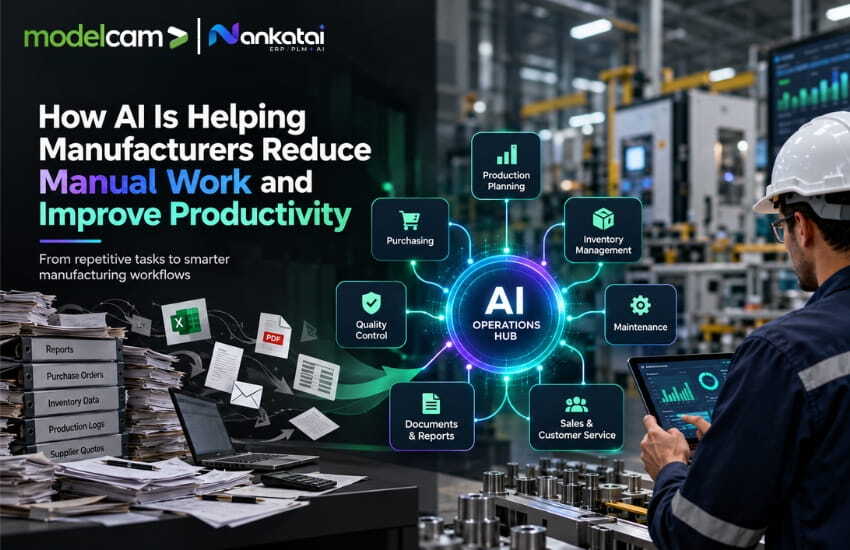
AI in manufacturing is transforming the way firms manage routine tasks. From production planning and inventory management to document processing and customer communication, AI can decrease repetitive processes, improve decision-making, and enable staff focus on more meaningful work.
Manufacturing has always relied on workers, equipment, procedures, and information. However, a large portion of this data is still manually transferred between documents, emails, spreadsheets, ERP systems, and various departments. This is where AI for the manufacturing industry can make a practical difference.
A manufacturing organization performs hundreds of little activities every day. Workers may enter production data, monitor stock levels, compare quotes from suppliers, follow up on purchase orders, create reports, check paperwork, or answer questions from customers.
Each of these activities may seem small on its own, but when repeated every day, they can take up a considerable amount of employees’ time.
This is where AI automation in manufacturing can make a practical difference. Rather than using AI only to generate content or answer queries, manufacturers can use AI-driven systems to track processes, spot potential problems, and handle repetitive tasks with minimal manual intervention.
Modern Manufacturing AI solutions can also bring information from different departments together. By connecting data and workflows, these solutions can reduce the delays and information gaps that often occur when teams work with separate systems or manually exchange data.
So, what does AI transforming manufacturing actually look like in day-to-day operations?
It goes far beyond robots and automated machinery. AI can also streamline many of the administrative, analytical, and data-related activities that support manufacturing operations.
For instance, an AI system can analyze production data and alert the team when an order appears to be at risk of delay. It can help compare supplier quotations, detect unusual inventory movements, or highlight pending activities that need attention.
This allows technology to play a more active role in business operations. Instead of simply storing information for employees to review later, AI can help surface relevant information when it is needed and support quicker decision-making.
As a result, manufacturing teams can spend less time searching through data, spreadsheets, and documents and more time addressing operational challenges and improving business performance.
Managing production schedules requires teams to keep track of several things at once, such as machine availability, raw materials, order priorities, and delivery timelines. When these details are monitored manually, even a small change can require multiple updates and checks.
With AI in manufacturing, production data can be tracked more consistently. AI can identify potential bottlenecks, highlight capacity constraints, and alert teams when a change could affect an order or delivery schedule.
The purpose is not to take people out of the planning process. Instead, AI gives production planners timely information so they can review potential issues and make decisions before they turn into larger disruptions.
By taking care of routine monitoring, AI can allow production teams to spend more of their time on scheduling, problem-solving, and process improvement.
Purchasing involves much more than placing orders. Teams often have to review supplier quotations, compare costs, check delivery conditions, track purchase orders, and follow up with vendors. Handling these activities manually can take up a considerable amount of working time.
AI can simplify parts of this process by extracting important information from quotations and other purchasing documents and arranging it in an easier-to-review format.
For instance, AI tools for manufacturing businesses can help purchasing teams bring supplier prices, delivery timelines, and other quotation details together for quicker comparison.
This is where data automation can be particularly useful. Instead of repeatedly entering information into spreadsheets or checking multiple documents, employees can access organized data and focus on evaluating suppliers and making purchasing decisions.
AI can also analyze supplier performance, including delivery records, quality information, and pricing trends. This gives purchasing teams useful insights without requiring them to manually review every record.
Keeping the right amount of inventory is important for both production continuity and financial efficiency. Overstocking can lock money into unused materials, while insufficient stock can create delays and affect production schedules.
AI for manufacturing industry applications can help teams analyze inventory data and identify unusual stock movements, slow-moving materials, or differences between recorded and actual quantities.
Rather than relying only on periodic manual checks, AI can continuously review available inventory information and bring unusual patterns or exceptions to the team’s attention.
This is one of the practical benefits of AI in manufacturing operations. Employees do not have to spend as much time going through large volumes of inventory data and can instead focus on understanding the issue and deciding what action to take.
For manufacturers managing a wide range of products, materials, suppliers, or multiple storage locations, this type of AI-supported monitoring can make inventory management more efficient and responsive.
Maintaining product quality and keeping machines in good working condition are essential for smooth manufacturing operations. Both areas also generate a lot of data that can be useful when analyzed properly.
AI can review quality data, rejection records, and production patterns to identify issues that occur repeatedly. It can help teams spot whether a particular problem may be linked to a machine, supplier, material batch, or production process.
Maintenance teams can also use historical information to understand equipment performance, previous breakdowns, maintenance schedules, and spare-part requirements. Instead of waiting for equipment to fail, teams can use these insights to plan maintenance more effectively.
Manufacturing AI solutions can therefore support a shift from reactive maintenance to more proactive decision-making. For example, if a machine shows similar warning signs before previous breakdowns, AI can identify the pattern and alert the maintenance team.
The final decision still remains with experienced quality and maintenance professionals. AI simply helps them access relevant information faster and identify issues that may otherwise take longer to spot.
From quotations and purchase orders to invoices, certificates, delivery records, and quality documents, manufacturing companies deal with a large amount of paperwork every day.
Manually reading these documents and entering their information into spreadsheets or business systems can be time-consuming. It can also increase the possibility of errors, particularly when employees have to process large volumes of documents.
AI-powered document processing can help by identifying important information within documents and transferring it into the relevant workflow or system.
This is where Data Analysis and Data Automation can work together. Instead of treating documents as information that simply needs to be stored, manufacturers can extract useful data from them and use it to support everyday business activities.
Platforms such as Nankatai are also exploring this type of AI-based approach by connecting business information with workflows across different functions. Such solutions can help reduce repetitive information-handling tasks while making business data easier to access and use.
For manufacturers that manage a large volume of paperwork, document automation can be a practical way to introduce AI into everyday operations without changing the entire production system.
The use of AI in manufacturing does not stop at production, purchasing, or maintenance. Sales and customer service teams also deal with a large amount of information every day.
They may need to track customer enquiries, prepare quotations, check order information, follow up on leads, and respond to service requests. Managing all of this manually can take time, especially when customer information is spread across different systems.
AI can support Sales Automation Tools by helping teams organise enquiries, identify follow-up opportunities, and review customer interactions. Similarly, Customer Relationship Management (CRM) AI can help businesses analyze customer information and identify patterns that may be useful for sales and service teams.
For example, customer data analysis can highlight frequently ordered products, recurring customer concerns, or changes in buying behaviour.
These insights can contribute to a better Customer Experience while reducing some of the routine work involved in managing customer information.
Instead of spending time searching through emails, spreadsheets, and customer records, employees can use AI to bring relevant information together and focus more on customer communication, problem-solving, and relationship building.
A growing area of AI for the manufacturing industry is the use of AI agents for manufacturing. These systems can do more than simply respond to questions. Depending on how they are configured, AI agents can monitor information, recognise patterns, and assist with specific tasks or workflows.
For instance, an AI agent could keep track of inventory levels, highlight unusual stock movements, summarise supplier performance, or remind teams about pending activities. This can reduce the need for employees to repeatedly check different systems or manually compile information.
Nankatai is one example of a platform using this approach, with AI agents designed to support functions such as production, quality, maintenance, purchasing, inventory, sales, accounts, and customer service.
Manufacturers need to consider how well a solution fits their existing processes and systems. Factors such as integration, data security, scalability, implementation effort, and measurable productivity gains should be evaluated before choosing a solution.
The real objective of AI automation in manufacturing should be to solve specific operational challenges and reduce unnecessary manual work.
AI adoption is not limited to large manufacturers with extensive technology infrastructure or large IT budgets.
AI solutions for small manufacturing businesses can begin with simple, repetitive activities such as comparing quotations, monitoring inventory, processing documents, preparing reports, or managing customer follow-ups.
A gradual approach can make implementation easier. Businesses can first identify one process that takes up unnecessary manual effort, introduce AI to support that process, and evaluate the results before expanding it to other areas.
This also gives employees time to become familiar with AI and understand how it can support their existing responsibilities.
For a small manufacturing company, saving even a few hours of manual work each week can be valuable. That time can instead be used for activities such as improving operations, serving customers, developing new business, or addressing production-related challenges.
The benefits of AI in manufacturing operations are not limited to reducing the number of hours spent on repetitive tasks.
When routine work is automated, employees can devote more attention to activities that require experience, judgement, and problem-solving. This can help teams work more efficiently while making better use of the information already available within the business.
Some of the ways AI can support manufacturers include:
Data security should also be considered when introducing AI, especially when systems handle sensitive information such as customer details, pricing, product designs, or operational records.
For manufacturers that prefer to keep business information within their own infrastructure, solutions such as Nankatai offer an on-premise deployment option. Ultimately, the right approach will depend on a company's operational needs, existing technology environment, and data-security requirements.
The future of AI-powered factory management is not about replacing people with technology. Instead, it is about giving employees smarter tools that can make everyday work easier and more efficient.
Manufacturers already have large amounts of useful information spread across ERP systems, spreadsheets, documents, machines, and different departments. The real opportunity lies in bringing this information together and turning it into insights that employees can actually use.
AI-driven solutions can help businesses analyze data, identify patterns, automate repetitive activities, and alert the right teams when something needs attention. This can make it easier for employees to respond to issues and make decisions without spending excessive time searching for information.
At the same time, General AI in Business is moving towards more focused and practical applications. Instead of relying on AI only as a general-purpose assistant, businesses can apply it to specific processes where it can solve real operational challenges and deliver measurable results.
For manufacturers, the value of AI ultimately comes down to improving how work gets done. When routine tasks require less manual effort, employees have more time for planning, problem-solving, quality improvement, and business growth.
As AI technology continues to evolve, manufacturers can begin with smaller, practical use cases and gradually expand their adoption. The objective is not to automate every task, but to identify where AI can genuinely save time, improve accuracy, support better decisions, and make manufacturing operations more productive.
Let’s connect: www.modelcamtechnologies.com
Email: sales@modelcamtechnologies.com
Mobile no : +91 8237016167
Modelcam Technologies provides a wide variety of Services from ART to PART from Concept Design to Industrial Modeling and Analysis for final Manufacturing.
©Copyright 2026. All rights reserved by Modelcam Technologies Private Limited PUNE.