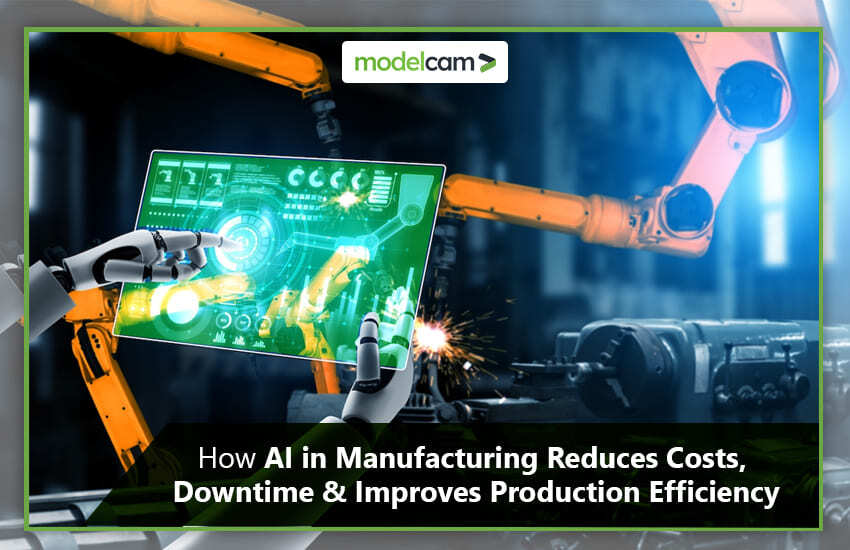
Today's manufacturing executives are under constant pressure to lower operating costs, eliminate downtime, and boost output without sacrificing quality. These expectations can no longer be addressed by traditional means alone. This is how AI in manufacturing is changing the industry. Manufacturers are attaining previously unheard-of levels of accuracy, scalability, and efficiency by incorporating data-driven intelligence into production systems.
Artificial intelligence in manufacturing is already a competitive requirement rather than an idea for the future, from predictive maintenance to smart factory automation.
Massive amounts of data are produced by machines, sensors, supply chains, and consumers in the contemporary manufacturing environment. By using this data for sophisticated data analysis, AI manufacturing solutions let manufacturers make quicker, more precise decisions.
Businesses can transition from reactive operations to proactive, intelligent systems by integrating automation technologies, industrial IoT and AI, and machine learning in manufacturing. AI-driven manufacturing and long-term digital transformation depend on this development.
One of the main causes of production costs is unplanned downtime. Equipment failure affects customer obligations, raises maintenance costs, and throws off production schedules.
Predictive Maintenance with AI
AI predictive maintenance looks for trends that point to possible problems using both historical and current machine data. Predictive maintenance using AI allows manufacturers to:
Identify wear and tear early on.
Plan maintenance in advance of malfunctions.
Extend the life of equipment
Lower the cost of emergency repairs
This method effectively illustrates how AI reduces downtime in manufacturing, transforming maintenance from a cost center into a competitive advantage.
Cutting costs is only one aspect of cost reduction; another is resource optimization. Efficiency, waste reduction, and process optimization are the main focuses of AI solutions to reduce manufacturing costs.
The main areas for cost savings include:
Optimizing energy use with smart systems
AI-driven process control for less material waste
AI automation for production efficiency can reduce labor expenses and increase production efficiency.
AI manufacturing analytics for better inventory planning
Manufacturers may maintain consistent output quality while streamlining workflows by utilizing AI in industrial automation.
Production efficiency is based on how well people, machines, and processes collaborate. AI production efficiency is attained by real-time performance optimization and ongoing operational data analysis.
Real Time Production Monitoring
AI systems monitor cycle times, output quality, and machine performance in real-time with real-time production monitoring.
This makes it possible:
Quicker decision-making
Identification of bottlenecks
Quick remedial action
By guaranteeing increased throughput and improved asset usage, these insights immediately assist AI in manufacturing productivity improvement.
For more information on how AI in manufacturing increases productivity, explore our comprehensive blog post, “Boosting Productivity with AI in Manufacturing - A Complete Guide”!
Problems with quality result in scrap, rework, and unhappy customers. AI quality control systems employ cutting-edge technologies, such as computer vision for fault detection, to perform highly accurate product inspections.
Advantages consist of:
High-speed automated inspection
Early detection of defects
Reliable norms of quality
Decreased human error
By producing dependable, flawless goods, these technologies greatly enhance the customer experience.
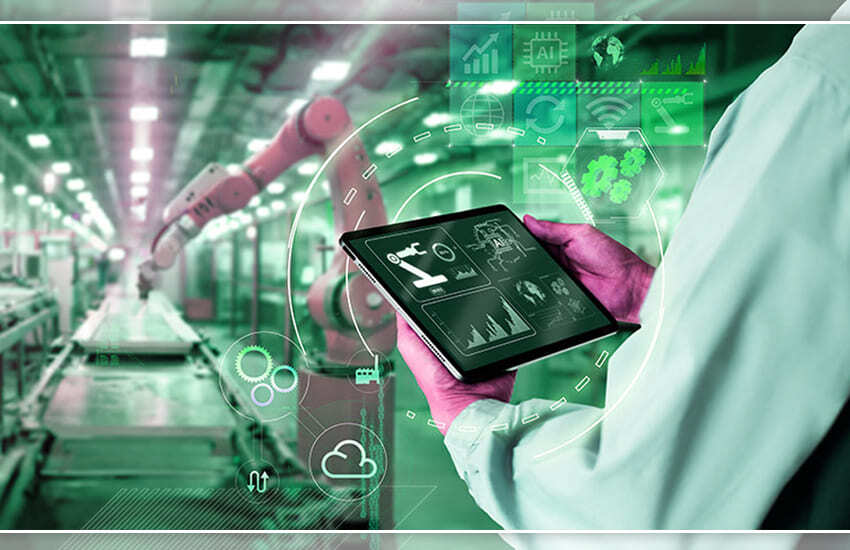
Intelligent decision-making and networked systems form the foundation of the smart factory concept. AI, IoT, and robotics are combined in smart factory automation to produce manufacturing environments that are adaptable.
Digital Twins in Manufacturing
In the industrial industry, digital twins in manufacturing produce virtual copies of real assets and procedures. Digital twins, which are powered by AI and AI manufacturing analytics, enable manufacturers to:
Model production scenarios
Improve workflows and layouts
Forecast results prior to adoption
This capacity maximizes operating efficiency while reducing risk.
Industrial IoT and AI work together to facilitate smooth data transfer between production environments. Real-time data is gathered by sensors and processed by AI using sophisticated data automation frameworks.
This integration facilitates:
Predictive analytics
Process optimization
Faster response to market changes
For firms looking to scale smartly, such AI-driven solutions are essential.
AI in business affects decision-making, client engagement, and revenue in addition to operations. AI-powered tools are being used by manufacturing companies more often for:
Analyzing customer data to identify trends in demand
Sales automation Tools to improve lead management
Customer Relationship Management (CRM) AI to enhance customer relationships
A more responsive and customer-focused manufacturing approach is ensured by this connection between operations and sales.
The manufacturing sector benefits from AI at every stage of the value chain.
Decreased maintenance expenses and downtime
Increased output and production efficiency
Enhanced product quality and adherence
Reduced energy and operating expenses
Increased customer satisfaction
Because of these benefits, AI for manufacturing industry is more of a strategic investment than a technological advancement.
The adoption of AI-enabled engineering, automation, and digital manufacturing solutions by manufacturers is greatly aided by companies such as Modelcam Technologies. Modelcam helps companies create intelligent, future-ready production systems with its extensive experience in CAD, PLM, and manufacturing engineering services.
Businesses may achieve sustained efficiency, resilience, and growth by integrating AI technologies with practical industrial requirements.
By cutting expenses, cutting downtime, and increasing production efficiency, AI is revolutionizing manufacturing. AI-driven manufacturing enables companies to run more intelligently, quickly, and competitively through everything from smart factory automation to AI predictive maintenance.
The next wave of industrial innovation will be led by those who make early investments in intelligent systems, analytics, and automation as manufacturers use Artificial Intelligence in Manufacturing. Manufacturing in the future will be intelligent, not merely automated.
Let’s connect: www.modelcamtechnologies.com
Email: sales@modelcamtechnologies.com
Mobile no : +91 8237016167
Modelcam Technologies provides a wide variety of Services from ART to PART from Concept Design to Industrial Modeling and Analysis for final Manufacturing.
©Copyright 2026. All rights reserved by Modelcam Technologies Private Limited PUNE.