
Product development cycles are getting shorter, customer needs are getting more complicated, and competition is intensifying in the field of modern engineering. Today's businesses cannot afford design delays, tedious manual modeling, or mistakes in engineering documentation. For this reason, design automation has become a game-changing technology that enables companies to produce designs more quickly, intelligently, and accurately.
Engineering Design Automation enables teams to reduce human error, remove repetitive processes, and increase productivity at every level of the design lifecycle, whether they are working on huge assemblies, complex mechanical components, or end-to-end product development workflows.
Let's examine how this expanding trend is changing accuracy, speed, and innovation in engineering and production, from CAD automation to rule-based design automation.
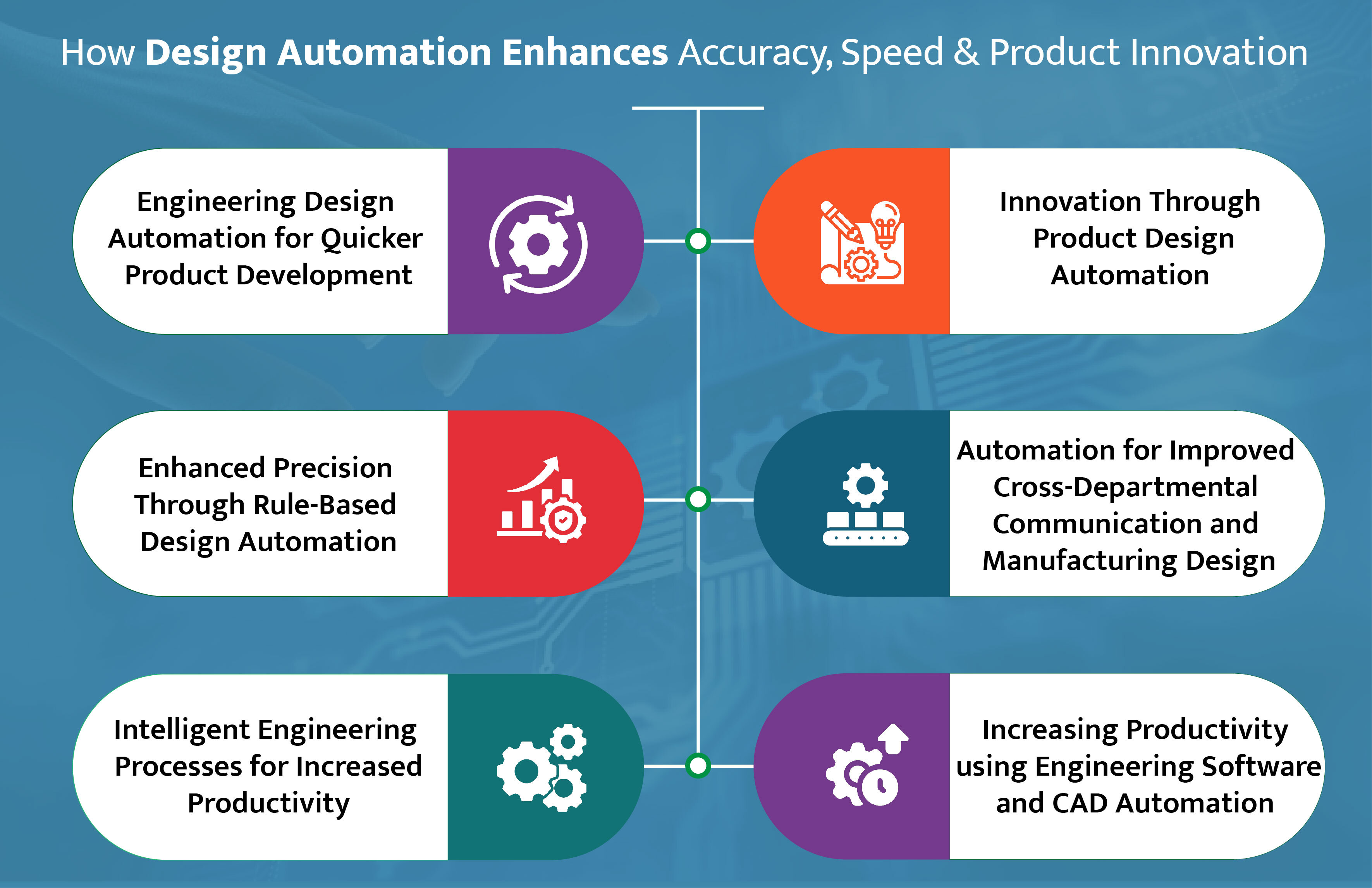
Design automation's capacity to significantly accelerate the design cycle is one of its greatest benefits. Engineers sometimes spend hours or even days producing routine assembly, updating drawings, or making repeating models.
Teams can automate repetitive processes like these with mechanical design automation:
CAD modeling with automation
Tools for automated drafting
Automated creation of BOMs
Automation of parametric design for modifiable components
By reducing reliance on manual modeling, these features free up engineers to concentrate on innovation, performance enhancement, and crucial design choices.
Even complicated assemblies can be produced in a matter of minutes using automated engineering workflows. Businesses who use these workflows report much decreased engineering effort and considerably shorter deadlines, which is a major advantage for companies looking to get products on the market more quickly.
For more information, you can check out our blog post, “How Design Automation Reduces Time and Costs in Manufacturing”!
One of the biggest causes of design changes, rework, and production delays is still human mistake. Teams can apply engineering logic, computations, and predetermined standards straight into the CAD model by implementing rule-based design automation.
This guarantees that each design:
Complies with established geometric guidelines
Satisfies the dimensional limitations
Conforms to industry norms
Produces BOMs and drawings free of errors
Throughout the product development process, this kind of intelligence-driven automation leads to increased accuracy. The model automatically updates when engineers make changes to inputs, removing discrepancies between 3D models, drawings, and documentation.
In addition to lowering errors, this kind of CAD process automation guarantees that engineering teams provide consistent results across several product lines.
Businesses may revolutionize product design and delivery with the help of intelligent, automated workflows. Businesses that use Design Automation services can simplify:
Part modeling
Adaptable assemblies
Product configuration that is automated
Engineering computations
creation of documentation
These workflows frequently interface with CAD customization services, enabling businesses to create unique tools that fit their internal procedures.
Organizations can increase engineering efficiency and remove bottlenecks by using solutions like CAD automation software, model-driven engineering, and automation for product development.
AI-powered design automation is also becoming more and more common.
Engineering decisions are supported by AI-driven solutions through:
Data Analysis
Predicting design failures
Automating selection of components
Improving design quality with smart recommendations
More businesses are using AI-driven engineering solutions to automate difficult modeling activities and increase product reliability as the use of AI in business grows.
When engineers have more time to experiment, refine, and optimize, innovation flourishes. Engineers may concentrate on innovation instead of labor-intensive CAD work thanks to product design automation. Automation allows businesses to test more design iterations without lengthening project durations.
Engineers may quickly change parameters and produce new design iterations, using:
Automated CAD modeling,
Automation of parametric design
Automated creation of BOMs
Workflows for smart engineering
This adaptability promotes quick prototyping and quicker idea validation, both of which are essential for developing next-generation products.
Additionally, automation removes tedious, error-prone manual operations, allowing teams to precisely create digital models. Long-term innovation and higher engineering quality result from this.
Accurate engineering data is crucial for manufacturing teams. Errors in models, BOMs, and drawings might result in higher prices or manufacturing delays.
Companies gain from automation for manufacturing design in the following ways:
Improved cooperation between design and manufacturing teams
Manufacturing document updates that happen automatically
Consistent and accurate product data
Engineering procedures based on models that minimize back-and-forth communication
These automated processes facilitate a smooth transition from design to production, improve internal coordination, and lessen bottlenecks.
Aligning engineering, sales, and business development is also aided by integration with Customer Relationship Management (CRM) AI and Sales Automation Tools. By producing precise quotes, 3D images, and personalized product alternatives, automated product configuration helps sales teams and raises client satisfaction.
In engineering, speed and accuracy are crucial. Businesses can drastically save engineering time through automation by using specialist engineering productivity software.
Among the main advantages are:
Quicker drafting
Automated part configuration
Reduced manual data entry
Consistent engineering standards
Improved customer data analysis for product customization
Engineering teams can expedite activities that might usually take days to accomplish with the use of tools like data automation, AI-driven modeling, and CAD automation.
Businesses utilizing Design Automation Solutions India have seen increased quality control, decreased rework costs, and increased accuracy.
The engineering landscape is changing in favor of digital transformation, high-efficiency automation, and smart design. Prominent firms like Modelcam Technologies are putting next-generation automation frameworks into practice to assist businesses in achieving quicker development cycles and error-free outputs.
Design automation is essential for supporting engineering teams, regardless of their objectives - speed, accuracy, or creativity, in:-
Automate tedious CAD jobs
Improve model consistency
Accelerate time to market
Enable AI-driven improvements
Innovate faster
It is now necessary to remain competitive in the global engineering and industrial ecosystem; it is no longer discretionary.
Design automation becomes a crucial tool as companies strive for more inventive goods, faster turnaround times, and more accuracy. Businesses may save engineering time, improve accuracy, and stimulate innovation in every project by utilizing sophisticated workflows including engineering design automation, CAD automation, rule-based design automation, and product design automation.
Organizations may increase speed and accuracy while laying a solid foundation for the future of digital engineering by using AI-powered design automation, utilizing data automation, and integrating automated engineering workflows.
Let’s connect: www.modelcamtechnologies.com
Email: sales@modelcamtechnologies.com
Mobile no : +91 8237016167
Modelcam Technologies provides a wide variety of Services from ART to PART from Concept Design to Industrial Modeling and Analysis for final Manufacturing.
©Copyright 2026. All rights reserved by Modelcam Technologies Private Limited PUNE.