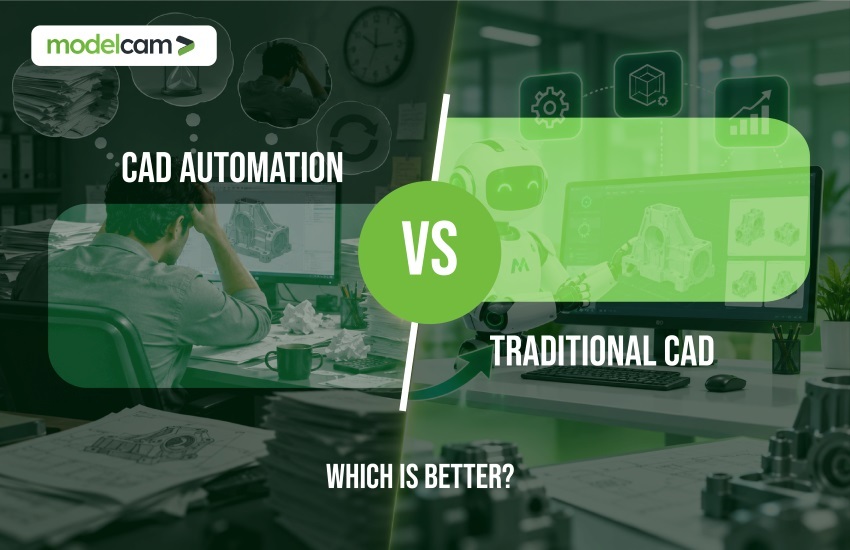

The way engineers handle routine design work is being altered by design automation. Design automation helps engineering teams save time, increase accuracy, and concentrate more on resolving challenging design issues by automating repetitive operations.
Precision has always been necessary in engineering. Later in the production process, a minor mistake in a dimension, drawing, material specification, or design update can set off a series of issues. However, engineers frequently spend hours on monotonous tasks that don't call for any original thought. Automation can really help in this situation.
Design automation automates repetitive design tasks using software, engineering rules, parameters, and predetermined logic. Engineers can supply particular inputs and let the system produce the necessary output rather than manually constructing each design or design variation.
For instance, engineers do not need to start from scratch if a corporation frequently designs components with varying diameters, lengths, or combinations. The model and associated drawings can be automatically updated when certain parameters are changed using parametric design.
This method, which can be applied to CAD, product development, documentation, and production workflows, is the cornerstone of engineering design automation.
To get more knowledge about Design Automation Services, by exploring our blog post, “Still Designing Manually? Switch to Design Automation Services Today”!
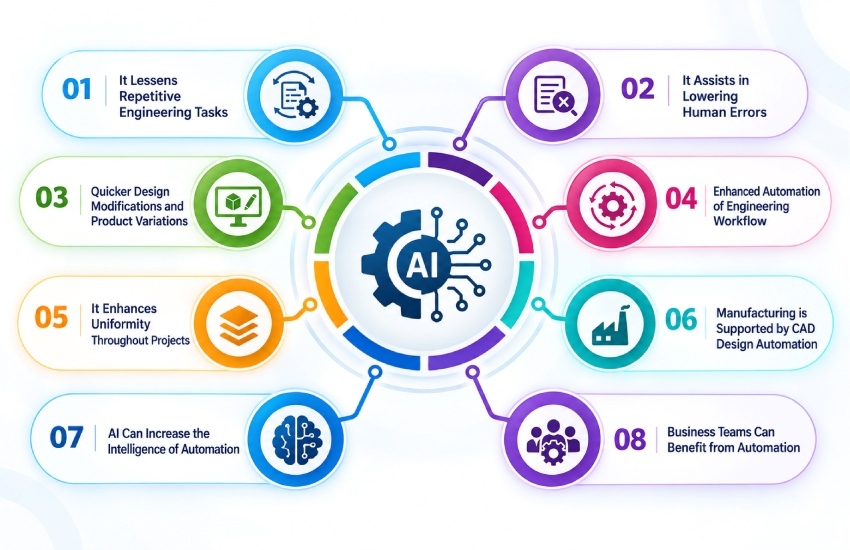
Modifying dimensions, making drawings, compiling bills of materials, updating documentation, and producing various design configurations are just a few of the tasks that engineers devote a significant amount of time to.
Although these duties are crucial, doing them by hand adds to the workload and increases the possibility of errors.
Many of these rule-based tasks can be handled using CAD Design Automation. Applications for automation can apply pre-established technical principles, retrieve data, and carry out tasks automatically. This is especially helpful when a company produces comparable goods or parts on a regular basis.
The outcome is straightforward: engineers spend more time making actual engineering decisions and less time clicking, copying, checking, and updating files.
When performing repetitious operations, even seasoned engineers might make mistakes. The finished product may be impacted by a missing dimension, an inaccurate value, an out-of-date drawing, or a neglected design modification.
According to research published in Safety Science, between 20% and 50% of the incidents and accidents evaluated in process industries had at least one design flaw as a root cause. The bulk of errors were eliminated by comprehensive design evaluations prior to systems being put into operation, according to the report.
By continually using the same predetermined guidelines, Automated Design Solutions assist lower such risks. Organizations can incorporate technical knowledge into automated procedures rather than depending solely on memory and manual verification.
This does not mean that engineers are no longer needed. Instead, it provides them with improved tools for design control and inspection.
Several product variations are frequently needed in modern manufacturing. A different size, configuration, material, or standard can be required by a customer.
It can take a long time to manually create each variant.
Engineers can use Product Design Automation to generate reusable templates based on engineering principles and characteristics. The associated model, sketch, or documentation can be updated more quickly when a parameter changes.
One of the main advantages of engineering design automation is that businesses can adapt to design modifications without having to repeat the entire process.
Additionally, it facilitates quicker product development and aids engineering teams in managing more design changes without corresponding increases in manual labor.
A design is not an isolated entity. CAD, PLM, ERP, manufacturing, procurement, and other business systems frequently exchange engineering data.
Inconsistencies and delays may result from manual data transfer between these platforms.
These tasks are connected and needless manual handoffs are decreased with the aid of engineering workflow automation. For instance, Modelcam Technologies collaborates with engineering firms to find project or product lifecycle components that can be automated and to interface engineering systems with business systems.
As a result, the process from design to manufacture runs more smoothly.
Different engineers may use slightly different approaches when working on similar tasks. This may eventually lead to variations in design standards, documentation, naming conventions, and drawings.
Standardizing these procedures is made possible via automation.
Automated systems can incorporate engineering knowledge, rules, equations, tables, and templates. This implies that rather than having to be manually constructed for each project, the same design logic may be used repeatedly.
This uniformity can be quite helpful for companies that oversee many projects.
Once the CAD model is finished, automation continues to have advantages. Engineering choices can be linked to downstream manufacturing requirements through effective design automation.
Design Automation in Manufacturing can assist businesses in producing designs that adhere to established manufacturing guidelines and standards. The transfer from engineering to production can also be facilitated by the automated creation of drawings, configurations, and associated documentation.
This helps achieve Smart Manufacturing's overarching objective, which is for engineering, manufacturing, data, and digital systems to collaborate rather than function independently.
AI and automation are being used together more and more. While AI-driven systems can analyze vast amounts of data and spot trends or potential improvements, traditional automation often adheres to predetermined rules.
AI-Driven Solutions, for instance, can help engineering teams by analyzing design data, spotting odd trends, or helping with optimization. Organizations can also use data created throughout the design process more effectively with the use of data analysis and data automation.
AI shouldn't, however, take the place of technical judgment. The most effective strategy frequently combines automation, AI, and engineering know-how.
Beyond engineering, design information can have an impact. Accurate product information and quicker design setup can enable sales and customer-facing teams to react faster.
Customer requirements and engineering data can be linked, for instance, by interaction with Sales Automation Tools or Customer Relationship Management (CRM) AI.
Engineering automation can assist teams in responding with appropriate product configurations more quickly, while customer data analysis can offer insights into what customers require. In the end, this could enhance the customer experience.
This is where AI in business takes on greater significance—not just as a technological fad, but as a means of integrating various corporate operations.
The process, product complexity, number of variants, and degree of automation all affect the actual savings. However, studies and case studies from the industry demonstrate that automation can result in a considerable decrease in repetitive tasks.
One documentation activity that took over 2.9 hours to complete by hand for a batch of 50 parts was reduced to about 8 minutes after automation, according to a 2025 study on CAD-based automation—more than a 90% reduction in task time.
This does not mean that all engineering tasks will become 90% faster. Instead, rule-based, repetitive tasks make excellent candidates for automation.
It takes more than just buying software to achieve successful automation. Businesses must comprehend their current engineering procedures in order to determine where automation can be most beneficial.
A competent design automation company should be knowledgeable about software and engineering operations. It should be able to recognize repetitive tasks, record technical expertise, develop appropriate automation logic, and link the solution with current systems.
For example, Modelcam Technologies offers CAD customisation, knowledge-based engineering, bespoke applications, libraries, and interface with engineering and business systems in addition to Design Automation Services in India.
Engineering teams shouldn't have to repeatedly spend their precious time on the same tasks. Repetitive, rule-based tasks can be transformed into quicker, more reliable workflows with the help of design automation services.
Automation may help engineers reduce unnecessary errors and save time in a variety of ways, from manufacturing integration and AI-driven analysis to CAD Design Automation and Parametric Design.
Eliminating engineers from the design process is not the aim. Giving them more time to do what they do best - solving issues, enhancing products, and developing superior engineering solutions - is the goal.
Engineering automation services will play a bigger role in creating effective, scalable, and future-ready engineering operations as manufacturing becomes more interconnected and competitive.
Let’s connect: www.modelcamtechnologies.com
Email: sales@modelcamtechnologies.com
Mobile no : +91 8237016167
Modelcam Technologies provides a wide variety of Services from ART to PART from Concept Design to Industrial Modeling and Analysis for final Manufacturing.
©Copyright 2026. All rights reserved by Modelcam Technologies Private Limited PUNE.