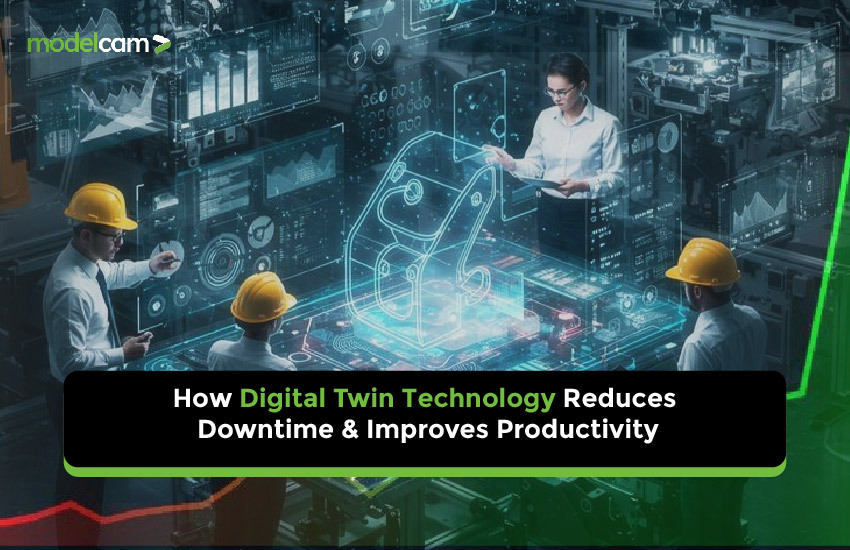
Unplanned downtime is more than just a technical problem in today's fiercely competitive industrial environment; it directly affects revenue, delivery promises, and customer trust. Digital twin technology becomes a key enabler in this situation. Manufacturing companies can model, track, and improve operations in real time by building a virtual version of their physical assets, procedures, and systems.
Innovative engineering firms like Modelcam Technologies are assisting manufacturers in their shift to intelligent, networked ecosystems that are in line with Industry 4.0 by utilizing data-centric methodologies, AI-driven engineering, and sophisticated automation. Let's examine how this change lowers manufacturing downtime and boosts large-scale factory productivity.
A machine, production line, or full facility can be represented digitally using digital twin technology, which continuously gathers operating data from sensors and industrial Internet of things solutions. Digital twins, in contrast to static 3D models, change dynamically through the use of predictive algorithms, AI-powered analytics, and real-time monitoring systems.
Fundamentally, a digital twin incorporates:
IoT solutions for industry
Systems for real-time monitoring
Data analysis powered by AI
Predictive analytics in manufacturing
Cloud-based digital twin software
By bridging the gap between digital intelligence and physical operations, this convergence makes it possible to optimize industrial processes.
The emergence of Industry 4.0 technology has greatly increased the use of digital twins in manufacturing. Machines are now linked nodes in an intelligent ecosystem rather than isolated assets in a smart factory.
Operational parameters including vibration, temperature, load, cycle duration, and output quality are gathered by an industrial digital twin. These data streams are fed into software platforms for digital twins, where AI-powered solutions examine trends and spot irregularities before they become serious malfunctions.
The outcome? By switching from reactive maintenance to predictive maintenance with digital twin models, manufacturers can decrease manufacturing downtime.
To know more about digital twins in manufacturing, explore our blog, “Digital Twin in Manufacturing: A Game Changer for Quality Control: Part 4”!
Traditional maintenance models are either preventive (service on schedule) or reactive (repair after failure). Both strategies have drawbacks. Digital twin predictive maintenance employs predictive analytics in production to identify early indicators of equipment deterioration.
AI-driven systems predict possible malfunctions by evaluating past and present data. By stepping in before a failure happens, maintenance personnel may significantly lower unscheduled stoppages and boost operating efficiency.
Continuous monitoring is a key advantage of digital twin technologies. Systems for real-time monitoring offer insight into system performance, production indicators, and machine health.
Plant managers get immediate notifications rather than learning about problems after they affect output. This proactive oversight ensures a smooth production flow while greatly reducing manufacturing downtime.
Finding the underlying reasons for downtime can take hours or even days. Virtual simulations of failure situations are made possible by digital twin technology company platforms.
Without interfering with real operations, engineers can test remedial measures digitally and mimic conditions in the industrial digital twin environment. This reduces manufacturing losses and speeds up troubleshooting.
Cutting downtime is just one aspect of the problem. The ability to continuously increase manufacturing productivity is the true competitive advantage.
Digital twin systems offer in-depth data analysis on material flow, energy consumption, bottlenecks, and cycle times. Manufacturers can balance production loads, improve workflows, and get rid of inefficiencies with AI-driven insights.
Optimizing the manufacturing process has a direct impact on increased productivity and improved resource use.
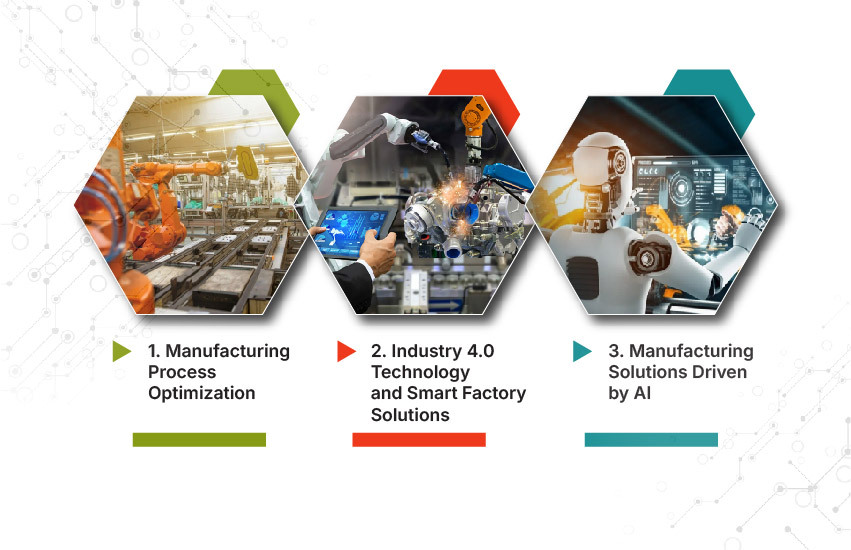
AI-powered manufacturing solutions, industrial IoT solutions, and digital twin software are all integrated into smart factory solutions. This makes it possible to make decisions on your own using real-time operational intelligence.
Synchronized production systems are made possible by Industry 4.0 technology, which gives machines the ability to connect with one another. A robust and flexible industrial environment is the end result.
In digital twin ecosystems, artificial intelligence is essential. AI in business now powers shop-floor intelligence in addition to customer analytics.
Data automation powered by AI guarantees:
Quicker identification of anomalies
Better quality assurance
Better inventory control
Improved forecasting of production
Together, these capabilities enable efforts to increase operational efficiency while boosting industrial productivity.
Services for implementing digital twins go beyond improving operations. They have a direct impact on long-term scalability, customer satisfaction, and income.
Manufacturers are able to consistently meet delivery timetables by avoiding downtime and maintaining constant production quality. Forecasts of demand are further aligned with manufacturing output through the integration of customer data analysis with production systems.
By lowering supply chain interruptions, delays, and defects, this enhances the customer experience.
Cutting-edge manufacturers combine digital twin solutions with enterprise platforms like sales automation tools and artificial intelligence (AI) systems for customer relationship management (CRM).
For instance:
Sales demand planning is in line with production projections.
Accurate sales commitments are supported by real-time inventory data.
Strategic decision-making is enhanced by data analysis.
This integration shows how engineering, operational, and commercial teams are brought together under a single digital ecosystem using AI-driven solutions.
Digital twin technology adoption necessitates careful planning. To guarantee smooth integration, organizations usually work with a specialized digital twin technology business or an Indian provider of digital twin solutions.
The framework for implementation consists of:
Digitization of assets and integration of sensors
Digital twin software deployment
Setting up industrial IoT connectivity
Configuring AI-driven predictive analytics
Constant improvement of performance
In order to match technical deployment with business goals like cost containment, efficiency, and scalability, digital twin consulting services are essential.
An industrial digital twin creates a data-driven culture in addition to replicating machinery. Leadership teams may increase operational transparency with AI-driven decision intelligence.
Important quantifiable results include:
Decreased manufacturing downtime
Increased productivity in the factory
Improved manufacturing predictive analytics
Accelerated cycles of invention
More robust indicators for improving operational efficiency
Businesses that use digital twins in manufacturing frequently cite faster time-to-market, better asset utilization, and significant cost reductions.
Digital twin solutions will progressively incorporate sophisticated AI, machine learning, and automated decision processes as Industry 4.0 technology develops. Future-ready factories will function as ecosystems of fully integrated smart industrial solutions, where performance is continuously improved by digital twin software.
Self-optimizing production environments will be created by combining data automation, AI-powered manufacturing solutions, and real-time monitoring systems.
In addition to reducing manufacturing downtime, manufacturers who engage in digital twin implementation services now will create scalable frameworks that promote long-term growth.
Digital twin technology is a strategic business enabler, not just a new invention. Organizations can significantly lower production downtime and boost factory productivity by combining industrial IoT solutions, digital twin predictive maintenance, AI-driven analytics, and manufacturing process optimization.
In a market defined by speed, precision, and customer expectations, digital twin ecosystems provide the intelligence required for sustainable operational excellence. Manufacturers can effectively use digital twin consulting services and make the shift to fully integrated AI-driven solutions with the help of engineering partners like Modelcam Technologies.
Businesses that turn data into action will rule the manufacturing industry in the future, and digital twin technology is the cornerstone of that change.
Let’s connect: www.modelcamtechnologies.com
Email: sales@modelcamtechnologies.com
Mobile no : +91 8237016167
Modelcam Technologies provides a wide variety of Services from ART to PART from Concept Design to Industrial Modeling and Analysis for final Manufacturing.
©Copyright 2026. All rights reserved by Modelcam Technologies Private Limited PUNE.