
Even though a design appears flawless on a computer-aided design (CAD) screen, what happens when it encounters pressure, heat, vibration, or fluid flow in the real world? Before a product is put on the manufacturing floor, organizations can find answers to these issues with the aid of engineering simulation services.
A design failure is more than just a technical issue for contemporary manufacturers. Expensive prototypes, production delays, material waste, redesign effort, warranty claims, and eroded consumer confidence are all possible outcomes. For this reason, simulation design services are starting to play a significant role in the creation of contemporary products.
Before a product reaches consumers, it goes through a number of steps. Engineers design an idea, generate a CAD model, choose materials, construct prototypes, test the product, make adjustments, and then proceed with manufacturing.
The issue is that some flaws don't show up until an actual prototype is constructed.
For instance, a component can seem robust enough in the design phase yet break under repeated pressures. During operation, a machine component could get too hot. Unexpected pressure or ineffective fluid flow might occur in a pipe or tube.
It can be costly to fix these issues after production has begun. Engineers may need to rebuild prototypes, order new materials, alter production procedures, or even change tooling.
This method is altered by Simulation in Engineering, which enables engineers to visually discover a wide range of possible issues before devoting a substantial amount of time and resources to actual testing.
Engineering simulation forecasts how a system or product will function under particular circumstances using technical data and mathematical models.
Engineers can evaluate various design conditions digitally rather than producing several copies of a product right once.
Depending on the product and its specifications, businesses can employ:
FEA Analysis (Finite Element Analysis): To investigate structural performance, deformation, stress, and strain, use finite element analysis, or FEA.
CFD Analysis (Computational Fluid Dynamics): To comprehend fluid flow, pressure, velocity, and turbulence, use computational fluid dynamics, or CFD analysis.
Thermal Simulation: Thermal performance and temperature distribution are assessed using thermal simulation.
Heat Transfer Simulation: To comprehend how heat travels through parts and systems, use the Heat Transfer Simulation.
Flow Simulation: Use flow simulation to research how liquids and gasses behave.
Multiphysics Simulation: To assess scenarios where several physical effects interact, use a multiphysics simulation.
Structural Analysis Simulation: To evaluate how components react to loads and operating circumstances, use structural analysis simulation.
While there is still time to modify the design, these techniques assist engineers in identifying possible sources of failure.
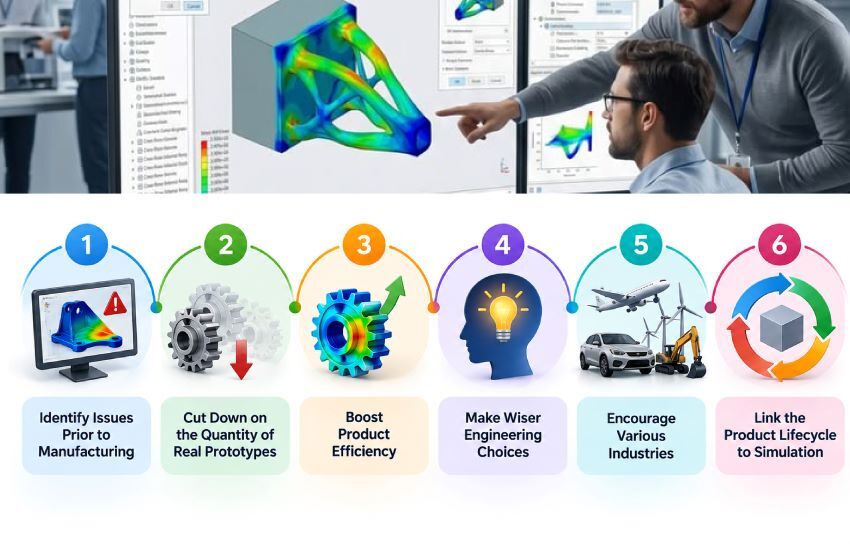
Early failure identification is one of the main benefits of Product Design Simulation.
Consider a business that is creating a hefty industrial bracket. Conventional development could entail producing a prototype and putting it through physical testing. Engineers must modify the bracket and create a new prototype if it bends or experiences significant stress.
Engineers can use simulation to first apply anticipated loads to the virtual model. Stress and strain analysis can identify potential weak points in the design.
Before production, the engineer can then alter the material, add structural support, alter the geometry, or thicken the material.
The fundamental concept of Design Validation Services is to digitally validate the design before investing a significant amount of money in physical validation.
Although useful, physical prototypes aren't always the best place to start.
Engineering teams can virtually investigate multiple design possibilities using simulation. Because of this, virtual prototyping services are especially helpful for products with intricate geometry or costly materials.
Best-in-class companies that used simulation-driven design produced 27% fewer prototypes and cut development time by 29%, according to a research.
This does not negate the need for physical testing. Instead, before costly physical testing starts, simulation assists businesses in improving their design.
Simulation is more than just identifying mistakes. Additionally, it can assist engineers in producing better products.
A component might be structurally sound yet unduly hefty, for instance. Engineers can discover a balance between strength, weight, material consumption, cost, and performance with the use of Product Design Optimization Services.
In a similar vein, thermal simulation can assist engineers in identifying overheating issues, while CFD analysis can help enhance airflow through a system.
Because of this, engineering teams may use Simulation for Product Development to continuously develop a product from concept to manufacturing.
There are generally multiple design possibilities available to engineering teams. It can be challenging to select the best one based solely on expertise.
Measurable engineering data from simulation can help with those choices.
Different materials, geometries, loads, operating circumstances, and performance criteria can all be compared by engineers. Teams may make decisions based on anticipated product behavior rather than just assumptions thanks to this combination of simulation and data analysis.
Through CAD to CAE Integration, modern engineering analysis tools also facilitate the integration of CAD models with engineering analysis.
Numerous engineering fields can benefit from simulation.
Engineers can assess components, airflow, thermal behavior, structural loads, and other performance requirements in the Simulation for Automotive Industry.
Engineers can assess designs under challenging operating conditions where weight and dependability are crucial with the aid of aerospace simulation services.
In a similar vein, businesses can assess machinery, structures, parts, and manufacturing procedures prior to production by using Industrial Equipment Simulation, Heavy Engineering Simulation, and Simulation Services for Manufacturing.
The same idea holds true for many industries: find possible issues early on and make design improvements before the cost of change increases significantly.
When simulation is integrated with more comprehensive digital engineering procedures, it becomes even more potent.
A physical product or system can be virtually represented using digital twin technology, and data can be used to track, evaluate, and improve the system's performance. This can help with risk management, performance enhancement, and predictive maintenance.
Instead of using simulation as a one-time testing activity, businesses may utilize it throughout the Simulation for Product Lifecycle when it is integrated into the broader engineering workflow.
Additionally, this method facilitates Industry 4.0 Simulation, Smart Manufacturing, and increasingly AI in Engineering Simulation.
Engineering teams can analyze vast volumes of engineering and customer data, spot trends, automate tedious operations, and facilitate quicker decision-making with the aid of AI-driven solutions. AI, however, functions best when paired with solid engineering expertise and trustworthy simulation models.
Not every business has an internal staff for every kind of analysis. Working with a simulation design services company might give you access to specialized engineering knowledge in these situations without the need for a sizable permanent staff.
Experienced engineering partners that offer CAE services, simulation consultancy, design optimization, and validation support are another option for businesses searching for Engineering Simulation Services India.
Instead of only running software, a trustworthy CAE Services Provider should comprehend the engineering challenge. The ideal partner should be able to comprehend design specifications, choose a suitable simulation technique, analyze results, and convert those findings into useful design enhancements.
Businesses may also use Industrial Simulation Solutions as part of a longer-term engineering plan or outsource simulation services for certain projects, depending on project requirements.
Preventing a costly design failure is frequently less expensive and easier than fixing it after production has started.
Before actual manufacturing, engineers may test concepts, find flaws, compare options, and improve designs with CAE Simulation Services. Simulation may lower uncertainty at every stage of the product development process, from thermal, structural, flow, and multiphysics investigations to FEA and CFD analysis.
Simulation Design Services are evolving from an optional engineering activity to a useful component of contemporary product development for businesses that prioritize quicker development, improved product performance, and reduced development risk.
To get more knowledge about simulation design services and how it benefits in product design, check out our blog post, “Simulation Design Services for Faster, Smarter & Cost-Effective Product Design”!
The objective is straightforward: identify the issue on the computer before the customer discovers it in the real world.
Let’s connect: www.modelcamtechnologies.com
Email: sales@modelcamtechnologies.com
Mobile no : +91 8237016167
Modelcam Technologies provides a wide variety of Services from ART to PART from Concept Design to Industrial Modeling and Analysis for final Manufacturing.
©Copyright 2026. All rights reserved by Modelcam Technologies Private Limited PUNE.