

Speed has become a requirement rather than a distinction in today's fiercely competitive production market. Businesses that don't innovate fast run the danger of losing income, market share, and customer trust. PLM services are essential in this situation. Product Lifecycle Management solutions help companies cut product development time by up to 40% while enhancing quality and teamwork by centralizing product data, optimizing procedures, and facilitating better decision-making.
To reduce inefficiencies and boost innovation, top manufacturing companies in PLM Services USA and PLM Services India are implementing cutting-edge PLM frameworks.
For more information, read our blog post, “Why Your Business Needs PLM Services in India & USA for Faster Innovation”!
Product Lifecycle Management Services oversee all phases of a product's development, including idea and design, manufacturing, servicing, and end-of-life. PLM unifies the engineering, production, sales, and customer experience departments into a single digital thread, in contrast to disparate tools.
PLM Consulting Services, PLM Implementation Services, and long-term optimization are just a few of the end-to-end capabilities provided by a reliable PLM service provider. These services guarantee quantifiable increases in operational efficiency and quicker execution of the product development process.
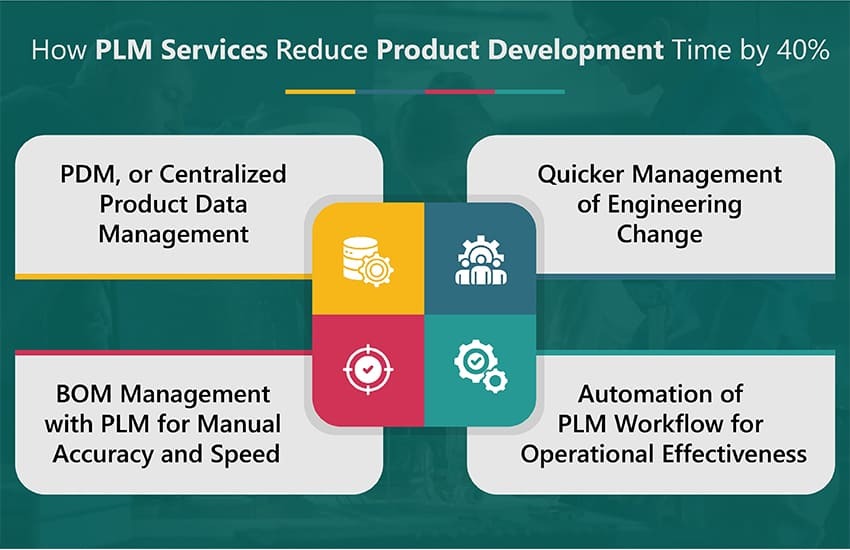
Scattered data is one of the main reasons for development delays. A single source of truth for CAD files, specifications, documents, and revisions is produced via product data management (PDM) in PLM systems.
When PDM is centralized:
Engineering teams do away with rework.
Outdated file errors are decreased.
Cross-location collaboration becomes effortless.
In addition to supporting PLM for product development projects across departments, this immediately aids enterprises in cutting down on product development time.
Uncontrolled engineering modifications have the potential to cause delays and raise expenses. Teams can monitor, approve, and execute changes in real time thanks to PLM solutions, which facilitate structured engineering change management.
Change workflows driven by PLM:
Reduce the number of approval bottlenecks
Minimize gaps in communication
Ensure traceability and compliance
Without sacrificing quality, this speeds up iterations and facilitates a faster product development process.
Managing the bill of materials frequently results in discrepancies between engineering and manufacturing. BOM management with PLM guarantees precise, version-controlled, and synchronized BOMs among teams.
Advantages consist of:
Decreased production errors
Quicker cycles for procurement
Better coordination between manufacturing and design
For firms looking to improve time to market, this feature is crucial for PLM for manufacturing companies.
Innovation is slowed down by manual approvals and disjointed workflows. Design reviews, compliance checks, and product releases are just a few of the procedures that PLM workflow automation digitizes and standardizes.
Automated workflows:
Use data automation to get rid of tedious activities
Boost visibility and accountability
Turn on real-time progress monitoring
Organizations can concentrate on innovation and shorten delivery times by cutting administrative expenses.
In order to improve speed and intelligence throughout the product lifecycle, modern PLM platforms are progressively integrating AI-driven features.
PLM systems use data analysis and predictive insights with AI in business to:
Early detection of possible design problems
Forecast delays and overspending
Allocate resources as efficiently as possible
Smarter decisions are made possible by AI-powered insights, enabling teams to take proactive rather than reactive action.
AI-driven solutions within PLM Solutions for Manufacturing assist businesses in evaluating past performance data and automating design suggestions. This guarantees uniformity among variations and speeds up product iterations.
These features enhance PLM Software Services, increasing its adaptability and scalability for multinational corporations.
PLM for engineering teams may collaborate in real time across geographical boundaries. Engineers may access updated data instantaneously, collaborate on designs concurrently, and rely less on spreadsheets and emails.
By delivering better goods sooner, this collaborative atmosphere improves customer experience and facilitates faster innovation cycles.
PLM serves as a link between design and manufacturing for manufacturers. By ensuring that manufacturing receives precise, verified data, PLM for manufacturing companies helps manufacturing organizations cut down on rework and production delays.
A quicker product launch and ongoing operational excellence are greatly aided by this alignment.
Engineering is no longer the only field where PLM is used. PLM improves downstream processes when used with CRM AI and sales automation tools.
Sales teams benefit from PLM insights and customer data analysis.
React more quickly to unique requirements
Cut down on quote-to-order cycles
Boost the match between the product and market
Better client experiences and increased revenue are made possible by this connection.
Achieving quantifiable results requires careful consideration of the PLM service provider. Skilled suppliers such as Modelcam Technologies provide:
Customized PLM Consulting Services
Scalable PLM Implementation Services
Industry-specific PLM best practices
Global providers guarantee quicker deployments and long-term value realization with their expertise in PLM Services India and PLM Services USA.
Effective PLM implementation results in:
A 40% reduction in product development time for organizations
Enhanced interdisciplinary cooperation
Quicker cycles of innovation
Improved traceability and compliance
PLM Services transform from a mere technology investment into a strategic growth enabler through the alignment of people, processes, and data.
PLM services are crucial for firms hoping to remain competitive in a time of speed, intelligence, and customer-centricity. PLM helps businesses shorten the time it takes to develop new products, improve time to market, and streamline operations by combining AI-driven, data-centric, and automated workflows.
Investing in the appropriate Product Lifecycle Management Services is now a strategic necessity for companies seeking to expand innovation, improve engineering efficiency, and provide superior customer value.
Let’s connect: www.modelcamtechnologies.com
Email: sales@modelcamtechnologies.com
Mobile no : +91 8237016167
Modelcam Technologies provides a wide variety of Services from ART to PART from Concept Design to Industrial Modeling and Analysis for final Manufacturing.
©Copyright 2026. All rights reserved by Modelcam Technologies Private Limited PUNE.