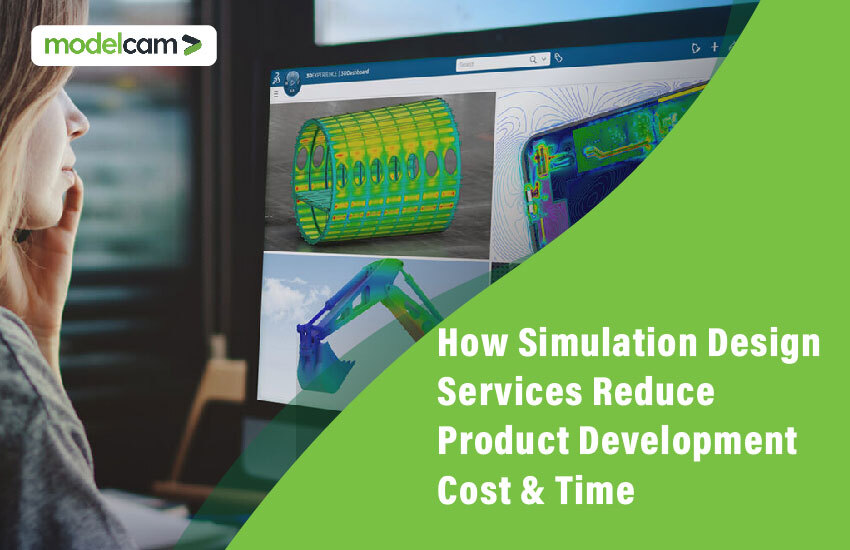
The way that modern businesses develop, test, and introduce goods is being revolutionized by simulation design services. Businesses can lower development costs, increase product quality, and launch products much more quickly by utilizing cutting-edge virtual testing techniques.
Companies cannot afford lengthy product development cycles or frequent prototype failures in today's cutthroat manufacturing climate. For this reason, engineering simulation services are now a crucial component of product creation in many different industries.
Industry reports state that businesses can shorten development cycles by over 40% and save product development expenditures by up to 30% by utilizing cutting-edge simulation technologies. In a number of industries, including industrial, automotive, and aerospace, simulation technologies are helping businesses create more clever and efficient products.
Simulation Design Services uses robust engineering software and digital tools to test and assess product performance in a realistic manner prior to manufacturing. Instead of relying just on physical testing, engineers can use simulation models to evaluate how products behave in real-world situations.
Simulation of structural analysis
Thermal simulation
Flow simulation
Analysis of stress and strain
Computational Fluid Dynamics (CFD) Analysis
Finite Element Analysis, or FEA Analysis
Multiphysics simulation
These technologies assist companies in lowering failure rates, increasing product quality, and optimizing early-stage designs.
Businesses like Modelcam Technologies offer sophisticated Simulation for Product Development solutions to industrial, heavy engineering, automotive, and aerospace industries.
For more information about simulation design services, please visit our blog post, “Simulation Design Services in Engineering: Everything You Need to Know”!
Multiple physical prototypes and frequent testing cycles are common components of traditional product development. Although this approach is effective, it is expensive and time-consuming.
High production costs for prototypes
Increased waste of materials
Long testing cycles
Delayed product launches
Expensive redesign processes
For instance, engineers have to rebuild a component, make a new prototype, and conduct more testing if a product fails during testing. Before final approval, this process may be repeated multiple times.
Before actual production begins, engineers can use Product Design Simulation to digitally identify issues. As a result, errors and development costs are significantly reduced.
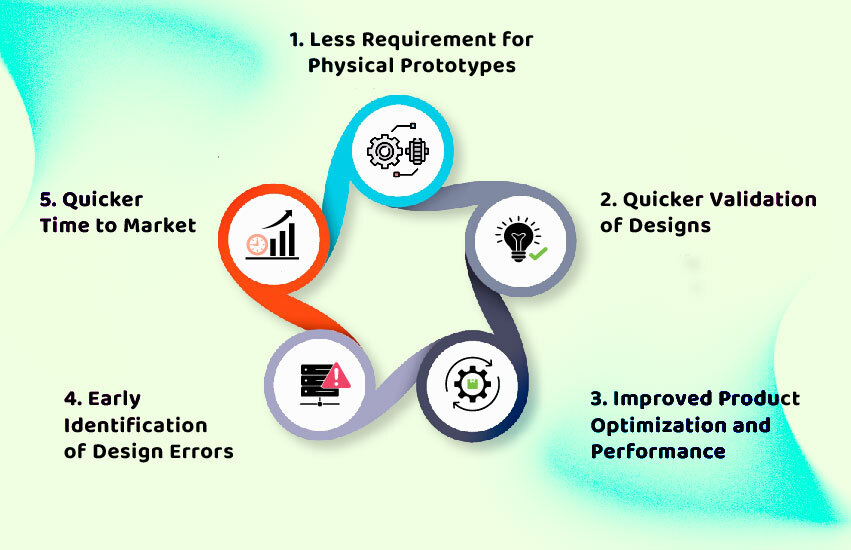
Reducing the need for actual prototypes is one of the main benefits of virtual prototyping services.
Engineers can model product behavior in a virtual environment by using sophisticated engineering analysis tools. This enables businesses to assess structural strength, durability, safety, and thermal performance without producing numerous prototypes.
Manufacturers in the automobile industry, for instance, employ Simulation for Automotive Industry programs to assess vehicle components under various operating circumstances prior to manufacturing.
Manufacturing costs for prototypes
Costs of materials
Testing expenses
Costs associated with product redesign
Design validation services allow engineers to quickly and accurately test different product concepts.
Engineers can determine whether a component can withstand pressure, vibration, or stress by using FEA Analysis (Finite Element Analysis). In a similar vein, thermal simulation aids in assessing cooling effectiveness and heat distribution.
Design changes can be made instantly because simulations are carried out digitally. This shortens development processes and expedites product approvals.
Compared to conventional testing techniques, businesses that use simulation consulting services can find performance problems considerably early.
Modern Product Design Optimization Services assist businesses in increasing product efficiency before the start of manufacturing.
Engineers are able to optimize:
Product weight
Structural strength
Energy efficiency
Thermal performance
Fluid flow systems
For instance, CFD analysis, or computational fluid dynamics, is frequently applied in industrial and aerospace settings to enhance airflow and lower drag.
This level of optimization raises product quality while reducing manufacturing and operating costs.
Early detection of design flaws in the development process is one of the main advantages of simulation in engineering.
Before manufacturing starts, engineers can identify weak areas, performance hazards, and material failures using Stress & Strain Analysis and Structural Analysis Simulation.
Product recalls
Manufacturing defects
Warranty claims
Production downtime
Early failure identification can result in significant cost savings in industries like heavy machinery and industrial equipment manufacture.
In the cutthroat market of today, speed is essential.
Faster product launches give businesses a significant competitive edge. Businesses can expedite design approvals and cut down on testing time with Simulation for Product Development.
Manufacturing Simulation Solutions, for instance, allow manufacturers to model production workflows, assembly procedures, and factory activities prior to deployment.
Timelines for product launches
Engineering effectiveness
Planning for manufacturing
Accuracy of production
Businesses are able to react to shifting market demands faster as a result.
With the incorporation of automation and artificial intelligence, modern engineering simulations are getting more intelligent.
Nowadays, AI in engineering simulation helps engineers manage enormous amounts of simulation data. AI-powered systems are able to forecast problems, find design enhancements, and maximize product performance.
AI-powered design optimization
Digital Twin Technology
Data automation
Predictive engineering models
Smart manufacturing systems
For example, Industry 4.0 Simulation allows manufacturers to create digital replicas of machinery and production processes for real-time monitoring and performance analysis.
Engineering simulations are becoming quicker, more intelligent, and more precise thanks to the application of AI-driven solutions.
Smooth CAD to CAE Integration is a key benefit of contemporary CAE Services Provider systems.
Instead of painstakingly duplicating designs, engineers can import CAD models straight into simulation software. This lowers engineering effort and increases process efficiency.
Quicker engineering cooperation
Improved precision of design
Increased output
Testing a product's performance in real time
Because of this, industrial simulation solutions are quite useful for intricate engineering projects.
Simulation technologies are now used in nearly every production sector to lower costs and increase product quality.
Manufacturers can test aerodynamics, crash performance, thermal systems, and structural strength with the aid of Simulation for Automotive Industry.
Using aerospace simulation services improves aircraft component dependability, fuel efficiency, and airflow analysis.
Businesses utilize Simulation Services for Manufacturing to improve factory operations, machinery performance, and production systems.
Manufacturers can increase the longevity, effectiveness, and operating safety of their equipment by using industrial equipment simulation.
By enhancing long-term product performance and maintenance planning, simulation technologies also help simulation for product lifecycle management.
Instead of keeping sizable internal simulation teams, many companies increasingly choose to outsource simulation services.
Availability of knowledgeable simulation engineers
Reduced operating expenses
Quicker project completion
Sophisticated engineering software
Industry-specific knowledge
Businesses may concentrate on manufacturing and innovation while simulation specialists tackle intricate engineering analysis when they work with a seasoned simulation design services company.
India's cost-effective solutions and highly qualified engineering personnel are making it a popular destination for Engineering Simulation Services India.
Reducing product development costs and speeding up product launches are critical for corporate success in today's fast-paced manufacturing sector.
Through sophisticated virtual testing, design optimization, and engineering analysis, Simulation Design Services assist businesses in achieving these objectives.
With fewer physical prototypes, companies can produce stronger, safer, and more effective products thanks to modern simulation technologies, such as FEA analysis, CFD analysis, thermal simulation, and multiphysics simulation.
The need for sophisticated engineering simulation services will only increase as more sectors embrace digital engineering technology, AI-driven solutions, and smart manufacturing.
Companies who invest in simulation technologies now are creating more effective goods, cutting expenses, and gaining a significant competitive edge in the long run.
Let’s connect: www.modelcamtechnologies.com
Email: sales@modelcamtechnologies.com
Mobile no : +91 8237016167
Modelcam Technologies provides a wide variety of Services from ART to PART from Concept Design to Industrial Modeling and Analysis for final Manufacturing.
©Copyright 2026. All rights reserved by Modelcam Technologies Private Limited PUNE.