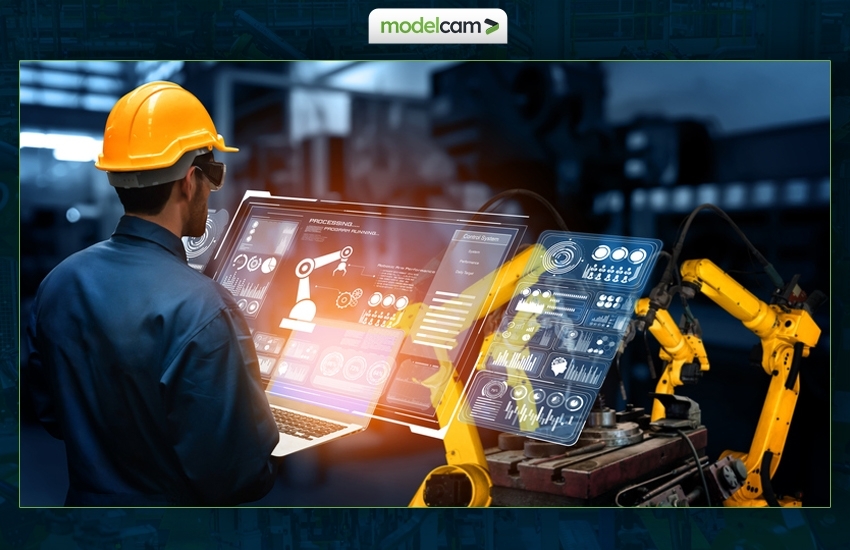
Artificial intelligence is already changing how factories function, compete, and expand; it is no longer a future idea. AI in manufacturing is emerging as a key component of Industry 4.0, from demand forecasting and process automation to quality control and predictive maintenance.
For more information, you can go through our blog post, “Why AI in Manufacturing is Essential for Industry 4.0”!
But a crucial concern remains for many leaders: "Is my factory ready for AI?"
Before investing in new systems, manufacturers must examine their preparation. In order to help decision-makers identify gaps, lower risk, and plan for successful adoption, this blog offers a useful AI readiness checklist for manufacturing. This guide will help you proceed with confidence by providing insights that are in line with smart manufacturing best practices, which are adhered to by professionals such as Modelcam Technologies.
The potential of Artificial intelligence in manufacturing resides in its capacity to convert raw shop-floor data into actionable intelligence. However, operational, cultural, and technical preparedness are critical to the success of AI.
Low ROI, ambiguous use cases, and poor data quality are common problems for factories that neglect readiness evaluation. Investments in AI automation in manufacturing are guaranteed to yield quantifiable benefits in terms of productivity, quality, and customer experience through a systematic AI manufacturing readiness assessment.
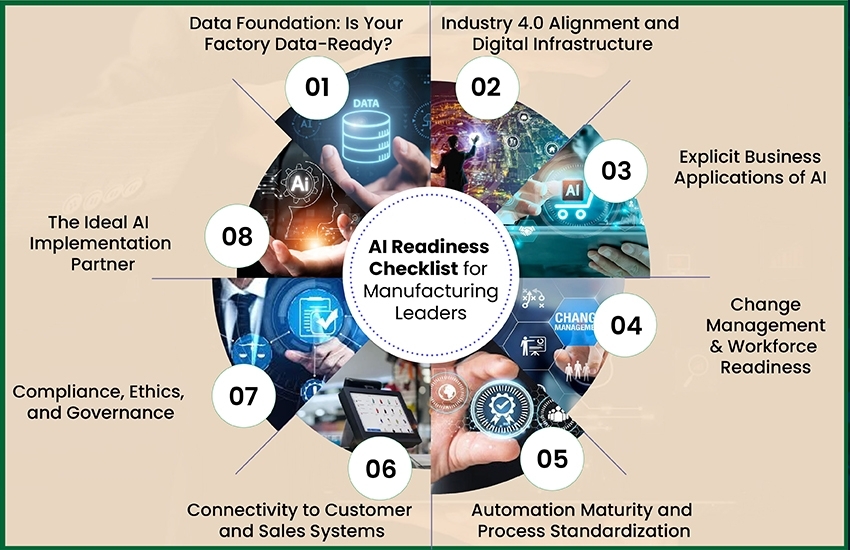
To find out if your factory is ready to use AI at scale, use the following checklist.
AI systems rely on high-quality, structured, and accessible data. Manufacturing automation using AI won't produce insights without a solid data foundation.
Important readiness questions:
Are machines linked by IoT systems, PLCs, or sensors?
Is data for maintenance, manufacturing, and quality digitized?
Do you have data automation and analysis systems?
AI-driven factories prioritize consumer data analysis, operational data integration, and real-time dashboards. The first step in AI implementation in the manufacturing industry is creating a clean data environment.
In situations with advanced digital capabilities, AI flourishes. Industry 4.0 AI concepts like automation, connectivity, and system interoperability should be included into your factory.
Assess your infrastructure:
Are systems for ERP, MES, PLM, and CRM integrated?
Are AI workloads supported by cloud or hybrid infrastructure?
Are access controls and cybersecurity implemented?
Scalable digital ecosystems are essential to modern Smart manufacturing solutions. AI in manufacturing solutions across departments is made possible by this foundation.
Establishing specific business goals is one of the most neglected aspects of How to implement AI in manufacturing.
Effective AI projects concentrate on:
Predictive maintenance
Defect detection and quality inspection
Production planning optimization
Energy and resource optimization
Every use case should have a clear connection to company KPIs like increased customer satisfaction, throughput, or cost savings. This clarity guarantees that rather than producing experimental results, AI for factories produces observable results.
Adoption of AI is a change in people as much as a change in technology.
Evaluate workforce readiness:
Do teams comprehend the function of AI in operations?
Are engineers qualified to decipher insights from AI?
Does the leadership support AI-driven decision-making?
IT, OT, and business teams work together more when factories use AI in their operations. A competent workforce lowers resistance to automation and speeds up the steps to adopt AI in manufacturing.
AI functions well in situations that are standardized. Inconsistent fundamental processes make it difficult for AI models to learn efficiently.
Checklist points:
Are processes standardized and documented?
Has automation been used to some extent already?
Can AI-driven solutions scale processes?
AI automation services for factories are made simpler by high automation maturity, allowing for quicker implementation and increased accuracy.
AI is no longer just used on the shop floor in production. End-to-end value is unlocked through integration with corporate systems.
Factories ready for AI leverage:
Sales Automation Tools for demand forecasting
Customer Relationship Management (CRM) AI for order insights
AI-driven supply chain coordination
Through quicker delivery and higher quality, this alignment improves overall customer experience and strengthens customer responsiveness.
Governance is another aspect of AI readiness. Manufacturers need to make sure AI is used responsibly and securely.
Think about:
Data privacy and compliance policies
Transparency and explainability of the model
Risk control and preparedness for audits
Within the company, strong governance fosters confidence in AI-driven decision-making.
Success depends on selecting the appropriate partner. Strategy, technology, and execution are all connected by a skilled Manufacturing AI implementation partner.
A trustworthy partner provides:
AI advisory services for manufacturing
Domain-specific Smart manufacturing consulting
Scalable AI automation in manufacturing solutions
Professional advice guarantees alignment with long-term digital transformation objectives, speeds up adoption, and lowers risk.
You're already headed in the correct direction if you're wondering, "Is my factory ready for AI?" Being prepared is more important than being flawless. Organizations may find gaps, prioritize investments, and proceed with confidence by using this AI readiness checklist for manufacturing.
AI is now mandatory. Manufacturers who take action now will dominate the competitive environment of tomorrow with resilient, intelligent, and connected operations.
Collaborate with professionals who are knowledgeable in both AI and manufacturing, and begin with a systematic AI manufacturing readiness assessment. Your factory may effectively make the shift to a smarter, AI-powered future with the correct approach, resources, and implementation.
Let’s connect: www.modelcamtechnologies.com
Email: sales@modelcamtechnologies.com
Mobile no : +91 8237016167
Modelcam Technologies provides a wide variety of Services from ART to PART from Concept Design to Industrial Modeling and Analysis for final Manufacturing.
©Copyright 2026. All rights reserved by Modelcam Technologies Private Limited PUNE.