
Efficiency is the key to staying ahead in the fast-paced engineering and industrial environment of today. For businesses trying to increase productivity, decrease errors, and expedite design processes, CAD customization has become a game-changer. Businesses can gain a competitive edge by utilizing CAD automation, custom CAD tools, and CAD scripting to transform operations.
The best seven strategies for integrating CAD customization into your workflow and streamlining your design process are examined in this blog.
Adopting CAD automation is one of the main strategies for implementing CAD customization. Hours of engineering work can be spent on manual repetitive operations including designing, dimensioning, and upgrading common components. Engineers can drastically cut down on errors and save up time for more intricate design work by automating these procedures with CAD scripting and macro programming in CAD.
To guarantee that part updates, BOM modifications, and revision management take place automatically, manufacturing organizations can, for example, integrate CAD automation with PLM solutions for automotive industry India or PLM for industrial equipment manufacturers. By producing precise designs more quickly, this not only increases efficiency but also improves the client experience.
Every engineering team has different needs, and generic CAD programs frequently don't satisfy them. Organizations can customize software features to fit their unique workflow by creating custom CAD tools. This could entail developing unique CAD environment buttons, shortcuts, or automated tests.
A product development company, for instance, can use parameterized CAD customization to automatically create components with particular requirements. This speeds up iterations throughout the design phase and lowers errors caused by manual input. Businesses that invest in customized CAD workflows frequently see improved design consistency and increased productivity.
Using CAD add-ons and CAD plugins is another efficient way to customize CAD. Without necessitating a total system redesign, these tools increase the capabilities of current CAD software. Plugins can help close the gap between conventional CAD capabilities and specific workflow requirements, whether that be through automating sheet metal design, improving assembly modeling, or running sophisticated simulations.
Combining PLM data management services India or PLM deployment services in India with CAD add-ons India guarantees smooth cooperation between product lifecycle management and design. Better tracking of design changes throughout the company and more seamless updates and revisions are made possible by this integration.
Strong Application Programming Interfaces (APIs) are a feature of modern CAD systems that enable engineers to integrate CAD software with other enterprise systems including AI-driven data analysis platforms, CRM AI, and sales automation tools. Data from sales or consumer insights can be used to inform design choices through CAD API integration, guaranteeing that goods satisfy customer requirements and market demands.
For instance, CAD APIs can be used by a PLM for engineering design teams to automatically update models in response to input from the manufacturing floor. This guarantees coordination between the engineering and manufacturing teams and reduces the number of design iteration cycles.
Macro programming in CAD is a crucial method for personalizing workflows and automating repetitive tasks. Engineers are able to replicate intricate procedures with a single click by recording command sequences or writing scripts. In addition to saving time, this improves consistency and lowers errors by standardizing processes throughout the organization.
Macros can be used by companies that offer PLM testing and validation services, PLM upgrades and migration India to verify that designs adhere to industry standards. In a similar vein, aerospace and defense firms can use parameterized CAD customization to guarantee that each component satisfies exacting requirements.
AI integration into business processes is the key to the future of CAD customization. AI-powered solutions are able to automatically assess design data, anticipate any problems, and recommend enhancements. AI-driven data automation, for instance, can recommend material utilization, optimize component layouts, or even pinpoint regions where mechanical parts might be made lighter.
AI may be used by businesses in industries like PLM for manufacturing companies in India and PLM for product development companies in India to increase customer data analysis, speed up time-to-market, and improve quality. A more intelligent, quick, and effective design process is guaranteed when AI-driven solutions are combined with custom CAD tools.
Lastly, engineers can specify rules, restrictions, and relationships that cause models to automatically adapt when inputs change thanks to parameterized CAD customization. This method works especially well for modular product designs or mass production, when small changes in materials or dimensions are common.
Teams may guarantee that modifications are consistently reflected in all documentation, assemblies, and manufacturing plans by integrating customized CAD workflows with PLM process consultancy India or end-to-end PLM implementation India. Better client satisfaction, fewer mistakes, and quicker project completion are the outcomes of this.
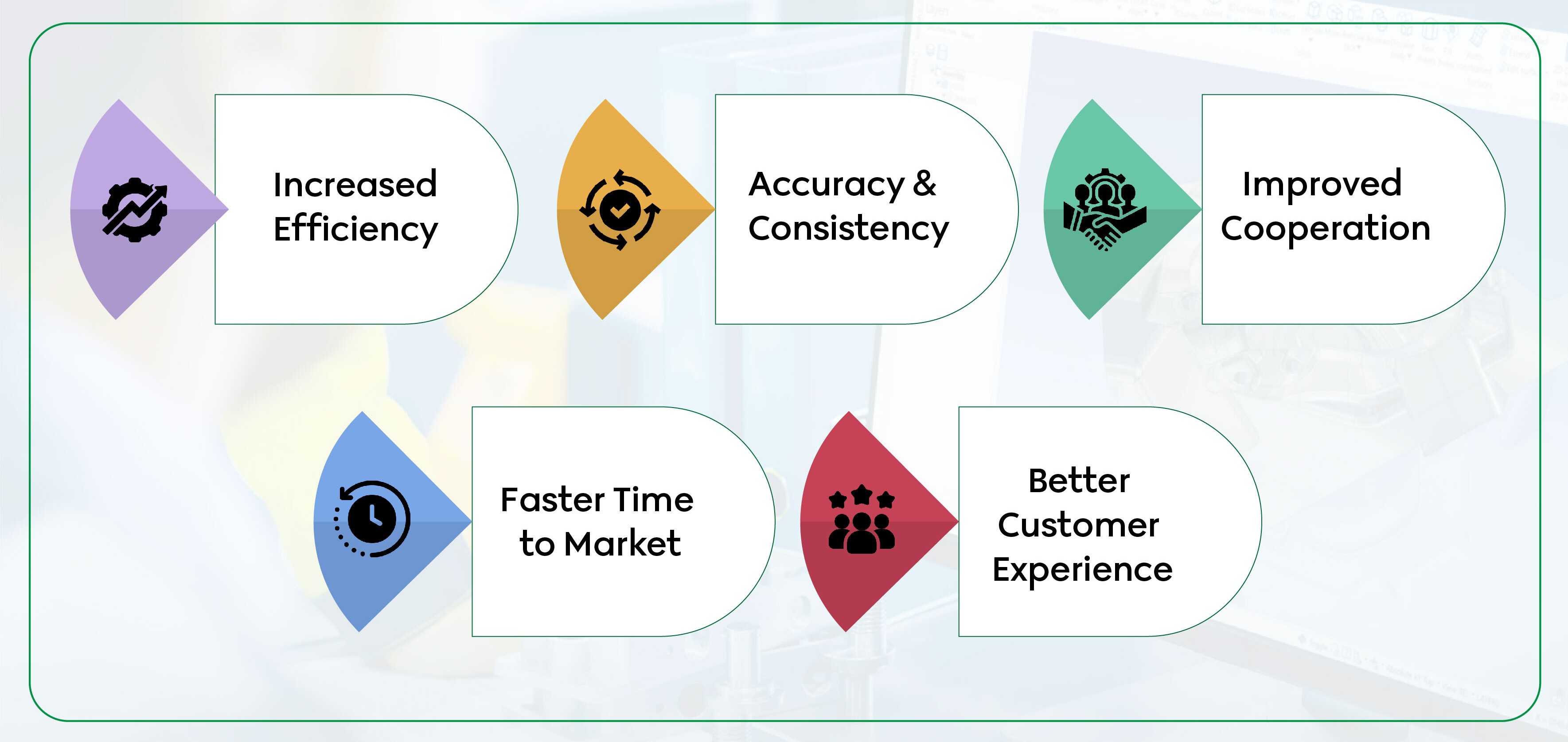
Using CAD customization has several advantages:
Increased Efficiency: Workflows that are automated eliminate repeated processes and save time.
Accuracy and Consistency: Standardized processes enhance quality and lower errors.
Improved Cooperation: Information flow is guaranteed when CAD is integrated with PLM and other enterprise applications.
Faster Time-to-Market: Product development is accelerated by AI-driven insights and automated procedures.
Better Customer Experience: Client satisfaction rises when designs are accurate and deliveries are made more quickly.
By coordinating CAD customization tactics with overall PLM implementation, organizations offering PLM support and maintenance India, PLM training and workshops India, and Windchill PLM deployment services can optimize these advantages.
To find out more about , you can visit our blog post, “Top 7 Benefits of CAD Customization for Product Design in 2025”!
Companies that want to remain competitive in today's engineering and industrial environment must embrace CAD customization; it is no longer a choice. These seven tactics provide a road map for optimizing workflows, boosting productivity, and improving customer experience - from CAD automation and CAD scripting to AI-driven solutions and parameterized CAD customization.
Through the utilization of CAD add-ons and CAD plugins, custom CAD tools, and PLM connectivity, companies may streamline their design processes while preserving flexibility for future expansion. By using these CAD customization strategies, your workflow will be smarter, faster, and more efficient than ever before, whether you're an engineering design team or a PLM for aerospace and defense India.
Let’s connect: www.modelcamtechnologies.com
Email: sales@modelcamtechnologies.com
Mobile no : +91 8237016167
Modelcam Technologies provides a wide variety of Services from ART to PART from Concept Design to Industrial Modeling and Analysis for final Manufacturing.
©Copyright 2026. All rights reserved by Modelcam Technologies Private Limited PUNE.