
What if your business could have an employee who handles routine tasks, organizes information, and prepares reports without constant follow-ups? With CompanyGPT, businesses can explore a practical way to simplify everyday work.
There is much more to running a business than attracting customers and growing revenue. Employees spend hours updating records, creating documents, answering queries, contacting clients, and handling daily administrative tasks. Although necessary, these activities often leave less time for important work.
This is where AI for business can help. Rather than using AI just to answer questions, businesses can use it to support daily operations and improve team productivity.
If you want to learn more about CompanyGPT, check out our blog post, “What is CompanyGPT? A Complete Guide to AI for Modern Businesses!”
An AI employee is an AI-powered assistant that helps with specific business tasks. Based on its role and permissions, it can organize information, create documents, draft emails, review records, and highlight issues that require human attention.
Unlike a basic chatbot, an AI employee can be set up for a specific department, role, and set of responsibilities.
For instance, an AI accounts assistant could check invoices, update records, and prepare payment reminders for approval. A sales assistant could organize customer details and draft proposals using existing company information.
These AI employees for business can assist existing teams while allowing people to focus on tasks that need their experience and judgement.
Business AI becomes valuable when it addresses real workplace challenges. Here are some ways it can support different departments.
Employees often spend significant time preparing reports, managing documents, and updating records. These repetitive activities can affect overall productivity.
AI automation for business can organise data, generate summaries, and manage predefined workflows. This reduces manual effort and gives employees more time for planning, problem-solving, and customer service.
Accounts teams regularly handle invoices, payment reminders, expense records, and financial reports. Performing these tasks manually can increase the risk of delays and mistakes.
An AI accounts assistant can review invoices, compare information, update registers, and draft payment follow-ups. Employees can verify the results and approve important actions.
This form of business process automation helps organise routine financial activities while keeping important decisions under human control.
Sales teams manage customer information, prepare proposals, track enquiries, and contact potential buyers. Delayed follow-ups can sometimes result in missed opportunities.
AI tools for business can prepare customer summaries, draft proposals, and highlight upcoming renewals. When integrated with suitable systems, Customer Relationship Management (CRM) AI can help organise customer records and identify their requirements.
These capabilities support sales automation tools and help improve the overall Customer Experience through more consistent communication.
Business information is often stored across spreadsheets, reports, policies, manuals, and other documents. Finding the right details can take employees considerable time.
An AI company knowledge base helps employees retrieve answers from internal documents. For example, they could ask about a company policy or an earlier project and receive information based on available records.
Using AI for company documents makes relevant information easier to find without searching through multiple folders.
CompanyGPT by Modelcam Technologies helps businesses apply AI to their internal data and everyday workflows.
It offers 161 ready-to-use business functions for departments such as HR, accounts, sales, marketing, purchasing, operations, IT, and customer support. The platform also provides industry-specific packs for sectors such as manufacturing and EPC.
Another key feature is FORGE AI, which lets businesses set up an AI employee with a specific role, daily schedule, and work log. It can draft content, verify information, update records, and highlight exceptions for human review.
For example, an AI purchase assistant could create requests for quotations, compare supplier quotes, and monitor pending purchase orders. The purchasing team can review the information before making decisions.
This enterprise AI approach helps businesses adopt AI-driven solutions that address real workplace needs instead of using AI only to answer general questions.
Businesses manage sensitive information, including customer details, financial records, employee data, and internal documents. Before choosing an AI solution, they should understand how and where their information is stored and processed.
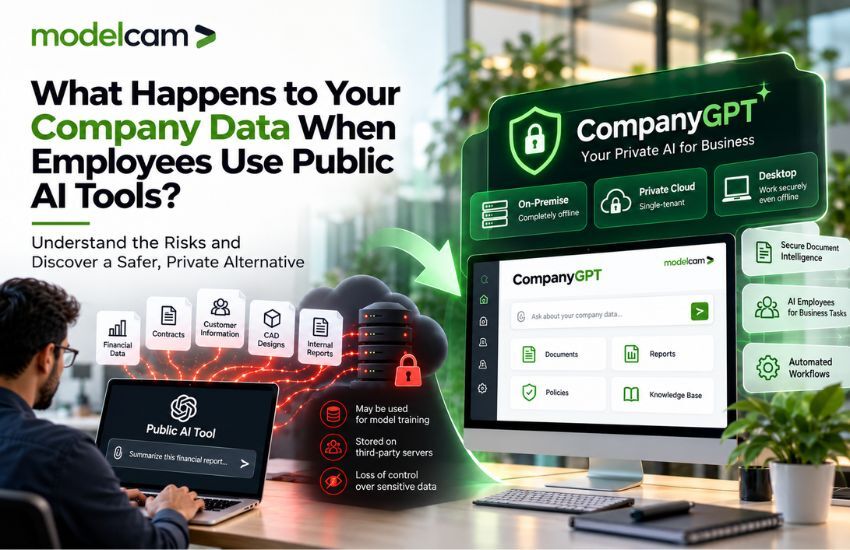
CompanyGPT provides several deployment options, such as an on-premise appliance, a desktop application, and a dedicated private cloud instance. Each business can select the most suitable option according to its operational priorities and security guidelines.
For organisations with strict data protection requirements, private AI for business may be worth considering. CompanyGPT's on-premise option is designed to work offline after activation, while its desktop version also supports offline use after setup.
However, businesses must still implement proper access controls, manage permissions, and ensure human supervision for sensitive tasks.
Adopting AI doesn't require replacing all your existing systems. Start by selecting one repetitive task that takes up a significant amount of employees' time.
Identify the problem, review the current workflow, and define how you'll measure improvement. Next, test an appropriate AI solution and assess its performance before expanding its use.
For instance, a business could begin by automating invoice checks or drafting routine customer follow-up emails. The team can track time saved, fewer errors, and faster response times.
Selecting suitable enterprise AI solutions also requires evaluating data quality, integration requirements, employee training, and security. The objective is to address a real business need rather than adopt technology without a clear purpose.
An AI employee can support your team by managing specific, repetitive tasks. Whether it's preparing reports or organising customer records, the right solution allows employees to concentrate on work that requires human judgement, creativity, and experience.
CompanyGPT enables businesses to explore AI business solutions that use internal knowledge and support workflows across departments. Start with simple tasks, establish clear approval processes, and evaluate the results before expanding.
Want to discover how an AI employee can help your business? Visit Modelcam Technologies to learn more about CompanyGPT and its approach to practical, secure AI for everyday business operations.
Let’s connect: www.modelcamtechnologies.com
Email: sales@modelcamtechnologies.com
Mobile no : +91 8237016167
Modelcam Technologies provides a wide variety of Services from ART to PART from Concept Design to Industrial Modeling and Analysis for final Manufacturing.
©Copyright 2026. All rights reserved by Modelcam Technologies Private Limited PUNE.