Imagine querying your firm's AI about a purchase document, an HR policy, an old quotation, or a customer record and receiving a response based on your own company data.
That is the concept behind CompanyGPT. It is intended to bring intelligence closer to company data, departments, documents, and daily activities, taking AI for business beyond general-purpose queries.
CompanyGPT provides a business-focused strategy that integrates company knowledge, ready-to-run business operations, automation, and flexible deployment choices as organizations search for practical ways to implement enterprise AI.
An AI platform called CompanyGPT is created for companies who wish to handle their own data, documents, and workflows. For departments like HR, Accounts, Sales, Marketing, Purchase, Operations, IT, Projects, and more, it offers ready-to-use business processes.
The CompanyGPT platform includes 161 business functions over 14 departments, with extra industry-specific packs for sectors like EPC and Manufacturing.
The idea is simple: Your Business's Data → Your Company AI → Your Company Workflows
CompanyGPT is intended to integrate business AI into regular operations rather than considering it as a separate software tool.
Writing, research, brainstorming, and other routine jobs can benefit from general AI technologies. However, companies frequently require responses based on data that isn't accessible on the public internet.
Imagine an accounting staff member searching for details from a previous invoice. A salesperson might require information from a previous proposal or client file. A purchase executive might have to review rate contracts or vendor quotes.
The company already has the information. Finding it fast and putting it into practical action is the true problem.
AI for company processes becomes useful in this situation. CompanyGPT links AI capabilities to business operations and company documentation. In order to help users understand where information originated, its responses might also cite the organization's own publications.
Company data, business functions, and business workflows are the three fundamental components of CompanyGPT.
Companies are able to use their own internal data and documents. Reports, policies, client data, purchase documents, company records, and other organizational knowledge may fall under this category.
Instead of depending solely on broad information, this builds an AI company knowledge base that is pertinent to the organization.
This strategy can also enable AI for company documents and AI document intelligence for companies that handle a lot of documentation.
Instead of requiring staff members to construct every AI work from scratch, CompanyGPT offers functionalities based on real-world company tasks.
The platform has features in the following areas:
CompanyGPT provides 161 functions in 14 departments, enabling various teams to apply AI in accordance with the tasks they do.
AI for business workflows aims to do more than just provide answers. Information retrieval, draft preparation, document review, data organization, and repetitive jobs are just a few of the tasks that AI may help with.
Because of this, CompanyGPT is pertinent to business process automation and AI business automation, where AI is integrated into the workflow rather than being used as a test tool.
Depending on the department, CompanyGPT's applications may differ.
AI can be used by an accounts staff to handle financial records and bills. RFQs, vendor quotes, and purchase data can all be used by purchase teams. Prospect briefs, proposals, and follow-up materials can be prepared by sales teams. Documents pertaining to employees and internal policies are accessible to HR personnel.
These illustrations demonstrate how AI in business may progress from testing to real-world, everyday application.
This can result in less time spent looking through documents and more time spent on productive work for companies investigating AI for business operations.
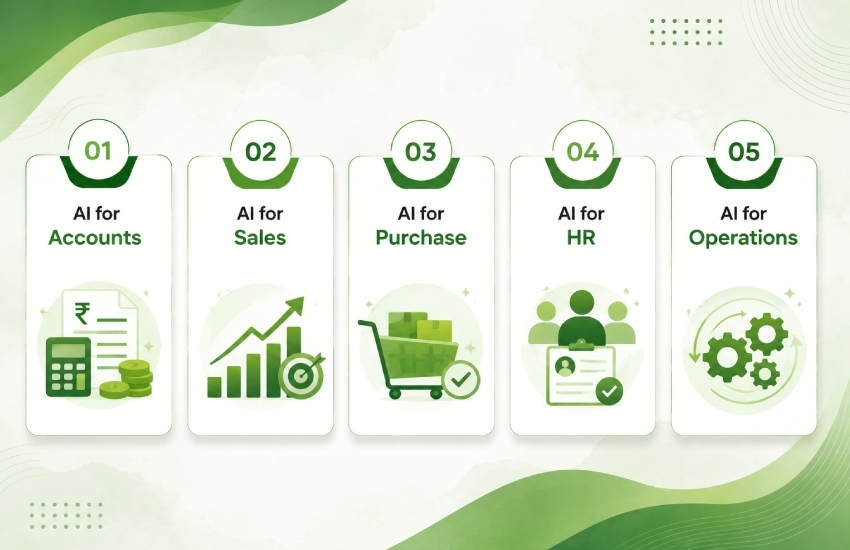
The ability for many departments to use the same AI system for various purposes is one of the main benefits of a business AI platform. Daily tasks in a variety of corporate functions can be supported by CompanyGPT:
The fundamental tenet of CompanyGPT is that AI should comprehend the business it works for.
Rather than only offering broad information, CompanyGPT is built around:
CompanyGPT includes 161 core business functions, plus industry packs that provide deeper workflows for specific domains. This makes it appropriate for companies who wish to incorporate AI into their regular business processes rather than just experimenting with it.
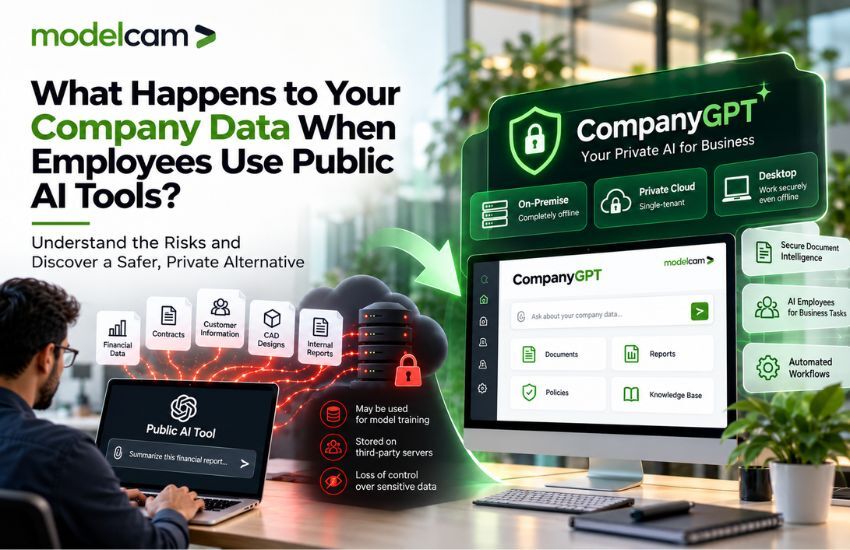
One of the most important factors to take into account when companies use AI is data protection. Confidential financial data, customer records, intellectual property, and personnel information may be found in company documents.
Depending on how an organization wants its AI and data to function, CompanyGPT provides a variety of deployment choices.
An on-premise AI for business appliance called the Sovereign edition is intended for companies that want AI operating within their own premises. It is intended to function offline following activation and offer access via the organization's local network.
The Desktop edition is intended for professionals, consultants, CAs, and smaller teams looking for a more local AI approach. It operates directly on Windows or Mac devices.
The Cloud edition offers a dedicated, single-tenant private instance for companies that would rather deploy in the cloud. This offers companies an additional choice for using private AI for business.
When combined, these choices make CompanyGPT applicable to businesses seeking flexible deployment, secure AI for business, and private enterprise AI.
FORGE AI is one of CompanyGPT's more intriguing ideas.
An AI employee can be given a specific function and daily responsibilities rather than being used simply when an employee asks a question.
For instance, the provided material emphasizes:
An AI employee can create drafts, keep work records, flag items for human approval, and adhere to a predetermined task roster. Crucially, individuals are still in charge of ultimate decisions and approval.
This establishes a useful link between AI support and AI-driven business operations.
Consider the following common repetitive business process:
Information retrieval → Document review → Data preparation → Draft creation → Approval → Follow-up → Record updating
Information handling can take a significant amount of time when staff members repeat this process across departments.
This repetitious workload can be lessened with the aid of AI business automation. CompanyGPT integrates business operations, role-specific tasks, and company data to integrate AI into these processes.
This is the point at which AI automation for business becomes more feasible.
Organizations should question, "Which business processes can AI improve?" rather than, "What can AI do?"
A variety of organizations can benefit from CompanyGPT, such as:
Organizations where internal papers, procedures, and business expertise are crucial to daily decision-making may find it very helpful.
Asking AI questions is only one aspect of the next stage of enterprise AI solutions.
AI that can handle internal data, assist departments, automate tedious tasks, deliver traceable responses, and function in regulated conditions is becoming more and more necessary for businesses.
This change is altering how organizations see AI tools for business. The emphasis is shifting from discrete AI experiments to networked, useful systems that facilitate real-world tasks.
This distinction is crucial for companies who are pursuing digital transformation. When AI is integrated with the organization's knowledge and procedures, its value increases significantly.
A business-focused enterprise AI platform, CompanyGPT combines company data, business functions, AI automation, and adaptable deployment models.
With numerous deployment options, industry-specific packs, and 161 ready-to-run functions spread over 14 departments, it offers an organized method for businesses to introduce AI across various teams. By enabling companies to investigate AI employees assigned to certain jobs and workloads, FORGE AI offers an additional option.
The main premise is straightforward: AI shouldn't just provide answers to queries. It should comprehend your business, utilize your data, and facilitate the operations of your company.
CompanyGPT provides a useful route to integrating AI into daily operations for companies investigating AI for businesses, private AI, enterprise AI software, or business process automation.
The future of business AI goes beyond smarter answers. It is about AI that understands your business environment, knowledge, processes, and the way your organization operates.
Let’s connect: www.modelcamtechnologies.com
Email: sales@modelcamtechnologies.com
Mobile no : +91 8237016167
Modelcam Technologies provides a wide variety of Services from ART to PART from Concept Design to Industrial Modeling and Analysis for final Manufacturing.
©Copyright 2026. All rights reserved by Modelcam Technologies Private Limited PUNE.