The Internet of Things (IoT) is revolutionizing company operations, innovation, and scalability in today's hyperconnected digital economy. IoT technology is enabling data-driven decision-making, automation, and real-time insights in anything from industrial facilities to smart offices. Businesses who successfully use the Internet of Things (IoT) are gaining a major competitive advantage as 2026 approaches.
This thorough guide will assist you in comprehending IoT, its advantages, business applications, and how businesses, particularly those in the industrial sector, may effectively deploy it.
The term "Internet of Things" (IoT) describes a network of physically connected objects that are equipped with sensors, software, and connections to gather and share data. These gadgets, also referred to as "smart devices IoT," include wearables, automobiles, home automation systems, and industrial machines.
IoT technology makes it possible for devices to communicate with one another without the need for human involvement. In order to streamline procedures, boost productivity, and improve client experiences, the generated data is evaluated.
IoT technology is fundamentally made up of four parts:
Devices/Sensors: Gather environmental data in real time
Connectivity: Data transfers across edge or cloud networks
Data processing: Makes use of AI-powered technologies and IoT data analytics.
User Interface: Uses applications or dashboards to show insights
IoT systems are growing more intelligent as a result of AI in business developments, allowing for automated workflows, predictive maintenance, and better decision-making.
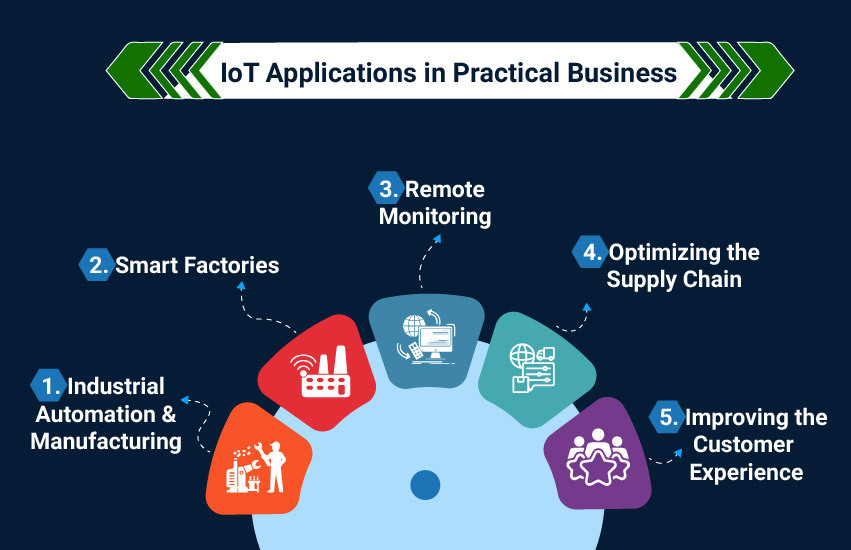
Across many industries, the use of IoT applications in practical situations is growing quickly. Here are a few significant use cases:
Production processes are being revolutionized by IoT in manufacturing. Automated maintenance alerts, defect detection, and performance monitoring are all possible with sensor-equipped machines.
IoT for smart factories makes it possible to monitor manufacturing lines in real time, increasing productivity and decreasing downtime. In manufacturing, connected devices guarantee smooth operations and more efficient use of resources.
IoT-based remote monitoring enables companies to keep an eye on systems, assets, and equipment from any location. This is particularly helpful for operations that are spread out geographically.
IoT solutions facilitate real-time inventory, shipment, and logistics tracking, increasing transparency and cutting down on delays.
Businesses may enhance engagement and personalize services using IoT-powered customer data analysis.
A subset of IoT with an emphasis on industrial applications is called Industrial IoT (IIoT). It improves manufacturing performance by integrating people, equipment, and data.
Among the main advantages of Industrial IoT (IIoT) are:
AI-driven insights for predictive maintenance
Automation results in lower operating expenses
Improved security and adherence
Monitoring manufacturing in real time
Businesses that provide IoT services for manufacturing companies are assisting sectors in making the shift to intelligent, data-driven operations.
To know more about industrial IoT, read our comprehensive blog post, “Industrial IoT in Pune: Driving the Future of Smart Factories”!
Businesses are combining IoT with CAD systems and Digital Twin technology to develop true topical authority and innovation.
IoT gathers data from tangible assets in real time.
A virtual duplicate of such elements is produced by Digital Twin.
Computer-Aided Design, or CAD, improves simulation and design accuracy.
This strong combination makes it possible for:
Simulation and performance evaluation in real time
Quicker cycles of product development
Enhanced precision in engineering
Improved decision-making using data analysis
This connection is being used by companies such as Modelcam Technologies to provide cutting-edge engineering and manufacturing solutions, increasing the efficiency and future-readiness of smart factories.
There are several strategic benefits of implementing IoT solutions:
Processes are streamlined via IoT and automation, which lowers errors and manual intervention.
Actionable insights for improved planning and execution are provided by IoT data analytics.
Operational expenses can be reduced with the use of predictive maintenance and efficient resource use.
Personalized services are made possible by customer data analysis, which raises customer satisfaction and loyalty.
Subscription services and remote diagnostics are two new business models made possible by IoT.
New levels of intelligence are being unlocked by the merging of IoT with AI-driven technologies. Massive IoT datasets are processed by AI to provide automation, optimization, and predictive insights.
Applications consist of:
IoT-powered sales automation tools
AI in customer relationship management (CRM) for tailored interaction
Automating data to make decisions more quickly
Innovation across industries is being fueled by the business synergy between IoT and AI.
IoT presents security dangers in addition to its many advantages. Companies need to handle IoT security challenges like:
Unauthorized access and data breaches
Vulnerabilities in devices
Risks to network security
Lack of standardization
In order to reduce risks, businesses ought to:
Robust encryption protocols
Authentication of secure devices
Frequent upgrades for software
Strong cybersecurity frameworks
For implementation to be effective, choosing the appropriate partner is essential. Businesses can successfully develop, implement, and manage IoT ecosystems with the assistance of a reputable IoT solutions provider in India.
Seek out suppliers who provide:
Complete IoT solutions
Proficiency in implementing IoT in industry
Integration with current systems, such as CRM and ERP
Secure and scalable architecture
Businesses that specialize in smart factory IoT solutions can help industrial companies expedite their digital transformation.
Here are some major trends influencing the future of IoT as it continues to develop:
Increased use of edge computing to speed up processing
Expansion of IoT ecosystems powered by AI
Growth of networked devices in production
Increased attention to cybersecurity
Connectivity in real time through integration with 5G networks
Companies who invest in IoT technology now will be better equipped to handle these developments.
In order for businesses to remain competitive in 2026, the Internet of Things (IoT) is no longer a distant idea. IoT is transforming businesses and facilitating more intelligent operations, from IoT in manufacturing to smart factories and AI-driven analytics.
Businesses may unleash new levels of efficiency, innovation, and growth by utilizing the appropriate IoT solutions, integrating cutting-edge technologies like Digital Twin and CAD, and resolving security issues.
Now is the perfect time to invest in IoT technology and collaborate with professionals that can help you navigate the path to a more intelligent, connected future if you want to embrace digital transformation.
Let’s connect: www.modelcamtechnologies.com
Email: sales@modelcamtechnologies.com
Mobile no : +91 8237016167
Modelcam Technologies provides a wide variety of Services from ART to PART from Concept Design to Industrial Modeling and Analysis for final Manufacturing.
©Copyright 2026. All rights reserved by Modelcam Technologies Private Limited PUNE.