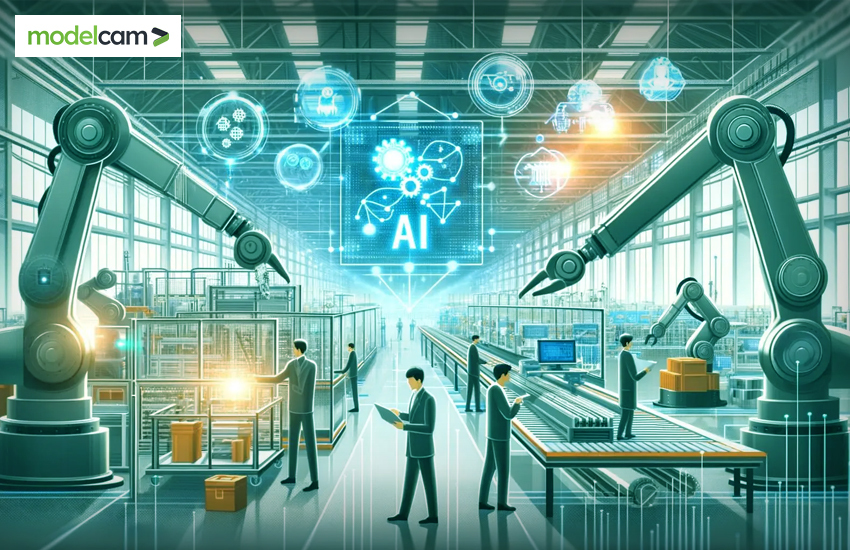
The integration of AI in Manufacturing is now a strategic requirement for businesses looking to boost output, save expenses, and stay competitive in the global market. It is no longer an experimental endeavor. Artificial intelligence in manufacturing is crucial for allowing better workflows, predictive decision-making, and real-time monitoring as production cycles change and customer demands move toward more speed, quality, and personalization. AI-driven systems redefine the digital transformation in the manufacturing ecosystem by converting data into actionable insights from supply chain operations to assembly lines.
AI for Manufacturing Industry gives businesses the flexibility to develop more quickly and adjust to disruptions thanks to connected production lines, real-time machine data, and sophisticated automation tools. Manufacturing companies throughout the world are implementing Smart Manufacturing programs to create self-optimizing, defect-detecting, and predictive maintenance autonomous systems. Scalable AI-driven solutions for contemporary manufacturing are implemented by companies like Modelcam Technologies to support this aim.
The future of industrial operations is being shaped by two powerful forces: data-driven decision-making and intelligent automation. Businesses are adopting linked devices, industrial robotics, and predictive analytics more and more as AI Automation in Manufacturing expands. These technologies enable production teams to minimize unscheduled downtime, maximize asset utilization, and identify problems before they arise.
Machine learning in manufacturing allows models to predict throughput fluctuations, identify inefficiencies, and forecast maintenance requirements by identifying trends in large datasets. Factories are moving toward fully integrated, automated, and intelligent Industry 4.0 environments with IoT-enabled sensors and sophisticated analytics.
Additionally, businesses need to maintain good product quality as customer demands rise. Defect detection, automated inspection, and adaptive quality control are all made possible by AI in business.

Automation is not the only advantage of using AI in manufacturing. AI-driven systems improve labor productivity, operational resilience, and competitiveness when strategically integrated. These are the main benefits:
AI systems are able to predict failures before they happen because of real-time monitoring and data processing. Predictive maintenance maximizes machine life cycles, saves repair costs, and decreases asset downtime.
Inspection accuracy is strengthened by computer vision technology. Artificial Intelligence in Manufacturing ensures consistent product quality and improves customer experience by enabling image-based analysis to identify mistakes.
Manufacturers can monitor demand trends, automate ordering, and cut down on excess inventory with AI-driven forecasting. Autonomous planning reduces operating costs and facilitates effective logistics.
Workers can concentrate on addressing complex problems because smart automation relieves them of repetitive tasks. Long-term employee retention and job satisfaction both increase as a result.
By using data for proactive assistance and service customisation, manufacturers can improve customer engagement. CRMs with AI capabilities strengthen client connections and increase retention.
When taken as a whole, these advantages highlight the importance of AI as a revolutionary force for the manufacturing sector.
An advancement in automated decision-making is represented by agentic systems. Agentic AI in Manufacturing enables robots to operate independently under predetermined guidelines, planning, carrying out, and optimizing procedures without continual supervision.
Applications include:-
Self-correcting production lines
Autonomous scheduling
Intelligent shop floor routing
Decision support systems
Agentic technologies allow factories to develop into completely flexible environments that react intelligently to changing limitations as they continue to adapt to Smart Manufacturing. To uncover these opportunities, Modelcam Technologies places a strong emphasis on scalable AI-driven solutions that are in line with actual production needs.
You can get to know more about Agentic AI in manufacturing by diving into our blog post, “What is Agentic AI? A Complete Guide for Modern Software Companies”!
Data is abundant in modern factories, but insight is lacking. Organizations may transform raw data streams into operational intelligence by utilizing AI in factory operations. IoT sensors monitor vibration, temperature, pressure, and speed to facilitate faster decision-making.
Intelligent analytics show:
Bottlenecks
Changes in cycle time
Patterns of energy usage
Problems with resource allocation
Machine learning in manufacturing allows systems to adjust to shifting conditions and continuously improve results. These techniques capture the spirit of the Future of Manufacturing Technologies, where processes become completely transparent and synchronized.
Despite the many advantages, a number of obstacles prevent widespread adoption:
AI automation and data collection are limited by the lack of sensor integration in traditional equipment.
AI necessitates training and reorganization since it calls for new skills in data science, programming, and analytics.
Strong rules must be put in place by businesses since more interconnected systems raise cybersecurity vulnerabilities.
Automation has a high return on investment, but smaller businesses may find it difficult to make upfront technological investments.
For AI to be successfully synchronized with ERP, MES, and current platforms, professional implementation is necessary.
Despite these obstacles, businesses like Modelcam Technologies are offering scalable roadmaps for digital transformation, guaranteeing long-term acceptance without interfering with operations.
Manufacturers should adhere to organized best practices in order to fully benefit from next-generation automation:
Give High-Impact Use Cases Priority
To guarantee quantifiable ROI, start with applications like quality control and predictive maintenance.
Create a Data Governance Framework: Machine learning and AI-driven solutions require clean, labeled datasets.
Workforce Upskilling and Training: To increase adoption, provide teams with automation and analytics expertise.
Combine Sales Automation and CRM Tools: Demand forecasting and sales planning are improved with AI-enabled CRM.
Put Scalable Roadmaps into Practice: Alignment with upcoming technological changes is ensured via long-term adaptability.
Measure and Improve: Benchmarking and constant gains are guaranteed when performance measurements are used.
Organizations can maximize long-term benefits and ease the transition to advanced automation by adhering to these recommendations.
Automated, intelligent, and networked production environments are at the heart of the future of manufacturing technologies. Factory processes will continue to be transformed by AI, robotics, edge computing, and digital twins. Autonomous systems will operate alongside human workers as Industry 4.0 grows, increasing creativity, adaptability, and sustainability.
Businesses who make today's investments in AI automation in manufacturing will reap long-term benefits in terms of resilience, speed, and worldwide competitiveness. The transition to smart manufacturing is made easier and more strategically aligned with the help of knowledgeable partners like Modelcam Technologies.
An important turning point in the development of industry is the move toward artificial intelligence in manufacturing. AI-driven solutions, such as autonomous planning and predictive maintenance, boost output, enhance customer satisfaction, and build robust supply chains. Even though there are obstacles to adoption, professional collaborations and best practices will guarantee a smooth transition. In the end, AI in manufacturing represents the future of intelligent, flexible, and sustainable production - it is not merely a fad.
Let’s connect: www.modelcamtechnologies.com
Email: sales@modelcamtechnologies.com
Mobile no : +91 8237016167
Modelcam Technologies provides a wide variety of Services from ART to PART from Concept Design to Industrial Modeling and Analysis for final Manufacturing.
©Copyright 2026. All rights reserved by Modelcam Technologies Private Limited PUNE.