

Business success is significantly impacted by innovation speed and design accuracy in today's cutthroat manufacturing and engineering environment. To fulfill market demands, organizations can no longer rely on disjointed systems or manual writing. This is where the development of effective, scalable, and intelligent products is made possible using engineering design software. Modern product development software guarantees accuracy, teamwork, and a quicker time to market from concept to production.
In order to increase design quality, optimize workflows, and match engineering outputs with business objectives, engineering teams are depending more and more on sophisticated engineering software solutions.
Let's examine why engineering design software is essential to the creation of modern products.
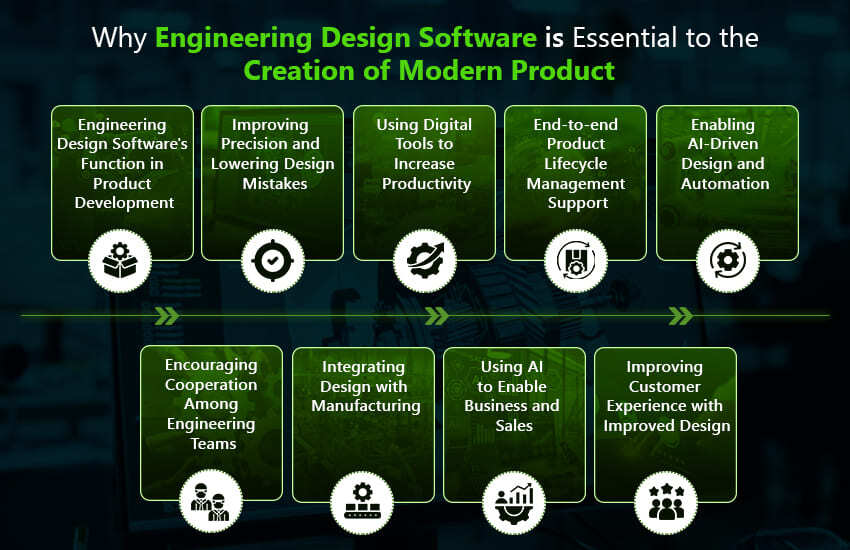
Fundamentally, software design for product development allows engineers to use digital tools to convert concepts into things that can be manufactured. Within a single ecosystem, these systems facilitate modeling, drafting, simulation, validation, and documentation.
Repetitive activities are eliminated, errors are decreased, and teams are able to concentrate on creativity rather than rework thanks to modern engineering design tools. Businesses can improve control over design iterations and guarantee consistency throughout the Engineering Design Process by utilizing integrated Product Design and Development Software.
In engineering, accuracy cannot be compromised. Product failures or expensive production delays can be caused by even small design errors. Engineering design accuracy is greatly increased by the parametric modeling, restrictions, and validation capabilities offered by Advanced Engineering Design Solutions.
Before manufacturing starts, engineers may test fitments, see assemblies, and identify interferences with Engineering Software for Product Development. This lowers the cost of physical prototyping and facilitates a seamless Design to Manufacturing workflow, guaranteeing that designs are ready for production from the outset.
Adoption of Mechanical Engineering Design Software is largely motivated by productivity. Reusable design elements, automated updates, and quicker drawing are all made possible by digital technologies. Teams thus see quantifiable increases in Engineering Design Productivity.
Organizations can standardize design procedures and eliminate tedious drawing work by utilizing CAD software for product development. Engineering teams may finish projects more quickly without sacrificing quality with the aid of these digital product development tools.
Design is not the end of successful product development. Data transfer between departments - from engineering and manufacturing to sales and service - is ensured by integration with product lifecycle management software.
Teams may see changes, lifecycle status, and compliance needs when Engineering Design Software is integrated with PLM systems. The Engineering Design Process is strengthened by this alignment, which also guarantees improved stakeholder participation.
AI-powered automation is the next development in engineering software solutions. Engineering Design Automation is being used in modern platforms to optimize layouts, recommend design enhancements, and minimize manual labor.
Rule-based modeling, predictive analysis, and design optimization are all supported by AI-driven solutions. Organizations may increase productivity and foster creativity by integrating AI and AI-driven solutions into design workflows. This strategy is in line with more trends in General AI in Business, where intelligent systems improve decision-making through data automation and analysis.
Global engineering teams need to work together seamlessly. Multiple stakeholders can collaborate on shared models, monitor changes, and uphold version control with the help of collaborative engineering design software.
By guaranteeing a quicker response to market demands, this cooperative strategy increases communication, lowers rework, and enhances the entire customer experience. Teams that work well together produce better products with shorter delivery times.
Successful product launches depend on a robust Design to Manufacturing Workflow. The gap between conceptual design and shop-floor execution is filled by engineering design software.
Engineering Design Tools guarantee that designs go seamlessly into production with their manufacturing-ready outputs, BOM creation, and CNC compatibility. This integration guarantees that engineering purpose is maintained throughout manufacturing and minimizes misunderstandings.
Technical teams are no longer the only ones with access to engineering design data. It facilitates corporate efforts including demand planning, forecasting, and sales enablement when integrated with business systems.
Organizations may match product development with customer needs by connecting design platforms with Sales Automation Tools and Customer Relationship Management (CRM) AI. Engineering teams may increase win rates and customer satisfaction by using customer data research to create products that better meet market expectations.
In the end, the end user is directly impacted by design quality. Good quality product design and development software guarantees that goods are dependable, useful, and meet consumer expectations.
Organizations may maintain consistency across product versions, implement enhancements, and react swiftly to feedback by using Engineering Software for Product Development. Long-term brand loyalty and a better customer experience are the outcomes of this.
Modern Engineering Design Solutions are exemplified by platforms such as BricsCAD, which is backed by Modelcam Technologies. They are the best mechanical engineering design software options for companies looking for efficiency without complexity because they combine strong CAD skills with flexibility, automation, and compatibility.
Businesses may future-proof their product development plans and maintain their competitiveness in rapidly changing markets by implementing strong engineering design software.
Engineering design software is now a necessity in a time characterized by intelligence, speed, and accuracy. These tools fuel every step of contemporary product development, from increasing engineering design accuracy and productivity to facilitating AI-driven creativity and smooth collaboration.
Businesses who invest in cutting-edge product development software and engineering software solutions have a clear advantage. Businesses may lower costs, increase innovation, and produce better goods more quickly and intelligently by adopting digital, AI-enabled, collaborative design platforms.
Let’s connect: www.modelcamtechnologies.com
Email: sales@modelcamtechnologies.com
Mobile no : +91 8237016167
Modelcam Technologies provides a wide variety of Services from ART to PART from Concept Design to Industrial Modeling and Analysis for final Manufacturing.
©Copyright 2026. All rights reserved by Modelcam Technologies Private Limited PUNE.