
Manufacturing sectors are rapidly going digital. Companies have been compelled to reconsider how they handle product data and development processes due to growing product complexity, shorter development cycles, and the need for smarter goods. PLM is essential in this situation.
Product lifecycle management in manufacturing allows businesses to oversee a product's whole lifecycle, from conception and design to manufacture, servicing, and retirement. However, skill, planning, and technological integration are necessary for these systems to be implemented successfully. To optimize the value of their digital engineering infrastructure, many businesses are engaging in PLM consulting.
Manufacturing firms in 2026 will be better positioned to enhance cooperation, expedite procedures, and spur innovation if they use PLM solutions for manufacturing with the assistance of knowledgeable consultants.
PLM is the term for the thorough product lifecycle management software employing cutting-edge digital tools and systems. Through a single platform, engineering, design, manufacturing, and supply chain teams are connected by modern product lifecycle management software.
Manufacturing PLM software enables companies to handle engineering modifications, product data, regulatory needs, and international team cooperation. It guarantees that the most up-to-date and precise information is used by all those involved in the product development process.
Businesses may lower errors, get rid of data silos, and enhance product quality through effective PLM system implementation. However, adequate planning and setup are necessary for the deployment of such systems, which is where PLM consulting services come into play.
Many firms see the value of PLM, but they have trouble integrating and using it. When firms try to implement sophisticated enterprise systems without professional assistance, it becomes evident why companies need PLM consulting.
Expert product lifecycle management consulting assists companies in coordinating PLM systems with production needs, engineering workflows, and business objectives. Consultants analyze existing processes, identify inefficiencies, and recommend strategies for successful adoption.
Manufacturers invest in PLM consulting for the following main reasons:
Streamlining engineering and design processes
Making sure smooth PLM system implementation
PLM integration with customer relationship management (CRM) AI systems and enterprise software like ERP
Minimizing inefficiencies in operations
Increasing the rate of product development
In the end, these enhancements result in increased market competitiveness and productivity.
To find out why PLM consulting is important, read our comprehensive blog post, “Why PLM Consulting & Services are Critical for Modern Manufacturing”!
Particularly with the incorporation of cutting-edge technologies like AI, IoT, and smart manufacturing, product creation is getting more complicated. PLM consulting for product development aids companies in successfully handling this complexity.
Consultants assist businesses in putting into practice product lifecycle management solutions that consolidate product data and improve engineering team collaboration. The design, manufacturing, and quality divisions are better able to communicate as a result.
Expert PLM consulting for manufacturing companies enables businesses to:
Effectively handle design adjustments
Monitor engineering modifications in real time
Boost cycles of product innovation
Assure adherence to regulations
For firms looking to retain operational efficiency while launching high-quality products more quickly, these capabilities are essential.
Installing software is only one aspect of deploying a PLM platform. Customization, system integration, training, and continuous optimization are all necessary. PLM implementation services are crucial in this situation.
Consultants assist businesses in integrating product lifecycle management software with current systems, including supply chain tools, ERP systems, and CAD platforms, by providing structured PLM implementation services.
Implementing a PLM system successfully usually entails:
Analysis of business processes
Configuring and customizing the system
Combining engineering and manufacturing tools
Validation and data migration
Strategies for user uptake and training
Manufacturers can guarantee that their PLM platform provides maximum value throughout the company with the right PLM services.
AI-driven technologies are becoming more and more important in modern manufacturing. AI integration with PLM systems gives businesses strong decision-making and optimization capabilities.
AI-driven solutions, for instance, are able to evaluate vast amounts of product data and offer insights that enhance manufacturing performance and engineering design. Organizations may lower development costs, improve product reliability, and identify design flaws early with sophisticated data analysis.
PLM systems with AI capabilities also facilitate data automation, allowing teams to effectively handle complicated product data. Manufacturers can transition to intelligent and networked product development environments with the use of these capabilities.
Although PLM is mostly related to engineering and manufacturing, it is also crucial for enhancing customer experience. Manufacturers can better understand consumer demands and product performance by integrating product data with business intelligence tools.
Businesses can learn how products function in real-world settings and spot areas for development by analyzing client data. Visibility into client interactions is further improved by integrating PLM with technologies for customer relationship management (CRM) AI.
Businesses may provide better products, quicker customer service, and more individualized solutions because of this integration, which eventually raises consumer satisfaction and brand loyalty.
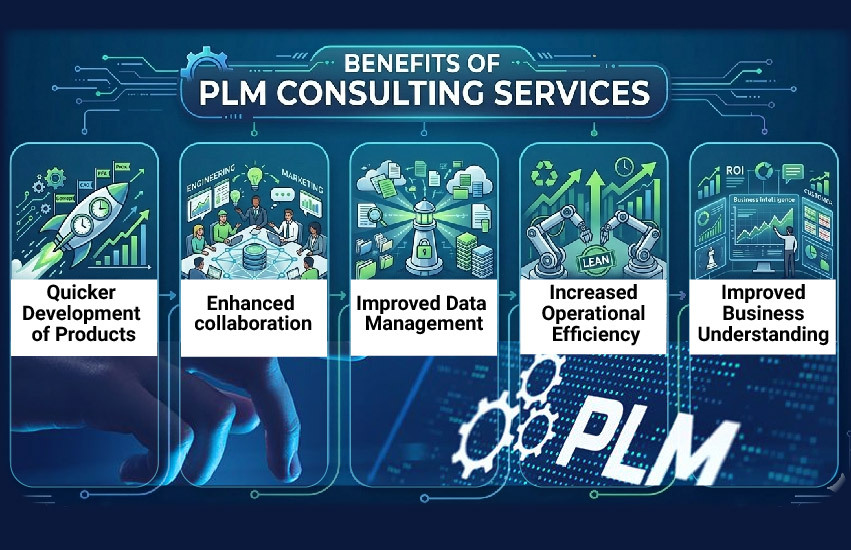
Manufacturers benefit strategically from investing in PLM consulting services for engineering companies. Expert consultants assist companies speed their digital transformation by bringing best practices, technological know-how, and industry experience.
Benefits of PLM consulting services include:
Expert PLM consulting solutions help businesses shorten development cycles and accelerate product launches by streamlining engineering workflows and doing away with manual processes.
Teams from different departments and places may collaborate and communicate easily thanks to modern product lifecycle management solutions.
Manufacturers may manage information more effectively and prevent expensive mistakes using automated procedures and consolidated product data.
Businesses can increase efficiency, decrease redundancy, and streamline operations with well-thought-out PLM solutions for manufacturing.
Manufacturers are able to track product performance and make well-informed strategic decisions thanks to advanced data analysis capabilities.
Find out more benefits of PLM consulting through our blog post, “Top Benefits of PLM Consulting & Services for Your Business”!
Engineering systems and business applications must be seamlessly integrated in today's production environment. This covers analytics tools, CRM systems, and ERP platforms.
Advanced features like product configuration management, sales automation tools, and service lifecycle management can be supported by manufacturing PLM software when correctly linked.
For instance, sales staff can obtain precise product information straight from the PLM system, which enhances client communication and lowers order processing errors. Revenue creation and operational efficiency are both improved by such integration.
The role of PLM will continue to grow as production becomes more digital. PLM skills will be further improved by emerging technologies like advanced analytics, digital twins, and AI in business.
Businesses that use product lifecycle management consulting now will be better equipped to handle smart manufacturing developments in the future. Manufacturers can create robust and scalable product development ecosystems by integrating PLM with AI-driven solutions and intelligent automation.
By increasing innovation, efficiency, and customer happiness, businesses who invest in PLM consulting for manufacturing companies will have a competitive advantage in the upcoming years.
Manufacturing firms will have to handle growing product complexity in 2026 while preserving cost effectiveness, quality, and speed. By helping businesses to efficiently manage product information and development processes, PLM offers the framework for accomplishing these objectives.
However, knowledge and careful planning are necessary for adoption to be successful. Manufacturers may adopt cutting-edge PLM systems, improve operations, and spur innovation throughout their companies with expert PLM consulting.
Businesses may revolutionize their product development processes and maintain a competitive edge in the manufacturing industry by applying intelligent data automation, integrating AI-driven solutions, and adopting PLM services.
Let’s connect: www.modelcamtechnologies.com
Email: sales@modelcamtechnologies.com
Mobile no : +91 8237016167
Modelcam Technologies provides a wide variety of Services from ART to PART from Concept Design to Industrial Modeling and Analysis for final Manufacturing.
©Copyright 2026. All rights reserved by Modelcam Technologies Private Limited PUNE.