For many years, manufacturing ERP software has played a crucial role in integrating production, inventory, finance, purchasing, sales, and other corporate operations into a single system. But today’s manufacturing environment is focused on a different question: “What needs to happen next?” rather than just "What happened?"
At this point, the shortcomings of conventional ERP systems start to become apparent.
These days, a factory continuously produces information. Customers request updates, suppliers postpone shipments, orders alter, material costs fluctuate, machines halt, and production schedules must be modified. Lack of data is not the issue. What occurs once the data is generated is the issue.
The main functions of traditional ERP software for manufacturing are to record transactions and provide reports. It can provide management with information on the quantity of materials acquired, the number of units produced, and the status of an order.
However, someone still needs to access the system, examine the data, pinpoint an issue, and make a decision.
Information and action become separated as a result.
Consider the gradual rise in a supplier's rejection rate. Every quality record might be accurately stored by a conventional manufacturing ERP system. However, by reviewing information, the purchasing or quality team might need to identify the pattern on their own.
Software that can recognize these patterns and alert the appropriate person to them is necessary for modern manufacturing.
ERP for the manufacturing industry is shifting toward more intelligent, action-oriented systems in part because of this.
Sales, production, purchase, stores, quality, finance, maintenance, and customer support may all have their own teams in a manufacturing company.
However, the plant itself does not operate in discrete units.
Production may be impacted by a delayed purchase. Dispatch may be impacted by a production delay. The customer may be impacted by a dispatch delay. Inventory, price, production scheduling, and customer relations can all be impacted by a quality problem.
These departments can be connected at the data level using conventional manufacturing management software. Connecting them at the decision and workflow levels is the next stage.
This is where modern ERP systems are beginning to shift.
ERP solutions for manufacturers must assist teams in comprehending the meaning of the data and any necessary actions, rather than merely transferring information from one department to another.
Manufacturers already own vast quantities of data.
Customer data is available to sales teams. Machine and production data are available to production teams. Purchase teams have quotes from suppliers. Inspection records are kept by quality teams. Costing and payment data are available to finance teams.
However, having data does not equate to having insightful knowledge.
This is where AI in business, data automation, and data analysis become crucial.
Instead of handling each transaction as a separate record, an AI-driven system can analyze data from many functions. For instance, order history, production capacity, delivery performance, and inventory data can all be linked to customer data analysis.
Making a new dashboard is not the only goal.
Reducing the amount of manual verification needed before a decision is taken is the goal.
The addition of a chatbot to an ERP is not the largest difference.
It means that regular business processes can incorporate AI-driven solutions.
For instance, an AI-enabled system may organize the pertinent data and emphasize variations in pricing, delivery terms, and other specified factors rather than requiring an individual to analyze several supplier offers.
Similar to how Customer Relationship Management (CRM) AI may link customer interactions with business data, Sales Automation Tools can assist sales teams in managing inquiries and follow-ups.
Because of this, ERP automation is more than just a means of doing away with repetitive data entry. It can also help turn business information into the next step in a workflow. This is where AI-powered ERP software is gradually changing the role of ERP systems.
The difference is quite simple to understand.
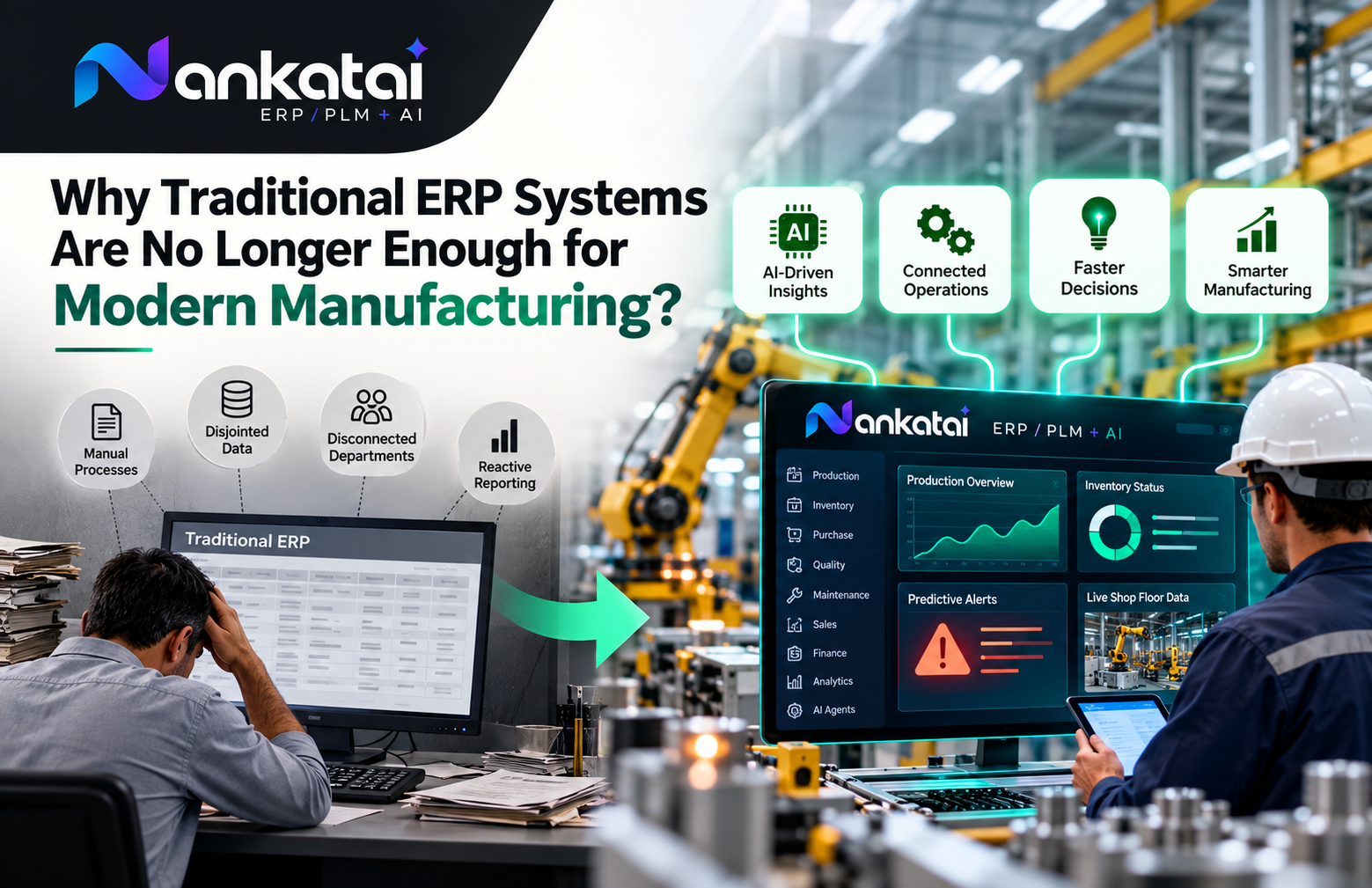
A traditional ERP mainly works as a system of record. It captures transactions, stores business information, and shows what has already happened.
Modern enterprise platforms are moving towards becoming systems of action. Instead of only storing information, they can analyze business data, identify situations that need attention, and help teams take the next step.
Nankatai follows this approach through its Enterprise Intelligence Platform (EIP), which extends beyond traditional ERP by using AI agents across different business functions. The platform includes 66 AI agents covering areas such as production, quality, maintenance, purchasing, inventory, sales, finance, and customer service.
This approach is especially relevant to manufacturing because decisions in one department rarely stay within that department.
For example, a change in production can affect inventory levels. Inventory shortages may require changes in purchasing. Purchasing decisions can influence product costs, which can then affect sales and customer commitments. Similarly, a change in customer demand can require production schedules to be adjusted.
When these functions are connected, businesses can move beyond simply collecting information and start using it to support faster, more coordinated actions. That is where intelligent automation can create greater value for modern manufacturers.
Absolutely.
Traditional ERP systems have played an important role in helping businesses bring transactions, processes, and records together in one place. They have made it easier for companies to organize information and maintain accurate business records.
But the way manufacturers operate today has changed.
The challenge is no longer just about collecting and storing information. Businesses also need to respond quickly to what that information is telling them.
So, when evaluating Manufacturing ERP software or upgrading existing ERP software for manufacturing, companies should look beyond the usual list of modules and features. A more useful question is:
Can the system help us move from information to action?
For example:
These considerations can be more meaningful than simply asking how many features or modules an ERP system offers.
Modern manufacturers do not necessarily need another layer of complex software.
What they need are systems that can understand how different parts of their business work together.
For instance, Manufacturing business software can help connect production and sales information, while ERP automation can reduce repetitive tasks and manual follow-ups. AI-powered ERP software can go a step further by helping teams spot unusual patterns or potential issues before they turn into bigger problems.
The real change is in how businesses think about information.
The real question is no longer what information the system provides, but what businesses can do with it.
That shift is far more significant than simply adding another report, feature, or dashboard to an ERP system.
Manufacturing operations are becoming increasingly connected. Machines are producing more data, customers want quicker responses, and supply chains can change rapidly. At the same time, employees cannot spend their entire day reviewing reports, checking transactions, and following up on every small issue.
A manufacturing ERP system will still need to record and organize business information. But ERP for the manufacturing industry must increasingly do more than that. It needs to bring together data, workflows, teams, and intelligent automation so that information can support timely action.
The evolution of ERP is therefore not simply about replacing the system that stores business information. It is about making that information more useful and actionable.
And that leads to a more important question for manufacturers:
Is your ERP only showing you what has already happened, or is it helping your teams understand what needs to happen next?
Let’s connect: www.modelcamtechnologies.com
Email: sales@modelcamtechnologies.com
Mobile no : +91 8237016167
Modelcam Technologies provides a wide variety of Services from ART to PART from Concept Design to Industrial Modeling and Analysis for final Manufacturing.
©Copyright 2026. All rights reserved by Modelcam Technologies Private Limited PUNE.