The rapid breakthroughs in AI in manufacturing are driving a huge revolution in the manufacturing sector. Businesses are using sophisticated technology to improve overall efficiency, cut expenses, and streamline processes as 2026 progresses. AI-driven manufacturing is changing the way factories run, from autonomous systems to predictive analytics.
Intelligent decision-making, automation, and data fuel today's smart factories. For businesses hoping to remain competitive in a rapidly changing industrial sector, this move toward AI in smart factories is more than simply a fad.
This blog examines seven effective ways AI is being used in smart factories to increase efficiency.
Predictive maintenance with AI is one of the most significant industrial AI applications. Conventional maintenance methods frequently result in needless downtime because they rely on planned inspections or reactive repairs.
AI-powered predictive maintenance uses sensors and real-time data processing to continuously monitor machinery. AI systems anticipate possible problems before they arise, enabling prompt action.
Advantages consist of:
Decreased equipment malfunctions
Reduced upkeep expenses
Enhanced uptime of operations
This is an obvious illustration of how AI increases productivity in manufacturing by cutting downtime.
In order to maximize resources and meet deadlines, effective production planning is essential. AI in production planning forecasts demand, distributes resources, and dynamically schedules operations using sophisticated analytics.
AI-driven manufacturing allows companies to:
Real-time scheduling adjustments for production
Optimize stock levels
Cut back on overproduction and waste
This is among the most real-world instances of how AI improves manufacturing productivity.
Manufacturing automation using AI is the foundation of contemporary smart factories. Robots and systems driven by AI are capable of doing repetitive tasks with unparalleled accuracy and reliability.
The following are some major benefits of AI for industrial automation:
Quicker cycles of production
Decreased human error
Higher safety requirements
Manufacturers may grow operations while maintaining high-quality output by putting AI-driven solutions into practice.
Customer happiness and brand reputation depend on maintaining product quality. AI for quality control employs machine learning and computer vision to quickly identify flaws.
In contrast to manual inspection, AI systems are able to:
Determine minute flaws
Make sure that product standards are consistent
Cut down on product recalls
This is one of the main AI in manufacturing benefits since it improves customer experience by providing dependable and consistent products.
Data plays a major role in modern manufacturing. AI uses sophisticated data automation and analytics to turn unprocessed data into insights that can be put to use.
AI-powered data analysis allows manufacturers to:
Track real-time production performance
Find inefficiencies right away
Make judgments based on data
Companies may remain flexible and responsive to market needs by incorporating AI in business into their operations.
AI is also transforming manufacturing supply chain management. AI is used by smart industries to manage logistics, estimate demand, and streamline procurement procedures.
AI-driven manufacturing allows companies to:
Lower the cost of inventory
Boost delivery schedules
Improve coordination with suppliers
This is a compelling illustration of how AI may be used in manufacturing firms to improve the efficiency and predictability of end-to-end processes.
AI is essential for enhancing customer experience even if manufacturing is frequently thought of as backend activities.
Manufacturers can do the following by combining AI with customer data analysis and customer relationship management (CRM) AI:
Estimate the demands of the client
Tailor your product offerings
Boost post-purchase assistance
Additionally, improved alignment between production and market demand is made possible by combining manufacturing data with sales automation tools, which raises customer satisfaction.
Learn more about how smart factories can enhance productivity using AI, check out our blog post, “AI in Manufacturing: How Smart Factories Are Boosting Productivity & Efficiency”!
Businesses looking for how to implement AI in factory operations must take a strategic approach to the process:
Evaluate existing procedures and find areas for automation.
Invest in needs-specific smart factory solutions.
AI integration with current CRM and ERP systems
Pay attention to scalable AI-driven solutions
Teach groups to collaborate with AI technologies.
In order to facilitate the shift to AI-powered operations, companies such as Modelcam Technologies are assisting manufacturers in implementing sophisticated engineering and digital transformation solutions.
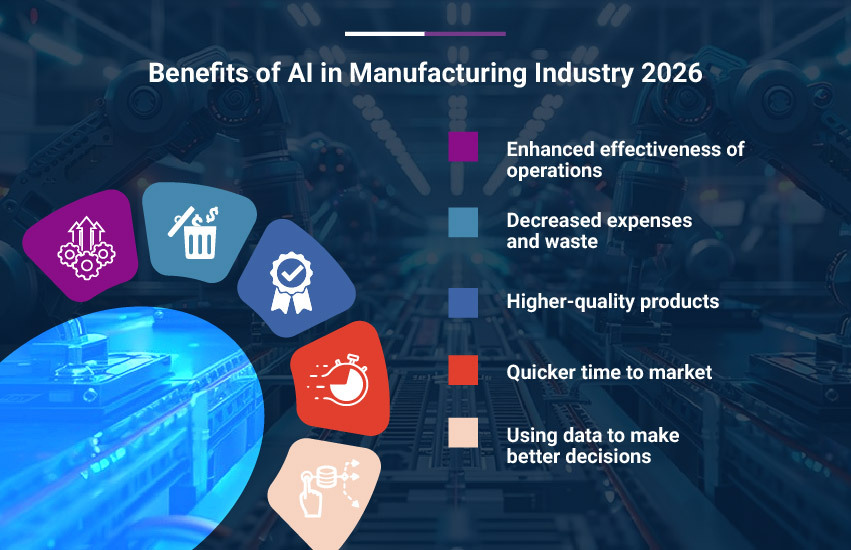
The benefits of AI in manufacturing industry 2026 go beyond increased output.
Companies are experiencing:
Enhanced effectiveness of operations
Decreased expenses and waste
Higher-quality products
Quicker time to market
Using data to make better decisions
These benefits demonstrate why AI in manufacturing is emerging as a key component of contemporary industrial strategy.
Traditional factories are becoming intelligent, networked ecosystems thanks to the development of AI in manufacturing. AI integration is opening up new possibilities for productivity and efficiency, from smart automation to predictive maintenance.
Manufacturers who adopt these advances will have a major competitive advantage as AI in smart factories continues to develop. AI is propelling industrial success in the future, whether it be through increasing customer satisfaction, decreasing downtime, or boosting quality.
The moment has come for companies looking to grow and innovate to make investments in AI-driven manufacturing and fully utilize smart factory technologies.
Let’s connect: www.modelcamtechnologies.com
Email: sales@modelcamtechnologies.com
Mobile no : +91 8237016167
Modelcam Technologies provides a wide variety of Services from ART to PART from Concept Design to Industrial Modeling and Analysis for final Manufacturing.
©Copyright 2026. All rights reserved by Modelcam Technologies Private Limited PUNE.