AI in manufacturing is now taking place on factory floors; it is no longer just a far-off vision. AI in manufacturing is enabling firms to operate more intelligently, quickly, and effectively than ever before, from decreasing machine downtime to enhancing product quality.
Precision, speed, and ongoing improvement have long been key components of manufacturing. Today's manufacturers, however, are confronted with a growing number of obstacles, including increased manufacturing costs, a lack of qualified personnel, more stringent quality standards, and rising customer expectations. Businesses are using artificial intelligence (AI) to revolutionize product design, production, and delivery in order to overcome these obstacles.
As per an estimation, by 2030, AI could boost the world economy by up to $15.7 trillion, with manufacturing being one of the main beneficiaries. Businesses are focusing on practical applications that produce measurable commercial value rather than experimenting with technology for its own sake, despite the rapid growth of AI use.
This guide will explain how Artificial Intelligence in manufacturing is transforming the sector, as well as its main advantages, common applications, and practical examples.
The application of AI technologies including machine learning, computer vision, natural language processing, and predictive analytics to enhance industrial processes is referred to as artificial intelligence in manufacturing.
Artificial intelligence (AI) systems learn from data, recognize patterns, and continuously enhance their performance, in contrast to traditional software that adheres to predetermined rules. Manufacturers are able to streamline manufacturing processes, automate monotonous jobs, and make better judgments as a result.
AI is now a key component of Smart Manufacturing, which combines cloud platforms, IoT devices, sensors, and connected machines to create intelligent factories. Additionally, it is emerging as a major pillar in AI in Industry 4.0, assisting companies in creating production environments that are more data-driven and nimble.
Every day, manufacturing produces massive volumes of production data. Making sense of the data has always been more difficult than gathering it.
Through quicker data analysis, AI turns this data into insightful knowledge that helps manufacturers find inefficiencies, anticipate breakdowns, and boost output.
AI frequently tackles the following business issues:
AI helps firms anticipate and avoid issues rather than responding to them after they arise.
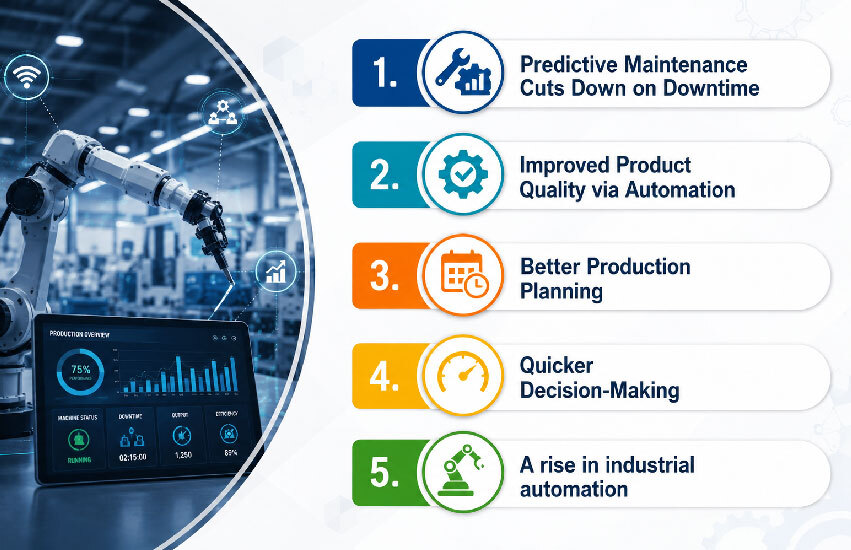
Predictive maintenance is one of the most often used AI applications.
AI uses sensor data to continuously monitor machine performance and spot early warning indicators before equipment malfunctions. Alerts are sent to maintenance staff, enabling the scheduling of repairs prior to expensive malfunctions.
For instance, AI reduces needless maintenance expenses by recommending replacements only when essential, as opposed to replacing machine parts every six months as part of standard maintenance.
One of the top concerns in manufacturing is maintaining constant quality.
AI can inspect thousands of products every hour using computer vision and Quality Control Automation, more consistently than manual inspections in detecting dents, scratches, incorrect dimensions, or assembly flaws.
This benefits manufacturers:
In order to suggest more effective production plans, AI examines production schedules, inventory levels, labor availability, and equipment capacity.
AI helps businesses shorten delivery times and eliminate production bottlenecks by reacting to shifting business conditions in real time rather than merely depending on past trends.
Production scheduling and capacity planning are currently features of many contemporary AI manufacturing solutions.
Manufacturers frequently have to make snap operational decisions.
Plant managers can monitor production performance, spot bottlenecks, and take corrective action more quickly thanks to AI-powered dashboards that simplify complex data analysis by providing real-time insights.
This improves AI in business decision-making across divisions and increases operational efficiency.
AI is advancing industrial automation.
AI-powered robots can detect items, adjust to changing situations, and carry out difficult assembly jobs with little assistance from humans.
In contrast to conventional automation systems, AI-driven robots use operational data to continuously enhance their performance.
Apart from the above given 5 benefits, there are many more benefits of AI in manufacturing! You can explore all those in our blog, "AI in Manufacturing: 10 Key Benefits Every Manufacturer Should Know in 2026"!
Every year, the number of AI applications in manufacturing keeps increasing. Among the most beneficial applications are:
AI has already been successfully implemented by numerous multinational manufacturers.
These illustrations demonstrate that AI is no longer exclusive to tech firms. AI is being used by manufacturers in a variety of industries to address actual operational problems.
Business objectives, current systems, and production needs all play a role in selecting the best AI software for the manufacturing industry.
Modern AI systems typically facilitate:
Additionally, a lot of businesses spend money on AI Solutions for Manufacturing that work with their current ERP, MES, PLM, CAD, and IoT systems.
Manufacturers can deploy customized AI solutions that smoothly integrate with their current digital engineering ecosystem with the assistance of technology partners such as Modelcam Technologies.
Installing software is only one aspect of a successful AI implementation in manufacturing. It calls for a methodical approach.
Among the finest practices are:
Businesses that use a phased rollout strategy frequently reduce operational risks and increase ROI.
AI is changing how factories operate, but its effects go beyond manufacturing.
AI-driven solutions are used by modern companies for operations, marketing, customer service, and sales.
Examples consist of:
This illustrates how General AI in Business is adding value in all divisions, not just manufacturing.
AI is quickly becoming a crucial component of contemporary production techniques as manufacturing becomes increasingly networked and data-driven. AI is assisting firms in increasing productivity, cutting expenses, and making better decisions through everything from intelligent production planning and digital twin in manufacturing to predictive maintenance and quality control automation.
The transition to smart manufacturing is a gradual process. Finding the right opportunities, selecting the best technology partner, and putting scalable AI manufacturing solutions into practice that support corporate objectives are the first steps.
Manufacturers who adopt AI now will be in a better position to increase productivity, maintain their competitiveness, and adjust to changing market demands by 2026. Whether you're beginning your first AI project or improving existing skills, investing in the top AI Solutions for Manufacturing will ultimately benefit your entire business.
Let’s connect: www.modelcamtechnologies.com
Email: sales@modelcamtechnologies.com
Mobile no : +91 8237016167
Modelcam Technologies provides a wide variety of Services from ART to PART from Concept Design to Industrial Modeling and Analysis for final Manufacturing.
©Copyright 2026. All rights reserved by Modelcam Technologies Private Limited PUNE.