In order to transform an automobile concept into a genuine, production-ready car or component, automotive engineering design services are crucial. Automotive engineering services assist businesses in creating safe, dependable, effective, and market-ready goods from the initial concept sketch through comprehensive engineering, testing, and manufacture.
There is much more to a modern car than just an engine, a body, and four wheels. It combines digital technology, electronics, software, materials, safety measures, and mechanical systems. The design and development process is much more complicated than before as a result. Therefore, automotive firms require a methodical engineering strategy that can take a product from conception to manufacturing.
The technical tasks involved in creating, developing, testing, and refining automobiles and automotive components are covered by automotive engineering design services. Product design, 3D modeling, CAD drafting, simulation, prototyping, design validation, and manufacturing assistance are a few examples of these services.
Making a product that satisfies performance, safety, cost, quality, and production requirements is the straightforward goal.
Working with a seasoned Automotive Engineering Services Company can give automakers and suppliers access to specialized engineering expertise and digital tools without the need for a sizable internal staff.
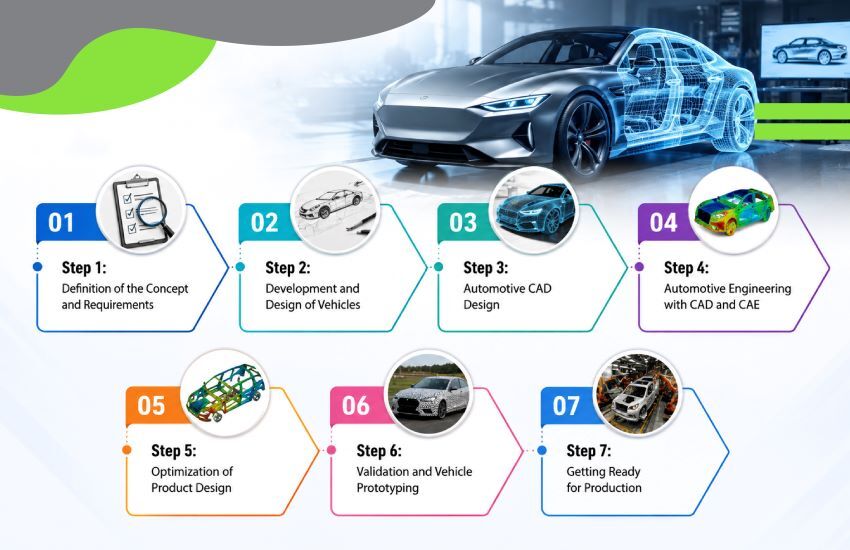
A clear grasp of what needs to be built is the first step in any successful automotive product development project.
Engineers and product teams now specify needs like:
At this point, customer experience is also increasingly crucial. Automakers can learn what consumers want from a car or part by analyzing customer data. Decisions on comfort, usability, design, features, and performance may be influenced by this information.
The end product is a precise engineering requirement that directs the remainder of the development process.
The idea proceeds to detailed vehicle design and development after the requirements are determined.
Engineers develop preliminary layouts and assess various design strategies. Dimensions, packaging, ergonomics, structural requirements, aerodynamics, and manufacturability are some of the aspects they take into account.
Automotive Design Engineering is crucial in this situation. In addition to being esthetically pleasing, a good design must function properly and be feasible to produce.
Digital technologies are used by modern engineering teams to develop and assess concepts prior to the production of real components. Later on in the project, this can greatly minimize the requirement for recurrent physical modifications.
Detailed automotive CAD design is the next step.
Engineers can create precise 2D drawings and 3D models of car parts and assemblies thanks to computer-aided design. Larger vehicle constructions as well as brackets and housings can be represented by these digital models.
Additionally, CAD facilitates teamwork. A shared digital representation of the product can be used by designers, engineers, suppliers, and manufacturing teams.
Professional Automotive Design Services India suppliers may help businesses with CAD modeling, engineering drawings, design detailing, assembly development, and design adjustments for complicated projects.
A component's design is just one step in the process. The behavior of the component under actual working conditions must also be understood by engineers.
In automotive engineering, this is where CAD and CAE in Automotive collaborate.
The digital product model is created via CAD, and factors like these can be analyzed using Computer-Aided Engineering (CAE) tools:
Before conducting actual testing, engineers can theoretically test various circumstances using automotive simulation. This can lessen costly development iterations and help discover design issues earlier.
Engineers can alter the design once simulation data are available.
Reducing weight, increasing strength, altering materials, changing geometry, or increasing manufacturability are some examples of product design optimization. For instance, engineers can investigate a lighter design while preserving the necessary performance if a component is stronger than necessary yet unduly heavy.
Because even minor modifications can have an impact when a component is produced in huge quantities, this iterative approach is crucial to current automotive engineering services.
The product can go to vehicle prototyping following digital design and simulation.
A prototype offers a chance to assess the design's performance in a real-world setting. Fit, function, usability, assembly, and performance can all be examined by engineers.
Issues that were not apparent during digital development may be found through testing. After that, the engineering team can update the CAD model and carry out the required analysis once more.
A more regulated Vehicle Design and Development process is produced by this link between digital design, simulation, prototyping, and validation.
Until a design can be produced reliably, it is not really finished.
Engineers collaborate with manufacturing teams during the production phase to guarantee that components can be made in accordance with the authorized design. It is necessary to take into account engineering designs, tolerances, materials, assembly specifications, and production procedures.
Before manufacturing starts, production issues can be found with the aid of design-for-manufacturing principles.
Strong Automotive Engineering Solutions can also help in this situation. Design data can be linked to analysis, documentation, production, and product lifecycle activities through a well-integrated engineering workflow.
AI is becoming more and more important throughout the whole automobile development process.
By assisting in the analysis of vast volumes of technical and operational data, AI-driven technologies can assist engineers. Additionally, AI can help with repetitive engineering chores, documentation, predictive analysis, and pattern recognition.
AI in business is not just for customer-facing solutions. Through data automation, quicker data analysis, and better decision-making, general AI in business can also help engineering and manufacturing teams.
AI can also be used by automotive companies for quality control, demand forecasting, customer service, and customer data analysis. AI-enabled Customer Relationship Management (CRM) AI, Sales Automation Tools, and other AI-Driven Solutions can help teams handle client interactions more effectively in sales and support operations.
The secret is to employ AI to assist business teams and engineers rather than to take the position of engineering judgment.
To know more about the impact of AI on automotive engineering, explore our blog post, “How AI and Automation Are Revolutionizing Automotive Engineering”!
Because engineering choices made in the early phases can affect cost, quality, and production later on, choosing the correct Automotive Engineering Services Company is crucial.
Experience with CAD, CAE, simulation, product development, prototyping, and engineering documentation are all necessary for a competent partner. It should also comprehend the real-world needs of production.
Partners that combine engineering know-how with cutting-edge digital technology and a methodical development approach might be advantageous to businesses seeking Automotive Design Services India.
The process of developing automotive products is interconnected. Design follows concept development, simulation follows CAD modeling, simulation aids in optimization, and verified designs advance to manufacturing.
These tasks are combined by contemporary automotive engineering design services to produce a more efficient development lifecycle. Businesses may create better goods while controlling development time and cost by combining technical know-how, digital tools, automotive simulation, product design optimization, and AI-enabled capabilities.
Creating a design is not the only objective for companies working on complex automotive products. The goal is to produce a design that is functional, testable, manufacturable, and ultimately adds value for the client.
Let’s connect: www.modelcamtechnologies.com
Email: sales@modelcamtechnologies.com
Mobile no : +91 8237016167
Modelcam Technologies provides a wide variety of Services from ART to PART from Concept Design to Industrial Modeling and Analysis for final Manufacturing.
©Copyright 2026. All rights reserved by Modelcam Technologies Private Limited PUNE.