
The way engineering and manufacturing teams approach design is evolving thanks to CAD Automation Services. Does that imply that traditional CAD is becoming obsolete, though? Not always. The true question is when CAD automation makes more sense and when traditional CAD should be used.
CAD software has long been used by engineers to produce intricate drawings, 3D models, assemblies, and manufacturing documentation. Conventional CAD is still a crucial component of product development. However, the process can become sluggish and monotonous when teams regularly carry out the same design tasks, manually update dimensions, replicate comparable models, or generate drawings.
CAD automation can be useful in this situation.
Using tools, commands, parameters, and modeling features, engineers and designers can develop, edit, and alter digital designs using traditional CAD. It provides designers with comprehensive control over every stage of the design process.
This flexibility is useful for a unique product or a challenging engineering task. Based on project needs, materials, dimensions, production constraints, and client specifications, an expert engineer can make design selections.
But the problem arises when comparable tasks must be undertaken repeatedly.
Consider a producer who produces a product in multiple sizes. An engineer may have to access an existing model, alter dimensions, update features, make changes to drawings, review the Bill of Materials, and repeat the process for each modification in a standard CAD workflow.
Despite the software's strength, a significant amount of manual labor is still required for the workflow.
CAD automation automates repetitive CAD tasks using rules, scripts, macros, parameters, APIs, and custom workflows. The system may carry out predetermined activities based on particular inputs rather than requiring an engineer to manually complete each step.
This forms the basis of CAD Automation in Manufacturing.
For instance, an automated workflow can leverage inputs like length, width, thickness, or material to generate the necessary design variations rather than manually designing ten variations of a common component.
Design automation may reduce repetitive modeling effort while capturing and reusing engineering knowledge and intent, according to Autodesk.
In order to assist engineering teams in streamlining processes and minimizing repetitive work, Modelcam additionally concentrates on customized design automation and CAD customization.
To get more knowledge about CAD automation, you can explore our blog post, “Is CAD Automation Worth It? Real Benefits for Engineering Teams”!
The CAD software itself isn't really the largest difference. It has to do with how the software is used.
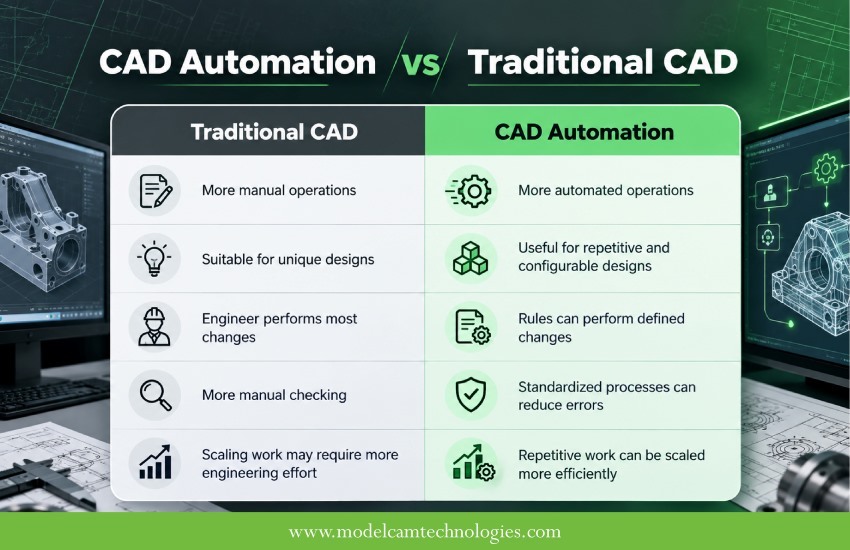
Traditional CAD relies more on human intervention. Predefined rules and logic are added to the process by CAD automation.
This does not imply that engineers should be replaced by automation. Rather, it can lessen the quantity of repetitive tasks that engineers must complete.
One of the most obvious areas for automation is repetition.
CAD Workflow Automation can eliminate needless manual procedures when engineers frequently make comparable products, alter standard components, produce drawings, or update documentation.
As a result, engineers may devote more time to design choices, problem-solving, and product enhancement.
Manufacturers frequently have to alter their products to meet the needs of consumers. It can take up important engineering time to do this manually for each order.
Businesses can establish guidelines for product configurations with Design Automation. While the system creates the proper design using predetermined engineering logic, users can supply particular inputs.
This strategy can also help in CAD customization, which is the process of modifying standard CAD tools to meet the unique needs of an organization.
Small variations in modeling techniques, naming standards, drawings, or documentation may occur when several engineers manually complete the same assignment.
Repetitive tasks can be standardized by automation.
This is especially helpful for CAD automation in manufacturing, where design data eventually finds its way to production, procurement, documentation, and other downstream processes.
A broader trend toward engineering automation includes CAD automation as just one component.
Workflows that transfer data between design, production, documentation, and business systems are becoming more and more necessary for engineering teams.
This is the point at which automation can go beyond just making a CAD model.
An organized process might, for instance, link design inputs with drawings, BOM data, documentation, or other engineering outputs. Businesses can create a more integrated process rather than considering each task as a distinct activity.
Additionally, when engineering data needs to be utilized across departments, this can present chances for data automation and data analysis.
Though it should not be confused with CAD automation, artificial intelligence is becoming more and more significant to engineering and production.
Pattern recognition, optimization, data analysis, knowledge retrieval, and decision support are just a few of the fields where AI can help. In the future, engineering procedures may be more closely connected with AI-driven solutions.
However, automation does not always need AI. If a company follows a straightforward rule such as, “If the product length is X, use component Y,” a rule-based automation system may be all that is required.
For more complex engineering challenges, AI can add another layer of intelligence by helping systems handle patterns, data, and decision-making more effectively.
This connects with the broader discussion around AI in business and General AI in Business. The real question is not simply whether a company is using AI, but whether the technology addresses a genuine business or engineering need.
Yes, it can - particularly for manufacturers that frequently deal with customized products.
When customers request products with specific dimensions or configurations, CAD automation can help streamline the design process and support faster, more consistent responses. When the engineering team needs to create a design manually before the sales team can provide accurate information, the overall process may take more time.
With an automated workflow, standard product configurations can be generated faster, helping teams respond to customer queries more efficiently.
This can improve coordination between engineering and sales while creating a smoother Customer Experience.
A similar approach can be useful for Customer data analysis, as information about customer requirements and product configurations can offer valuable insights for future design and sales decisions.
These technologies have a different role, but they can complement engineering automation effectively.
Sales Automation Tools can help sales teams reduce repetitive tasks and streamline daily activities, while Customer Relationship Management (CRM) AI can support customer information management and improve sales workflows.
CAD automation, in contrast, is mainly designed to streamline engineering and design workflows. When these systems are properly connected, information can flow more efficiently from customer requirements through sales and engineering to manufacturing. This can create a stronger foundation for implementing AI-Driven Solutions across different areas of the business.
There is no single answer when comparing traditional CAD with CAD automation.
Traditional CAD continues to be important when engineers need hands-on control over unique, complex, or highly customized designs.
CAD automation, however, can be particularly useful for workflows involving frequent repetition, standardized components, configurable products, or clearly defined design rules.
In many manufacturing environments, the most practical approach is not choosing one over the other, but using both where they provide the most value.
Engineers can continue using traditional CAD for creative, complex, and highly customized design work while relying on CAD Automation Services for repetitive tasks that surround the design process.
This combined approach can improve productivity while keeping engineering expertise and decision-making at the center of the workflow.
CAD automation can be worth considering when your engineering team frequently:
Adopting CAD automation does not have to mean changing the entire process at once. Businesses can begin by identifying a single repetitive task, automate it, measure the results, and then gradually expand automation to other suitable areas.
The future of engineering is not necessarily about choosing between CAD and automation. Instead, it is about bringing both together in a way that improves the overall design process.
Traditional CAD provides the foundation for developing detailed engineering designs, while CAD Workflow Automation can simplify repetitive and time-consuming tasks. Engineering Automation can take this further by connecting engineering workflows with other business processes, while AI can support advanced analysis, insights, and decision-making.
The objective is straightforward: reduce the time engineers spend on predictable, repetitive work so they can focus more on solving complex engineering challenges.
For manufacturers, this approach can lead to shorter design cycles, more consistent results, faster responses to customer requirements, and a design process that can scale more effectively as business needs grow.
CAD is not going away - it is evolving. The real opportunity lies in identifying which parts of the design process require human expertise and which can be streamlined through automation.
Let’s connect: www.modelcamtechnologies.com
Email: sales@modelcamtechnologies.com
Mobile no : +91 8237016167
Modelcam Technologies provides a wide variety of Services from ART to PART from Concept Design to Industrial Modeling and Analysis for final Manufacturing.
©Copyright 2026. All rights reserved by Modelcam Technologies Private Limited PUNE.