Engineering teams are using CAD Automation Services to speed up product development, decrease repetitive tasks, and increase design correctness. More businesses are implementing automation to boost production without sacrificing quality as industries shift toward digital engineering.
Today's engineering teams are under more and more pressure to provide excellent designs in shorter amounts of time. Engineers frequently have less time to concentrate on innovation due to strict project deadlines, frequent design revisions, and tedious manual activities.
CAD Automation Services can really help in this situation.
Engineers can automate these operations and concentrate on resolving challenging technical problems rather than spending hours making comparable drawings, changing dimensions, producing reports, or repeating common design chores.
An analysis states that manufacturers who use automation and digital technologies frequently see increases in operational efficiency and production. Automation is becoming a significant component of modern engineering, even though the outcomes differ among businesses.
The practice of automating repetitive design tasks utilizing pre-established rules, scripts, templates, and intelligent workflows is known as CAD automation. Engineers can automate repetitive tasks with tailored solutions instead of doing them by hand.
It is a crucial component of design automation, allowing engineering teams to finish projects more quickly while preserving design consistency.
Consider an engineering firm that produces hundreds of identical machine parts each month. CAD automation can automatically generate drawings, update measurements, and create documentation depending on predetermined parameters, eliminating the need to redesign every component from the beginning.
The outcome?
Faster project completion, less manual labor, and fewer mistakes.
Because CAD automation enhances design quality and productivity, many engineering firms are investing in CAD Automation in Manufacturing.
Among the most significant benefits are:
Engineers are not replaced by automation; rather, it frees them up to concentrate on developing better products by eliminating monotonous tasks.
For more clearance, you can check out our comprehensive blog post, "Why Your Engineering Team Needs CAD Automation Today"!
Every company has a different set of engineering procedures. These particular workflows might not necessarily be compatible with a typical CAD program.
CAD customization is crucial in this situation.
Businesses may automate their unique design rules, templates, calculations, BOM generation, drawing creation, and approval workflows using customized CAD systems.
The software adjusts to the engineering needs of the company rather than modifying current business procedures to suit it.
These specialized solutions speed up project completion by lowering repetitive labor when used with CAD Workflow Automation.
Automation's advantages are no longer just for engineers.
AI is currently being used by businesses to enhance decision-making, automate repetitive tasks, and boost overall productivity. AI-powered tools help engineers by streamlining tedious activities, supporting data analysis, and offering insightful information that enhances project planning.
In a similar vein, data automation makes it easier for businesses to gather, handle, and process engineering data. Teams may obtain precise information fast, cutting down on delays and enhancing cooperation, rather than having to manually compile project data.
Engineering firms are increasingly integrating automation with AI-powered solutions to create more intelligent and integrated workflows as digital transformation progresses.
The primary benefit of engineering automation is that it frees up engineers' time for creative work rather than monotonous tasks.
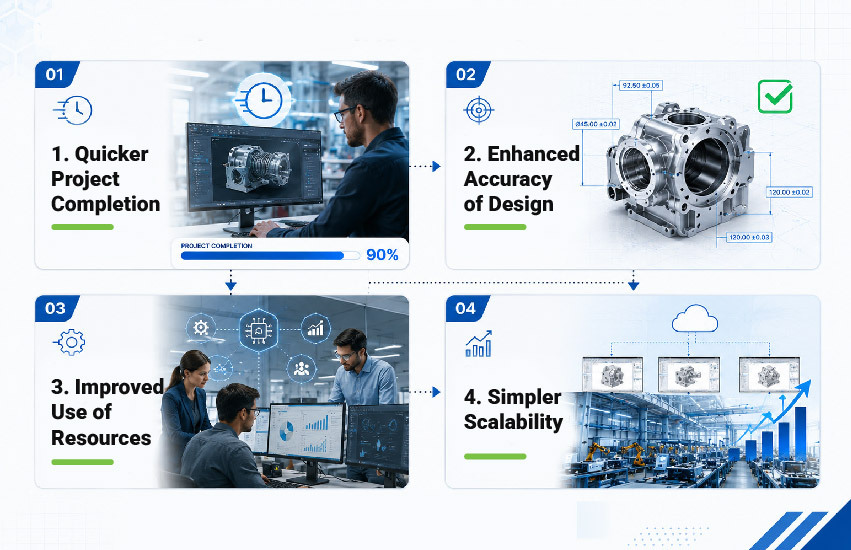
The following are some real-world advantages that engineering teams enjoy following automation implementation:
Automated design workflows shorten the time needed for repeated tasks including creating drawings, updating models, creating BOMs, and creating documentation. Because of this, engineering teams may finish projects more quickly without sacrificing quality.
Human mistakes and inconsistency are common outcomes of manual design procedures. Automated processes guarantee that established engineering standards are consistently adhered to, leading to more precise and dependable designs.
Organizations can leverage the knowledge of competent engineers for customer-focused engineering, complicated problem-solving, and product innovation rather than allocating them to monotonous tasks.
Automation makes it simpler to handle growing workloads without appreciably increasing engineering effort as projects get bigger and more complicated.
Think about a manufacturing business that creates specialized conveyor systems.
A somewhat different configuration is needed for each customer. Without automation, engineers create bills of materials, change dimensions, alter drawings, and prepare paperwork for each purchase.
These repetitive tasks can be automated utilizing pre-established principles with CAD Automation in Manufacturing. The system automatically creates the new designs and associated documentation after engineers add the necessary parameters.
Faster design cycles, less human errors, and more reliable project delivery are the outcomes.
Customer experience is directly impacted by engineering efficiency.
Customers receive quotes, design approvals, and finished products more quickly when engineering teams react swiftly to design modifications. This enhances communication, fosters trust, and fortifies enduring business partnerships.
Additionally, businesses can use customer data analysis to better understand client needs, find product variations that are commonly requested, and enhance future designs. These insights speed up turnaround times and enable engineering teams to provide more individualized solutions.
Engineering firms nowadays don't just rely on automation. To further improve the efficiency of corporate processes, they are integrating automation with AI-driven solutions.
For instance:
Automation is changing customer service and sales in addition to engineering.
These days, a lot of businesses employ sales automation tools to increase sales productivity, manage prospects, and automate follow-ups. In a similar vein, Customer Relationship Management (CRM) AI enables companies to better analyze consumer interactions, tailor communications, and forge closer bonds.
Even though these technologies fulfill various commercial purposes, they all work toward the same objective: increasing productivity, decreasing manual labor, and facilitating more intelligent decision-making throughout the company.
The answer is yes, for the majority of engineering organizations.
The time saved on repetitive chores is not the only way to gauge the benefit of automation. It also results from better teamwork, less engineering work, higher-quality designs, and quicker project completion.
Investing in CAD Automation Services is becoming more of a business need than a competitive advantage as companies continue their digital transformation journey.
Businesses that adopt automation now are better equipped to adapt to shifting consumer needs, increase operational effectiveness, and foster long-term company expansion.
Engineering teams must manage growing complexity while producing more projects, quicker designs, and better quality. Reaching these objectives becomes more challenging when relying only on manual procedures.
By automating tedious design procedures, increasing workflow efficiency, and freeing up engineers to concentrate on innovation, CAD Automation Services offer a workable alternative. Businesses may create a more flexible and effective engineering environment by combining Design Automation, CAD Customization, CAD Workflow Automation, and modern AI technology.
Automation provides quantifiable benefits for businesses of all sizes, whether your objective is to decrease design time, increase accuracy, or expand engineering activities. Engineering teams can enable faster innovation, improved customer experiences, and sustained business success the sooner they adopt automation.
Let’s connect: www.modelcamtechnologies.com
Email: sales@modelcamtechnologies.com
Mobile no : +91 8237016167
Modelcam Technologies provides a wide variety of Services from ART to PART from Concept Design to Industrial Modeling and Analysis for final Manufacturing.
©Copyright 2026. All rights reserved by Modelcam Technologies Private Limited PUNE.