
Businesses must create goods more quickly, lower costs, and increase accuracy in today's competitive engineering and manufacturing environment. Conventional design workflows that mostly depend on manual procedures are frequently sluggish, prone to mistakes, and challenging to scale. Here is where companies' approaches to product development are being revolutionized by design automation.
Businesses may automate tedious design procedures, expedite product development cycles, and enhance team collaboration with the help of contemporary engineering design automation technology. Automation tools are enabling engineering teams to go from concept to production much more quickly, from CAD models to outputs ready for manufacturing.
By increasing productivity, fostering innovation, and providing better customer experiences, businesses that use CAD design automation and other automated design solutions are earning a considerable competitive advantage.
Design automation is the process of automating repetitive design processes that would otherwise need human labor through the use of software, scripts, and digital engineering tools. It makes it possible for engineers to combine engineering workflows with manufacturing systems, generate design variations automatically, and develop parametric models.
Businesses may drastically cut design time without sacrificing accuracy and consistency by using engineering automation tools and sophisticated CAD automation software.
For instance, automation can automatically create new models depending on predetermined criteria in product development environments when many design configurations are necessary. This enables engineers to prioritize creativity and innovation over repetitive design activities.
Nowadays, a lot of businesses are using automated product design and mechanical design automation to speed up engineering processes and boost departmental efficiency.
The majority of engineering design work relied on manual modeling and documentation prior to the widespread use of automation techniques. Every design aspect would be created from the ground up by engineers, who would then hand alter drawings and repeat the same procedures for each variation of the product.
Although full creative control is possible with manual procedures, they have a number of drawbacks:
Longer design time
An increased likelihood of human error
Managing complicated product variations is challenging.
Scalability issues for large technical teams
These difficulties can impede innovation in fields where accuracy and speed are crucial. When updates or design changes are required, manual operations frequently take a substantial amount of work.
For this reason, the argument between design automation vs manual design is becoming more crucial for contemporary engineering and industrial firms.
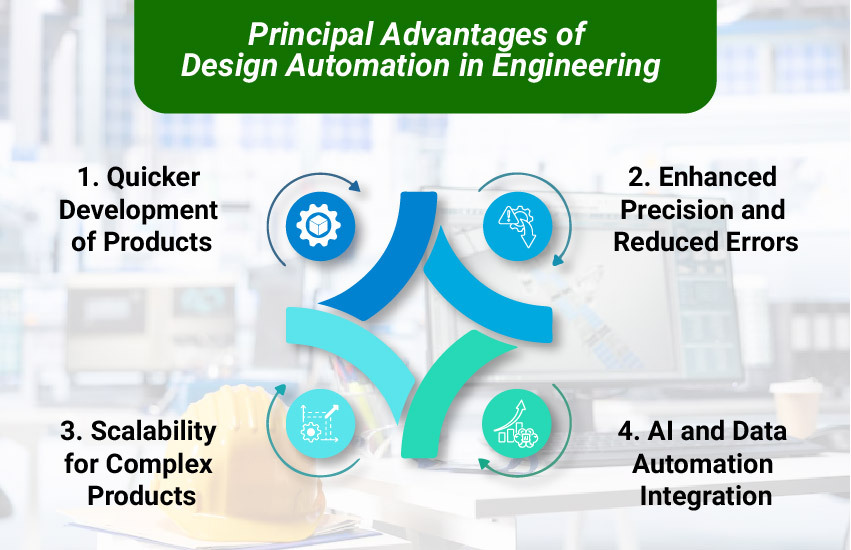
The advantages of design automation in engineering go much beyond time savings. The way engineering teams work together, create, and produce value is changing as a result of automation.
Accelerating product development cycles is one of engineering design automation's main benefits. Engineers can spend less time on tedious modeling activities thanks to automated procedures that can produce design variations fast.
Engineers can automatically create drawings, assemblies, and configurations in minutes as opposed to hours with CAD automation software.
Errors are more likely in manual design methods because they frequently require repeating computations and data entering. Many of these risks are eliminated by mechanical design automation, which automates design validations and calculations.
Automated workflows lower the possibility of expensive technical errors and guarantee consistency across designs.
Several product variations and adaptations are frequently needed in modern manufacturing. Businesses can develop adaptable design templates that automatically produce new variations by using manufacturing design automation.
This strategy facilitates quicker reactions to market demands and encourages scalable product development.
AI-driven features and data automation tools are now included in many contemporary engineering platforms. These technologies maximize performance, evaluate design factors, and suggest design enhancements.
By incorporating AI into business processes, engineering teams may use real-time data analysis to make more intelligent decisions.
For deeper insights into design automation in engineering, read our blog post, “How Design Automation Enhances Accuracy, Speed & Product Innovation”!
CAD design automation, which allows engineers to automate intricate modeling and drawing activities, is one of the most significant fields of automation.
Organizations can produce design variations automatically by using the automated CAD design process. Also, they can:
Update drawings instantly when models change
Reduce repetitive CAD tasks
Improve collaboration across engineering teams
Engineering teams can guarantee consistency across projects and standardize workflows by utilizing CAD automation software.
Businesses that provide specialist CAD design automation services assist companies in tailoring these automation processes to meet their needs for product design.
Manufacturing companies are under more and more pressure to provide cutting-edge goods fast while upholding strict quality standards.
Design automation for manufacturing companies is therefore turning into a strategic investment.
A more effective digital product lifecycle is made possible by manufacturers connecting engineering processes with manufacturing systems through the use of sophisticated automated design solutions.
Manufacturers benefit from automation:
Shorten the lead time for engineering
Boost the precision of the design
Simplify product setups
Boost the readiness of production
Businesses can create specialized automation frameworks that incorporate CAD systems, PLM platforms, and manufacturing tools by using engineering design automation services.
Although design automation is essentially an engineering solution, it also contributes significantly to enhancing customer experience.
Faster product development cycles enable businesses to react swiftly to client demands. Faster supply of specialized solutions is made possible by engineers' ability to rapidly create customized product designs.
Organizations can also use advanced analytics technologies to analyze customer data in order to comprehend trends in product performance and design preferences.
Businesses can link engineering processes with customer insights by integrating automation technologies with AI-driven solutions, sales automation tools, and Customer Relationship Management (CRM) AI platforms.
Product designs are more closely aligned with consumer demands and market expectations because to this integration.
Automation will play a major role in engineering innovation as digital transformation continues to disrupt sectors.
Smarter design processes are made possible by technologies like intelligent CAD systems, predictive analytics, and AI-driven engineering automation tools.
Automation will play a major role in managing sophisticated manufacturing workflows, digital twins, and intricate product ecosystems in future engineering settings.
Early adoption of engineering design automation will put organizations in a better position to compete in a global market that is changing quickly.
In addition to increasing operational effectiveness, automation frees up technical teams to concentrate on strategic problem-solving, creativity, and innovation.
The engineering and manufacturing sectors are changing as a result of the transition from manual to automated design workflows. Although manual methods are still useful in some situations, they are not as accurate, scalable, or efficient as contemporary automation technology.
Businesses may expedite product innovation, decrease errors, and streamline engineering operations by utilizing design automation. Advanced automated design solutions, mechanical design automation, and CAD design automation are examples of technologies that assist businesses remain competitive in a market that is changing quickly.
Design automation will be crucial in determining the direction of product development as businesses continue to adopt AI in business, AI-driven solutions, and intelligent data systems.
Investing in engineering design automation is now a strategic imperative for manufacturing and engineering organizations seeking to increase productivity and innovation.
Let’s connect: www.modelcamtechnologies.com
Email: sales@modelcamtechnologies.com
Mobile no : +91 8237016167
Modelcam Technologies provides a wide variety of Services from ART to PART from Concept Design to Industrial Modeling and Analysis for final Manufacturing.
©Copyright 2026. All rights reserved by Modelcam Technologies Private Limited PUNE.