Pharmaceutical regulatory documentation plays a critical role in bringing medicines to market. However, preparing and managing these documents can be detailed and time-consuming for regulatory teams. Pharmaceutical regulatory documentation automation can help teams organize information, prepare documents, reduce repetitive tasks, and maintain consistency across large volumes of regulatory content.
From CTD modules and submission documents to GMP records and compliance documentation, pharmaceutical companies work with information from various sources. This is where AI can provide practical support.
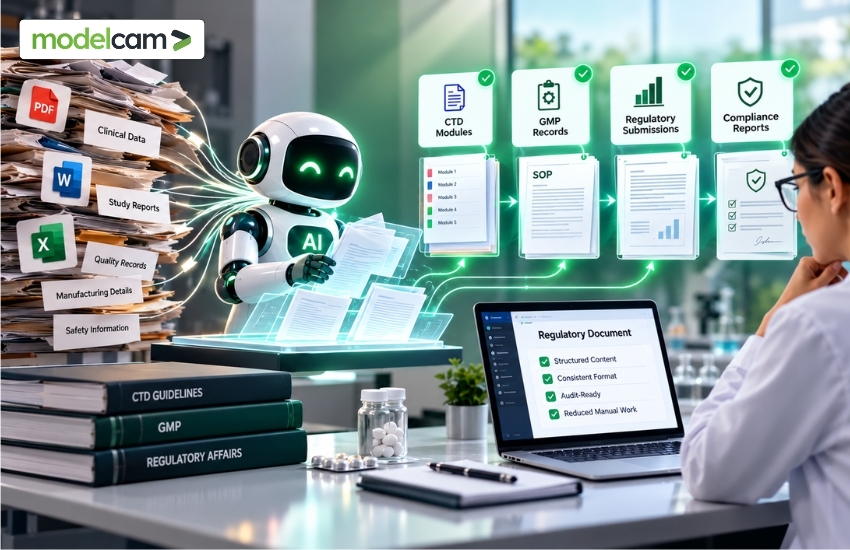
Regulatory teams deal with large volumes of technical information. This may include clinical data, safety information, quality records, manufacturing details, study reports, and supporting evidence.
The Common Technical Document (CTD) provides a standardized structure for organizing pharmaceutical information submitted to regulatory authorities. It includes five modules covering administrative information, summaries, quality, nonclinical information, and clinical information.
Preparing these documents often requires collecting information from multiple teams, verifying details, following specific formats, reviewing earlier versions, and maintaining consistency.
Even a small error or missing detail can lead to additional review and rework.
This is where AI for pharmaceutical regulatory documentation can provide value. Instead of managing every repetitive documentation task manually, regulatory professionals can use AI to organize information and streamline document-related workflows.
AI can support different stages of the documentation process. AI regulatory documentation tools can process large volumes of information, identify relevant content, summarize documents, and help create structured outputs.
For example, a regulatory professional may need to review several technical documents before preparing a particular section of a submission. An AI-powered system can help find relevant information and organize it according to the required structure.
This can support AI for regulatory documentation and make regulatory document automation more practical for teams managing multiple products or submissions.
AI can also assist with repetitive tasks such as:
The goal is not to replace regulatory expertise. Instead, AI-powered regulatory documentation can reduce repetitive manual work involved in preparing and managing documents.
One useful application is AI for CTD documentation.
CTD documentation stands for Common Technical Document documentation. It provides a standardized way for pharmaceutical companies to organize information for regulatory submissions. With AI for CTD preparation, teams can use existing information and help structure it into the appropriate sections. AI can assist with content identification, document organization, summaries, and consistency checks.
This can support automated CTD documentation while keeping human review as an important part of the process.
For example, when product information is spread across multiple source documents, an AI system can help identify and organize relevant content for review. A regulatory professional can then verify the information before it is included in the final submission.
This approach can also support AI for regulatory submissions and regulatory submission automation, particularly for teams handling recurring or large-scale submission activities.
Regulatory documentation goes beyond submission packages. Pharmaceutical companies also handle a wide range of GMP and compliance-related documents.
AI for GMP documentation can help teams organize procedures, records, reports, and other controlled documents. AI-based tools can assist with extracting information, preparing drafts, comparing document versions, and highlighting content that may need attention.
This can support GMP compliant document automation while keeping human review as part of the process.
For example, instead of manually searching through several documents to find information needed for an updated record, teams can use AI to locate and organize relevant content before reviewing it.
The same approach can support pharmaceutical compliance documentation and help teams maintain consistent, audit-ready pharmaceutical documents.
Learn more about how AI can support GMP documentation in our blog post, “How AI Can Help QA Teams Manage GMP Documentation.”
A key benefit of AI is its ability to work with information collected from different sources.
Regulatory teams may work with Word files, PDFs, spreadsheets, reports, forms, and other structured or unstructured data. Manually transferring information between these sources can be time-consuming.
AI-driven Data Analysis can help identify patterns, extract useful information, and connect related content.
This is where Data Automation can provide value. Instead of repeatedly searching, copying, and reorganizing information, teams can create workflows that move information through the documentation process more efficiently.
AI in business is increasingly being applied to repetitive knowledge-based tasks. In pharmaceutical organizations, AI in pharmaceutical regulatory affairs can similarly support document-heavy workflows while allowing specialists to focus on review, interpretation, and decision-making.
Automation does not mean removing regulatory professionals from the process.
Regulatory documentation requires context, scientific knowledge, judgment, and accountability. Therefore, qualified professionals should review AI-generated content before it becomes part of an official document or submission.
This is particularly important when using AI for pharmaceutical regulatory affairs or AI for pharma regulatory submissions. A practical workflow could look like this:
Source information → AI processing → Draft or structured output → Human review → Approval → Final document
This approach combines the efficiency of automation with expert oversight.
Consider a regulatory team preparing documentation for a new pharmaceutical product. Rather than manually searching through every source file, the team can provide approved documents to an AI-based documentation system.
The system can help identify relevant information, summarize content, organize sections, and prepare an initial draft. The regulatory team can then review the output, make necessary changes, and approve the final version.
This type of pharmaceutical document automation can reduce repetitive work while improving consistency across documents.
It can also support pharma document automation and regulatory affairs document automation when organizations manage large documentation workflows across multiple products.
Businesses looking to introduce AI into document-heavy workflows can explore Modelcam Technologies’ AI Document Studio. It helps organizations manage documents more efficiently through AI-powered document processing and content-related capabilities.
For pharmaceutical teams, solutions like this can support areas such as AI regulatory writing for pharma, document analysis, information extraction, and other repetitive documentation tasks while keeping human review at the core.
The aim is not just to create documents faster, but to make document workflows more organized, efficient, and scalable.
Explore Modelcam’s AI Document Studio to discover how AI can help turn complex document workflows into more efficient digital processes.
The future of pharma regulatory documentation automation is about more than generating documents quickly. It involves creating connected workflows where information can be captured, organized, reused, reviewed, and managed more efficiently.
AI can assist with content creation, document comparison, information extraction, customer data analysis where relevant to business processes, and other repetitive tasks. These capabilities reflect the broader shift toward AI-Driven Solutions and smarter AI in business operations.
For pharmaceutical organizations, the focus should be on using AI where it provides practical value while keeping human expertise at the center.
With appropriate controls, AI for pharmaceutical regulatory documentation can help teams reduce repetitive documentation work and spend more time on activities that require regulatory knowledge, scientific judgment, and careful review!
Let’s connect: www.modelcamtechnologies.com
Email: sales@modelcamtechnologies.com
Mobile no : +91 8237016167
Modelcam Technologies provides a wide variety of Services from ART to PART from Concept Design to Industrial Modeling and Analysis for final Manufacturing.
©Copyright 2026. All rights reserved by Modelcam Technologies Private Limited PUNE.