GMP documentation plays a key role in pharmaceutical quality operations. For QA teams, however, managing GMP documentation often involves a lot of repetitive tasks, including drafting, reviewing, updating, maintaining records, and performing compliance checks.
In the pharmaceutical sector, documentation is much more than routine paperwork. It provides evidence that processes were carried out correctly, important decisions were documented, and quality standards were followed. The FDA highlights the importance of maintaining reliable and accurate CGMP data, along with appropriate controls to support data integrity.
This is where Artificial Intelligence (AI) can offer valuable support to QA teams.
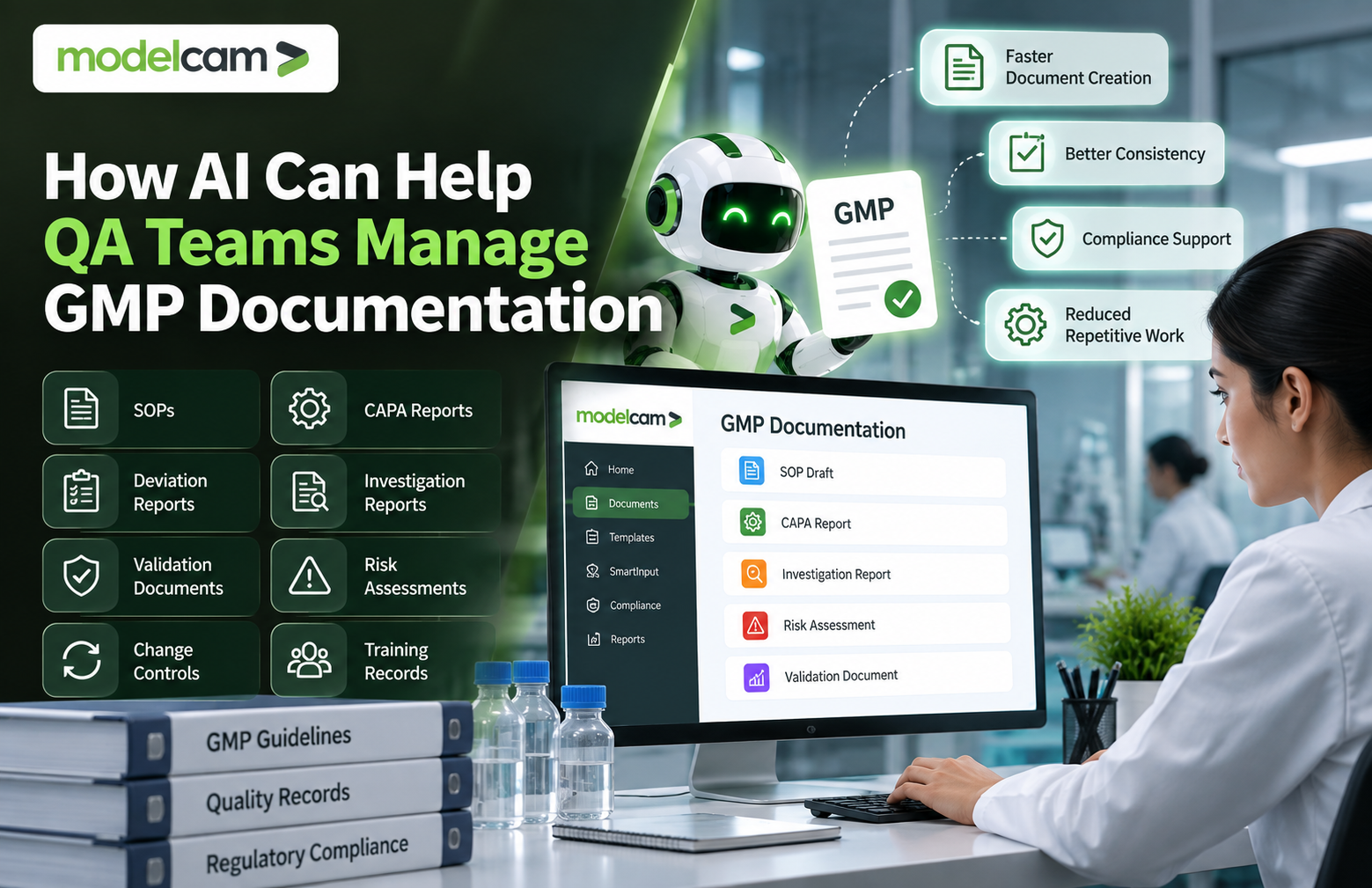
QA professionals work with a wide range of documents, such as SOPs, deviation reports, CAPA records, investigation reports, risk assessments, change controls, validation documents, training records, and other quality-related records.
Manually creating, reviewing, and managing these documents can require considerable time and effort. QA teams must also make sure that every document is complete, consistent, well-structured, and aligned with established procedures.
As pharmaceutical companies expand, the amount of pharmaceutical documentation they handle also increases. A larger volume of documents can mean more reviews, frequent revisions, and a greater possibility of missing information or inconsistencies in formatting.
AI is not intended to replace QA professionals. Instead, AI for GMP documentation can take care of suitable repetitive tasks, allowing QA teams to spend more time on activities that require human judgment, such as reviewing documents, investigating issues, making decisions, and maintaining overall quality.
Document drafting is one of the most practical ways AI can support QA teams. Based on the information entered by the user, AI-driven tools can create a basic structure for a document. This gives QA professionals a starting point instead of requiring them to build every document from scratch. They can then review the draft, make necessary changes, and customize it according to the specific requirement.
For example, while preparing an investigation report, AI can help arrange the available information under relevant sections, such as the issue description, investigation details, possible causes, corrective actions, and preventive actions.
The QA professional continues to be responsible for reviewing the information, verifying the content, and making the final decision. AI mainly helps reduce the repetitive writing work involved in preparing such documents.
Maintaining consistency is an important part of GMP compliance. When multiple people prepare QA documents, they may use different formats, terminology, or levels of detail. Over time, these differences can make documents more difficult to review and manage.
AI can assist teams in following consistent document structures and writing formats. This can strengthen GMP document management by making QA documentation easier to create, review, organize, and maintain.
AI can also help detect missing sections or incomplete information before a document is finalized. For instance, an AI-assisted system could identify that an investigation report does not contain enough information about the affected batch, root cause, or corrective action.
For more knowledge and understanding, you can check out our blog post, “How GMP-Aware AI is Revolutionizing QC/QA Documentation in Pharma”!
Early quality-checking can also be aided by AI.
An AI system can determine whether the information supplied is sufficiently particular and comprehensive rather than creating a paper from extremely little data.
For instance, before creating a document, Modelcam's AI Document Studio employs SmartInput to assess inputs in areas like specificity, coherence, completeness, and regulatory context. When the information supplied is inadequate, it can potentially pose follow-up queries.
Because the quality of an AI-generated paper greatly depends on the quality of the information provided to it, this kind of approach may be helpful.
QA teams devote a large portion of their time to tasks that adhere to predetermined patterns.
AI can help QA teams with several repetitive documentation activities, such as arranging information, creating structured drafts, summarizing existing content, and maintaining a consistent document format.
This is where Data Automation can work alongside AI in pharmaceutical industry workflows to make routine documentation tasks more efficient. Instead of trying to automate the entire quality process, organizations can use AI for specific tasks that are repetitive and time-consuming. QA professionals can then remain involved in activities that require experience, expertise, and professional judgment.
Managing GMP documents involves much more than simply creating them. QA teams also have to handle document revisions, approvals, record maintenance, retrieval, and retention throughout the document lifecycle.
Effective GMP document management requires proper controls at every stage to ensure that documents remain accurate, accessible, and appropriately maintained.
When integrated with suitable systems, AI can help QA teams organize and classify documents, improve search capabilities, and retrieve relevant information more quickly. Instead of manually going through large volumes of records, users can potentially find the information they need with less effort.
At the same time, AI-enabled systems need to operate within the organization's established quality and compliance framework. Depending on the application, appropriate controls, validation, access management, data protection, and change controls may be required.
FDA guidance also emphasizes the importance of suitable controls for computerized systems used in GMP environments, particularly around access, data changes, data protection, and record integrity.
Data privacy is an important factor when introducing AI into pharmaceutical operations.
QA documents can contain sensitive details related to products, batches, manufacturing processes, investigations, laboratory work, and internal procedures. Sharing this information with an external AI platform without proper security measures may expose the organization to unnecessary data risks.
For this reason, companies exploring AI for GMP documentation should understand how their data is handled at every stage, including how it is processed, stored, accessed, and protected.
Modelcam's AI Document Studio follows an approach based on anonymised placeholders. Instead of entering actual confidential details, users can use references such as “Product X,” “Batch ABC,” or “Analyst Y.” According to Modelcam, confidential information remains on the user's device and is not sent outside it.
An approach like this can help organizations explore AI-assisted documentation while reducing the need to expose sensitive pharmaceutical information.
AI is best used as a supporting tool in quality operations rather than as a replacement for QA professionals.
Documents created with AI still require careful human review. QA professionals bring knowledge of internal procedures, regulatory requirements, product-specific risks, and the organization's quality systems. These areas often require experience and professional judgment that cannot simply be handed over to an AI tool.
Human oversight is also important as regulatory expectations around AI continue to develop. Current FDA principles for AI use in drug development highlight areas such as human-centric design, risk-based approaches, data governance, documentation, and lifecycle management.
The practical approach, therefore, is to combine human expertise with AI assistance. AI can help with suitable repetitive and documentation-related tasks, while QA professionals remain responsible for reviewing information, applying their judgment, and making final quality decisions.
AI is gradually changing how pharmaceutical quality assurance teams approach everyday tasks. From preparing documents and organizing information to supporting quality checks, AI can help reduce the time spent on repetitive activities.
This reflects a larger shift toward AI in business, where organizations are adopting AI-Driven Solutions to improve efficiency while keeping human expertise and oversight at the center.
However, AI does not need to be applied to every area of an organization. Different teams have different requirements and priorities. For instance, Customer Relationship Management (CRM) AI, Sales Automation Tools, and Customer data analysis may support sales and marketing functions, while QA teams need solutions that are focused on documentation, compliance, traceability, and data integrity.
For pharmaceutical QA teams, the priority should remain on maintaining accurate and reliable records, following established processes, supporting GMP compliance, and protecting the integrity of quality-related information.
Modelcam's AI Document Studio is built to support professionals working in pharmaceutical and laboratory environments. Modelcam states that its platform provides 50 GMP-compliant documents across five key areas, covering QC/QA, R&D, Pharma, Biotech, and Lab Management.
The platform combines structured inputs, quality scoring, document generation, and highlighted placeholders to help users create a more organized starting point for their documentation. Instead of beginning with a blank document, professionals can work with a structured draft that can then be reviewed and refined.
AI-generated content should not be treated as a final document without review. QA professionals should verify the information, make the necessary changes, and ensure that the document follows their organization's quality procedures before it is used, filed, or submitted for regulatory purposes.
Managing GMP documentation does not always have to involve hours of repetitive paperwork for QA teams. With the right approach, AI can help simplify many routine documentation activities.
From creating structured drafts and maintaining consistency to checking information and organizing QA documentation, AI can help make everyday processes more efficient. It can also support smoother pharmaceutical documentation workflows, giving QA professionals more time to focus on tasks that require their knowledge, experience, and judgment.
The purpose of AI for GMP documentation is not to replace QA professionals. Instead, it can provide them with practical tools to handle documentation more effectively. When combined with proper human review, quality controls, data integrity measures, and GMP compliance practices, AI can become a useful part of modern pharmaceutical quality operations.
Let’s connect: www.modelcamtechnologies.com
Email: sales@modelcamtechnologies.com
Mobile no : +91 8237016167
Modelcam Technologies provides a wide variety of Services from ART to PART from Concept Design to Industrial Modeling and Analysis for final Manufacturing.
©Copyright 2026. All rights reserved by Modelcam Technologies Private Limited PUNE.