Imagine a factory where production decisions are based on real-time data rather than assumptions, machines can alert teams before they fail, and quality problems can be immediately detected. This is no longer a far-off concept. AI solutions for manufacturing are transforming how contemporary factories plan, create, track, and enhance their operations.
Manufacturing has traditionally relied on speed, accuracy, and efficiency. However, manufacturers are being forced to discover more efficient ways to operate due to expanding customer demands, complicated manufacturing processes, rising costs, and increased competition. This is where AI in manufacturing is having a significant impact.
Large volumes of data are produced by robots, sensors, supply chains, production systems, and consumer interactions in modern companies. Traditionally, a large portion of this data was either unutilized or needed a substantial amount of manual labor to analyze.
Businesses can utilize artificial intelligence in manufacturing to transform this data into insightful knowledge. AI can recognize trends, spot odd behavior, foresee potential issues, and facilitate quicker decision-making.
This is one of the reasons AI manufacturing solutions are starting to play a significant role in the digital transformation. Manufacturers can utilize AI-driven systems to spot possible issues early and take action, rather than only responding after something goes wrong.
As a result, there is a shift toward "smart manufacturing," in which linked devices, software, personnel, and data collaborate to increase output.
Production schedules, delivery obligations, and operating expenses can all be impacted by machine downtime. Conventional maintenance frequently occurs after an equipment develops a problem or according to predetermined schedules.
A more intelligent strategy is provided by predictive maintenance.
Information like temperature, vibration, pressure, operation hours, and machine performance can all be analyzed by AI systems. They can assist in anticipating when equipment might need maintenance by spotting odd patterns.
For instance, an AI system can notify the maintenance crew before a significant malfunction occurs if it detects that a machine's vibration levels are progressively rising.
Instead than having to deal with unplanned malfunctions, this enables manufacturers to schedule maintenance. Thus, AI-based predictive maintenance can increase machine availability, minimize interruption, and promote longer equipment life.
Another area where AI is changing manufacturing workflows is quality control.
Manual checking can be a major component of traditional inspection procedures. Although human expertise is still crucial, personally examining a large number of products can take a lot of time and result in inconsistent results.
To find flaws and abnormalities, Quality Control Automation makes use of technologies like computer vision, machine learning, and artificial intelligence.
Products can be inspected, compared to predetermined quality standards, and potential flaws can be found by AI-powered systems. This can assist producers in identifying quality issues early in the manufacturing process.
AI applications in manufacturing can thereby promote improved product consistency while lowering the quantity of repeated manual inspection tasks.
AI in conjunction with the Digital Twin in Manufacturing is one of the most potent pairings in modern manufacturing.
A digital twin is a virtual copy of a real machine, procedure, or manufacturing setting. It can depict what is happening in the real world by using real-time data from linked devices.
After analyzing this data, AI can spot trends, model potential outcomes, and make recommendations for enhancements.
For instance, before applying changes on the actual factory floor, producers can utilize a digital model to examine how a manufacturing process could react to those changes.
IoT, AI, and digital twins work together to facilitate AI-driven decision-making and ongoing process enhancement. It is also a crucial component of AI in Industry 4.0, where intelligent and networked technologies are revolutionizing conventional factories.
Nearly every step of the manufacturing process creates data. There is an abundance of information on everything from raw materials and machine performance to production output and customer requirements.
Converting this knowledge into useful action is the difficult part.
Large-scale data analysis can be completed by AI far more quickly than with conventional manual techniques. It can compare past data, spot abnormalities, spot trends, and offer helpful suggestions.
Repetitive tasks like gathering, organizing, and moving data between systems can be further reduced using data automation.
This frees up time for engineering and manufacturing teams to concentrate on strategic choices, innovation, and problem-solving rather than tedious administrative work.
Manufacturing has already undergone a transformation because of industrial automation, which eliminates monotonous human tasks. By increasing the intelligence and adaptability of automated systems, AI advances automation.
AI-driven systems are able to analyze changing conditions and react appropriately, as opposed to merely obeying a predetermined set of instructions.
Workflows can be made more interconnected by utilizing software platforms, robots, industrial equipment, and inspection systems. Manufacturers are able to increase flexibility without sacrificing consistency because of this.
AI can also help with supply chain operations, energy optimization, inventory control, and production scheduling.
AI's effects extend beyond machinery and manufacturing lines. Additionally, it is altering manufacturing-related business procedures.
AI can be used by manufacturers for customer data analysis, demand forecasting, customer service, sales, and customer support. Businesses may enhance customer experience by better understanding client needs and responding to them more quickly.
Sales Automation Tools can assist sales teams in organizing client data and automating repetitive tasks. Similar to this, teams can prioritize opportunities and find patterns in client interactions with the aid of Customer Relationship Management (CRM) AI.
This illustrates how AI in business may link industrial processes with customer-facing, sales, and service roles.
Even if there are many advantages, successful AI Implementation in Manufacturing calls for more than just buying AI software.
Manufacturers must first determine the appropriate business issue. They also require a clear execution strategy, appropriate infrastructure, employee training, and trustworthy data.
Starting with a specific use case, such production optimization, automated quality inspection, or predictive maintenance, is a sensible strategy. The solution can be progressively enlarged after the results are measured.
This strategy can help organizations grasp the true business benefit of their investment while making the deployment of AI more manageable.
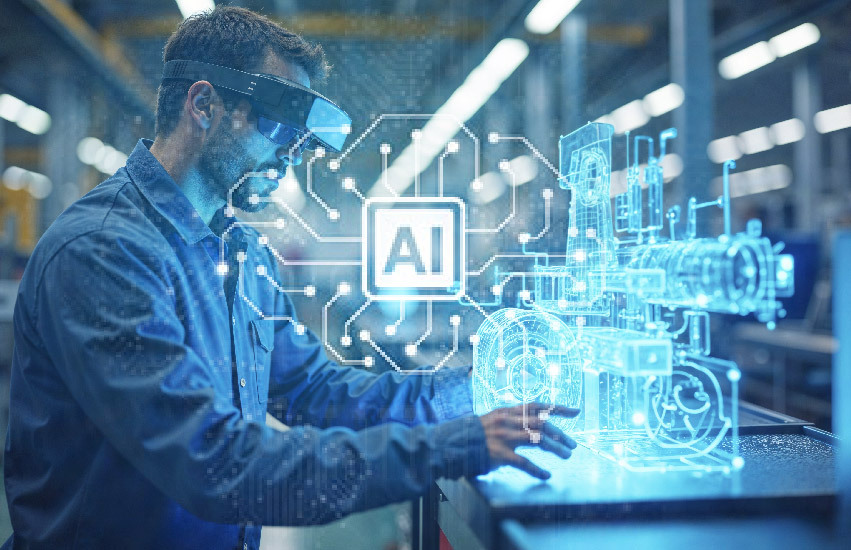
Technology will not take the place of people in manufacturing in the future. Rather, it will be about integrating intelligent digital tools with human expertise.
Engineers and production teams may make quicker, better decisions with the aid of AI software for the manufacturing industry. Digital twins can offer a virtual environment for testing and optimization, while AI-driven analytics might spot patterns that might be challenging to find manually.
AI Solutions for Manufacturing are establishing interconnected workflows throughout the company, from quality control and predictive maintenance to production scheduling, customer support, and sales automation.
Manufacturers may become more adaptable, data-driven, and ready for future developments if they begin developing these skills now.
Discover more about the effects of artificial intelligence on the manufacturing industry’s future through our blog, "The Future of AI in Manufacturing: Trends Every Industry Must Know"!
AI is transforming the manufacturing sector from a reactive one to one that is more intelligent and predictive. AI applications in manufacturing are assisting companies in increasing productivity, decreasing downtime, automating repetitive tasks, bolstering quality control, and optimizing data utilization.
AI has the potential to build a more intelligent manufacturing ecosystem when paired with Digital Twins, Industrial Automation, IoT, and contemporary engineering methods.
Adopting AI just because it's a new technology is not the true opportunity. It uses AI-Driven Solutions to address actual manufacturing problems and produce quantifiable commercial value.
Manufacturers who successfully integrate people, processes, data, and AI will be better positioned to create faster, smarter, and more efficient operations as Industry 4.0 develops.
Let’s connect: www.modelcamtechnologies.com
Email: sales@modelcamtechnologies.com
Mobile no : +91 8237016167
Modelcam Technologies provides a wide variety of Services from ART to PART from Concept Design to Industrial Modeling and Analysis for final Manufacturing.
©Copyright 2026. All rights reserved by Modelcam Technologies Private Limited PUNE.