Global industries are undergoing an unprecedented transformation due to the quick development of AI in manufacturing. Artificial intelligence is being used by manufacturers in a variety of industries, including heavy engineering, electronics, automotive, and aerospace, to increase productivity, accuracy, and scalability. AI-powered system integration is now a competitive need as businesses adopt Industry 4.0 technology.
Companies like Modelcam Technologies are leading the way in facilitating digital transformation by integrating smart factories, customizing CAD, and offering advanced technical solutions. Businesses that strategically implement AI-driven solutions in production, quality, maintenance, and customer operations will dominate the manufacturing industry in the future.
Let's look at the major trends influencing the upcoming ten years.
The foundation of the current industrial revolution is smart manufacturing. Factories are turning into intelligent ecosystems through the integration of real-time data analysis, industrial IoT, and machine learning in production.
AI in manufacturing makes it possible to:
Production line monitoring in real time
Automated identification of defects
Optimization of dynamic processes
Decreased human error
Large amounts of operational data are processed by artificial intelligence in manufacturing, which then transforms the data into insights that may be put to use. Optimized resource allocation, reduced downtime, and increased throughput are guaranteed by this data-driven production strategy.
AI-driven industrial solutions are able to automate processes at previously unachievable levels by continuously learning from performance data. Production facilities are evolving into self-correcting, autonomous, and adaptive environments as artificial intelligence (AI) for industrial automation improves.
Read more about AI-driven solutions in manufacturing, through our blog post, “Boost Your Factory’s Efficiency: AI Strategies for Smart Manufacturing”!
One of the biggest cost factors in the AI production sector is unplanned downtime. This problem is addressed by AI in predictive maintenance using sensor-based monitoring and predictive analytics.
Manufacturers can use machine learning models to:
Find irregularities in the behavior of the equipment.
Anticipate component failures prior to malfunctions
Plan maintenance in advance.
Extend the lives of assets
Here, it becomes particularly clear how AI increases production efficiency. Factories run on predictive intelligence rather than reactive maintenance. This enhances overall equipment effectiveness (OEE), lowers maintenance costs, and minimizes production disruptions.
When AI is used in factories that use predictive maintenance, operational reliability and cost optimization usually improve significantly.
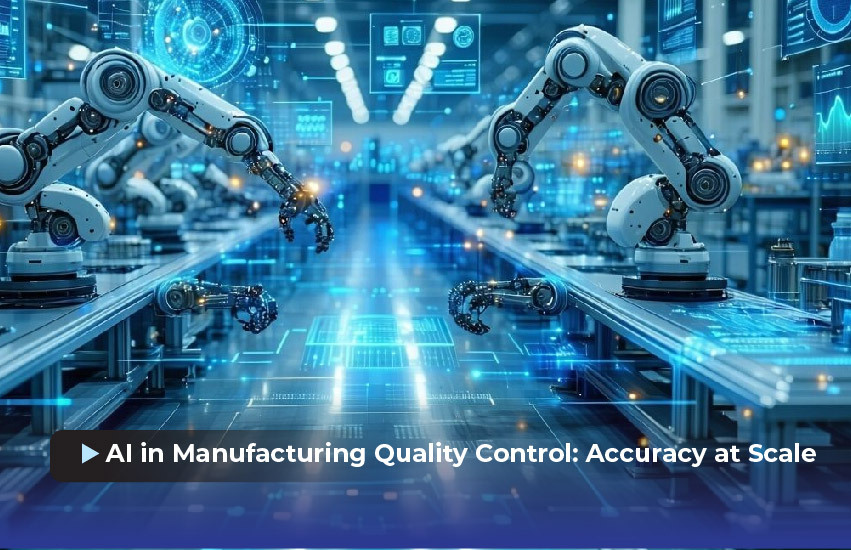
AI in manufacturing has significantly changed quality assurance. Conventional inspection techniques mostly rely on rule-based systems or manual procedures. AI is now used in quality control manufacturing to identify micro-defects in real time using deep learning algorithms and computer vision.
AI-driven production improves quality assurance by:
Defect detection on the surface in milliseconds
Making sure that production is consistent
lowering the rate of scrap
Upholding norms of compliance
The client experience is directly enhanced by this change. Stronger long-term connections, fewer returns, and increased brand trust are all results of higher-quality items.
Additionally, producers can match output quality to market expectations by combining production data with consumer data research. Thus, end-user happiness as well as productivity are being impacted by AI-driven solutions.
Digital twin technology is one of the most potent Industry 4.0 technologies. A virtual duplicate of a real asset, manufacturing line, or entire factory is called a digital twin.
Digital twins are improved by artificial intelligence in production through:
Creating production scenario simulations
Testing changes to the process virtually
Forecasting constraints in operations
Making the best use of resources
Before making physical modifications, producers can model "what-if" situations by integrating AI with data analysis and Industrial IoT. This speeds up innovation cycles, decreases risk, and requires less cash.
AI in manufacturing is now a strategic choice rather than a technical advancement because of digital twin-powered smart factory solutions that facilitate continual improvement.
Robotics is only one aspect of AI for industrial automation. It consists of autonomous workflow management, flexible supply chain coordination, and intelligent scheduling.
AI-powered systems are able to:
Modify manufacturing schedules automatically
Distribute tasks among machines.
Maximize the use of energy
Boost the distribution of labor
AI-enabled process automation in manufacturing increases production agility while decreasing operational inefficiencies. This adaptability turns into a competitive advantage in erratic marketplaces.
Manufacturing companies are incorporating AI-driven solutions with ERP and CRM systems as AI in business ecosystems grows, resulting in a smooth information flow from the shop floor to the executive dashboard.
Large corporations were previously the only ones able to employ powerful AI in factories. These days, MSMEs may use AI in manufacturing thanks to scalable cloud-based systems.
AI's advantages for smaller companies in the manufacturing sector include:
Tools for predictive maintenance that are reasonably priced
Dashboards for analytics hosted on the cloud
Solutions for scalable automation
Supply chain and inventory data automation
MSMEs can gradually implement smart manufacturing with modular AI-driven technologies. Even small-scale enterprises can now compete on a global basis because of this democratization.
Beyond production floors, AI use cases in manufacturing are spreading to areas that have a big impact on revenue development, like logistics, procurement, and customer engagement.
The new industrial asset is data. In manufacturing, AI turns unstructured data into strategic knowledge.
By using machine learning and sophisticated data analysis in manufacturing, businesses can:
Forecast demand accurately
Maximize the use of materials
Cut down on waste
Boost the robustness of the supply chain
Organizations can anticipate market changes and modify production in response with the aid of predictive analytics. Thus, AI-powered manufacturing facilitates both strategic planning and operational efficiency.
Faster executive decision-making is made possible by data automation, which also simplifies reporting, compliance, and performance monitoring.
Beyond the production floor, artificial intelligence in manufacturing has a bright future. AI in business combines CRM (Customer Relationship Management) AI systems, sales automation technologies, and production data.
This integration makes it possible for:
Precise coordination between production and demand
Quicker order fulfillment
Astute pricing techniques
Improved customer satisfaction
Manufacturers can use customer data analysis to identify purchasing trends and tailor products accordingly. AI-powered solutions close the gap between revenue creation and operations.
When production forecasting is in line with CRM AI insights, businesses can cut inventory costs and increase sales efficiency.
Sustainability is now a must. AI is essential to energy optimization and emission reduction in the production sector.
with AI-powered manufacturing systems:
Real-time energy consumption monitoring is possible.
Determine the waste points.
Maximize the use of resources
Cut down carbon footprint
Industry 4.0 technologies enable smart manufacturing techniques that retain profitability while promoting environmentally responsible growth.
Important upcoming trends consist of:
Supply chains are becoming increasingly automated.
Adaptive production systems in real time
AI-powered ecosystems for quality
AI incorporation into business strategy
The use of AI in factories will move from pilot initiatives to company-wide changes. Businesses that make early investments in manufacturing driven by AI will dominate their respective sectors.
Intelligence, automation, and data-driven decision-making will characterize AI's future in manufacturing. The transition is extensive, ranging from digital twin technology to CRM AI integration, from AI in predictive maintenance to AI in quality control manufacturing.
Businesses that use AI in their operations will see quantifiable increases in productivity, cost savings, and customer satisfaction. AI has advantages for operations, sales, and strategic planning in the industrial sector.
Which companies prosper in the upcoming industrial era will depend on how well AI-driven solutions are integrated as Industry 4.0 technologies advance. The transition to smart manufacturing involves strategic as well as technological.
The question now isn't whether or not to use AI in manufacturing, but rather how fast and efficiently businesses can do so to gain a sustained competitive edge.
Let’s connect: www.modelcamtechnologies.com
Email: sales@modelcamtechnologies.com
Mobile no : +91 8237016167
Modelcam Technologies provides a wide variety of Services from ART to PART from Concept Design to Industrial Modeling and Analysis for final Manufacturing.
©Copyright 2026. All rights reserved by Modelcam Technologies Private Limited PUNE.