
Imagine your factory could examine production data, spot possible delays, and keep confidential business information protected without relying on external cloud servers. On-premise AI for manufacturing enables this by running AI systems on a company's own infrastructure.
As manufacturers embrace digital transformation, they need technologies that boost efficiency while safeguarding production records, customer information, and business data. On-premise AI provides a way to improve manufacturing processes while retaining greater control over information and systems.
On-premise AI refers to artificial intelligence software that operates on a company's own servers or infrastructure instead of depending entirely on cloud-based platforms.
Manufacturers can use these systems to review production records, track operations, manage inventory, and make informed decisions. Keeping data within the company's infrastructure gives businesses greater control over how information is handled and stored.
On-premise AI solutions are especially valuable for manufacturers managing sensitive information, such as product designs, supplier contracts, production costs, and customer records.
For example, an AI system can examine internal production reports and identify repeated delays without transferring the data to an external platform.
Find out in our blog, “How AI Is Helping Manufacturers Reduce Manual Work and Improve Productivity!”
Manufacturers handle valuable information, including technical drawings, product specifications, and pricing details. Sharing such data with external platforms can raise security and compliance concerns.
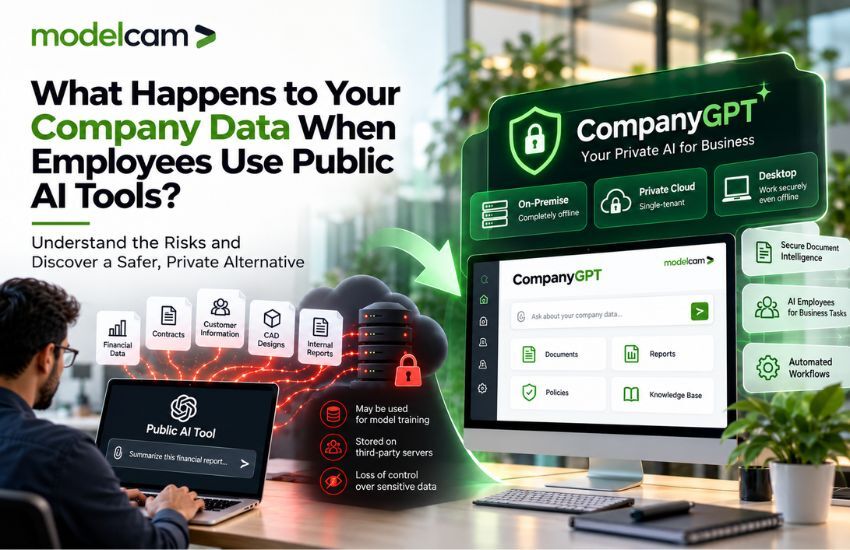
With private AI for businesses, organisations can retain sensitive information within their infrastructure and apply internal access controls. This makes it easier to manage who can view confidential business records.
However, on-premise deployment does not automatically ensure complete security. Regular software updates, access controls, backups, and network protection are still necessary.
AI data privacy in manufacturing is easier to manage when businesses have direct oversight of their systems and data.
Companies can define data-handling policies, control user permissions, and determine how information is stored and retained. This is particularly useful when handling confidential designs, proprietary processes, or customer-specific data.
A properly configured private AI infrastructure also helps manufacturers align AI usage with their internal security requirements.
Offline AI for manufacturing can benefit factories located in areas with unreliable internet access or operating under strict network restrictions.
Depending on the system's design, employees can use supported AI features through the internal network even when an internet connection is unavailable. This helps maintain access to essential operational information.
Cloud-based AI services may involve recurring subscriptions, usage-based charges, or rising costs as demand increases. On-premise systems generally require an upfront investment in hardware, installation, and configuration.
Maintenance and upgrades still incur expenses, but businesses can estimate long-term costs according to their operational needs and expected usage.
AI can examine production schedules, equipment availability, and delivery deadlines to identify potential bottlenecks.
For example, if machine downtime could delay an order, the system may alert the production manager. This allows the team to revise schedules and take action before delays become more serious.
Unexpected equipment failures can interrupt production and increase maintenance expenses. AI can examine equipment histories, maintenance records, and available sensor data to detect patterns associated with possible failures.
Maintenance teams can investigate these warning signs and plan inspections before a minor issue develops into a major disruption. Prediction accuracy depends on data quality and system capabilities.
AI can detect recurring quality problems by analysing defect records, supplier performance, and production data. It can also identify unusual stock levels and help purchasing teams anticipate shortages.
These insights support better inventory planning and reduce dependence on manual monitoring.
AI can support activities beyond the factory floor. Sales teams can analyse order histories, identify customer preferences, and prioritise enquiries more effectively.
When integrated with Customer Relationship Management (CRM) AI, these capabilities can improve follow-ups, support sales automation tools, and enhance the customer experience.
AI can also perform customer data analysis to reveal buying patterns, helping businesses understand customer needs and respond more effectively.
Choosing between cloud and on-premise AI depends on a manufacturer's budget, security needs, existing infrastructure, and business objectives.
Cloud AI suits businesses that require scalable computing resources and access across different locations. Depending on the provider and configuration, certain data may be processed on external servers.
On-premise AI gives businesses more direct control over their infrastructure and can operate offline if configured accordingly. However, companies are responsible for hardware, security, maintenance, and upgrades.
For manufacturers seeking secure AI for manufacturing, keeping sensitive data in-house can be beneficial. A hybrid model is another option, allowing businesses to process confidential information locally while using cloud services for other tasks.
Following a clear implementation plan helps manufacturers control costs and avoid unnecessary complications.
Step 1: Define your business requirements. Identify a specific challenge, such as production delays, stock inconsistencies, or recurring quality problems.
Step 2: Assess your existing data. Ensure production records, ERP data, and maintenance reports are accurate, accessible, and ready for AI analysis.
Step 3: Select suitable infrastructure. Consider server capacity, security needs, software compatibility, and requirements for offline access.
Step 4: Start with a pilot project. Introduce AI into one process or department, evaluate the results, and expand gradually.
Step 5: Train employees and track performance. Help staff use the system effectively and measure changes in processing time, downtime, accuracy, and operating costs.
This organised approach allows manufacturers to assess the benefits before expanding AI adoption across their operations.
Nankatai by Modelcam Technologies offers AI-powered business capabilities through an Enterprise Intelligence Platform (EIP). According to its official website, the platform operates on a company's own server and uses AI agents to support various business functions.
Its listed capabilities include production planning, maintenance, quality management, inventory, purchasing, sales, and reporting. The platform is also designed for offline operation, helping businesses manage operational information within their own premises.
Manufacturers can visit Nankatai to explore its features and determine whether the platform meets their operational requirements.
On-premise AI helps manufacturers strengthen production planning, anticipate equipment problems, analyse business information, and simplify routine tasks while retaining greater control over sensitive data.
Successful implementation starts with clear objectives, reliable data, and technology suited to the company's infrastructure and security needs. When adopted thoughtfully, AI-driven solutions can improve operational efficiency and support informed business decisions.
Manufacturers considering on-premise AI for manufacturing can explore solutions such as Nankatai to integrate AI into everyday operations while maintaining greater control over their data.
Let’s connect: www.modelcamtechnologies.com
Email: sales@modelcamtechnologies.com
Mobile no : +91 8237016167
Modelcam Technologies provides a wide variety of Services from ART to PART from Concept Design to Industrial Modeling and Analysis for final Manufacturing.
©Copyright 2026. All rights reserved by Modelcam Technologies Private Limited PUNE.