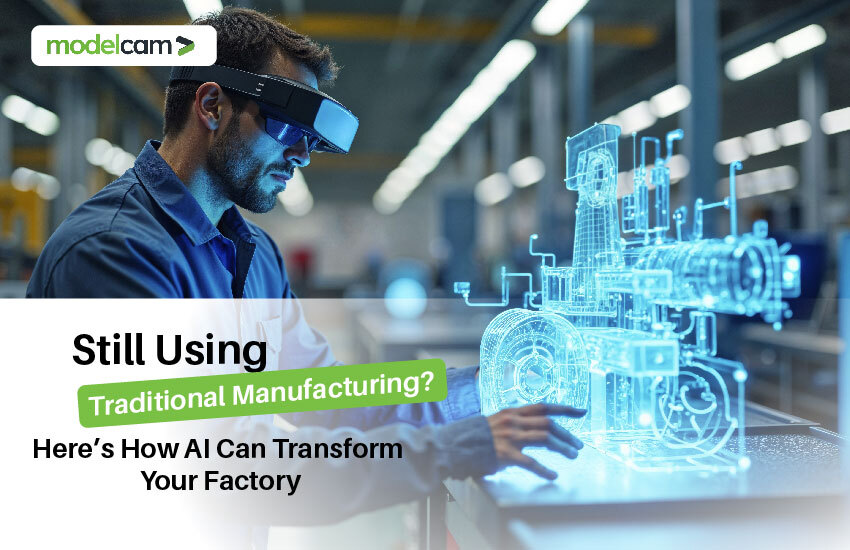
AI in manufacturing is increasingly essential for enterprises who need to remain competitive; it is no longer just a futuristic idea. AI in manufacturing is now assisting firms in increasing output, cutting expenses, and making more informed business decisions.
Imagine managing a factory where production lines automatically identify flaws, machines can anticipate errors before they occur, and managers are able to make decisions based on real-time data. Science fiction is not what this is. It is the reality of artificial intelligence (AI)-driven modern production.
Traditional manufacturing techniques have supported business expansion for decades. However, manufacturers are being forced to employ smarter technology due to growing client demands, increased operating costs, and international competition. Businesses that only use manual procedures may find it difficult to meet the demands of the modern market for speed and efficiency.
This is the area where AI in manufacturing is making a big difference.
Traditional manufacturing frequently makes decisions based on reactive maintenance, human inspections, and historical data. Although these techniques have been successful for many years, they frequently result in unanticipated equipment failures, manufacturing delays, and quality problems.
On the other hand, Smart Manufacturing optimizes operations through connected systems, AI-driven technology, and real-time analytics. Manufacturers may increase production by up to 20% and drastically lower maintenance costs by implementing AI technologies, according to industry reports.
To increase productivity and obtain a competitive edge, modern businesses are investing more and more in AI manufacturing solutions.
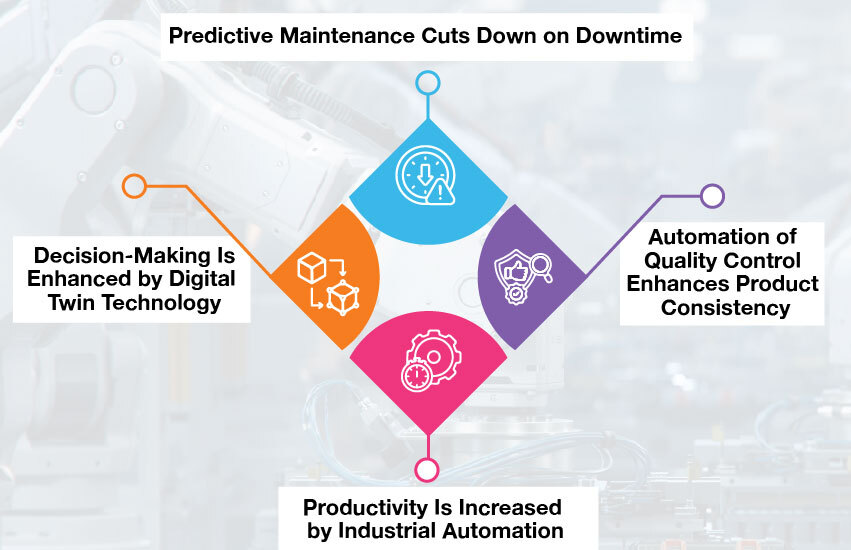
Predictive maintenance is one of the most useful AI applications in manufacturing.
Machines in conventional industries are only fixed when they break down or according to predetermined maintenance schedules. This strategy frequently leads to expensive downtime and needless maintenance costs.
AI-powered systems use sensors and data analysis to continuously monitor machine performance. Before a breakdown happens, they can see warning indicators like strange vibrations, temperature fluctuations, or performance declines.
For instance, the AI system can notify maintenance staff ahead of time if a CNC machine begins to exhibit unusual working patterns. This enables producers to plan repairs before they have an impact on output.
Businesses benefit from reduced maintenance expenses, longer equipment life, and fewer disruptions.
One of the most difficult tasks in manufacturing is maintaining a constant level of product quality.
Conventional quality inspections frequently depend on human observation, which can occasionally result in mistakes. This problem is addressed by AI-powered quality control automation.
Thousands of products may be inspected every hour by AI-enabled vision systems, which can spot even the tiniest flaws that might be hard for the human eye to see. These systems are able to quickly identify faulty products by analyzing photos in real time.
This lowers waste, rework, and customer complaints in addition to improving product quality.
AI-driven quality control can be revolutionary for firms who are committed to providing an exceptional customer experience.
AI is advancing industrial automation, which has long been a crucial component of manufacturing.
Conventional automation adheres to preset guidelines. On the other hand, AI-powered systems are able to learn from data and adjust to shifting circumstances.
AI, for instance, can automatically modify machine settings in response to environmental factors, material variances, or production requirements. This guarantees peak performance without continual human involvement.
Manufacturers can increase operational efficiency, decrease errors, and speed up production by fusing automation with intelligence.
The Digital Twin in Manufacturing is another potent innovation. A virtual duplicate of a machine, production line, or whole factory is called a "digital twin." AI uses real-time data from actual processes to continuously update this virtual model.
Before making real changes, manufacturers can utilize digital twin to test production adjustments, find bottlenecks, and model various scenarios.
For instance, managers can use the digital twin to assess the impact of a new production method before implementing it. This lowers risks and facilitates better decision-making for enterprises.
Because it enables businesses to increase productivity while reducing operational disruptions, the use of digital twin in manufacturing is expanding quickly.
AI in Industry 4.0 is now undergoing a significant shift in the industrial sector.
To build intelligent factories, Industry 4.0 integrates AI, machine learning, IoT devices, cloud computing, and advanced analytics.
In these settings, AI algorithms continuously optimize processes, manufacturing systems automatically exchange data, and machines connect with one another.
Faster production, improved resource use, and increased adaptability to market demands are the outcomes.
In an increasingly digital environment, companies who adopt AI in Industry 4.0 are setting themselves up for long-term success.
To understand more about AI in manufacturing’s future, explore our blog post, “The Future of AI in Manufacturing: Trends Every Industry Must Know”!
AI has advantages that go beyond production procedures.
These days, businesses are using AI to enhance supply chain management, customer service, planning, and sales.
Businesses can gain a better understanding of client preferences, purchasing trends, and future requests by analyzing customer data. Manufacturers are able to produce the appropriate goods at the appropriate times thanks to these insights.
AI-Driven Solutions and Data Automation are also being used by many firms to streamline forecasting, inventory management, and reporting.
Employees can concentrate on more strategic responsibilities that promote company growth by automating repetitive administrative tasks.
AI is being incorporated by manufacturers more and more into their customer contact and sales procedures.
Sales opportunities may be found, customer behavior can be analyzed, and follow-up tasks can be automated with the help of modern sales automation tools. This helps sales teams enhance efficiency and close deals faster.
Similarly, by examining past customer data, AI systems for customer relationship management (CRM) can offer tailored customer encounters.
AI, for instance, may forecast future purchasing patterns, provide product recommendations based on past purchases, and assist customer support teams with quicker responses.
In addition to improving the customer experience, this helps companies build enduring relationships with their clients.
Many manufacturers think that implementing AI necessitates a total overhaul of the factory. In actuality, small, focused projects are frequently the first steps toward successful AI implementation in manufacturing.
Businesses can begin by recognizing operational problems like poor production planning, frequent machine failures, or quality problems.
Manufacturers can then use particular AI Solutions for Manufacturing that tackle these issues. As quantifiable outcomes are attained, these solutions can eventually be implemented throughout the entire firm.
Businesses may assure a smoother transition and adopt the best AI software for the manufacturing industry by collaborating with seasoned technology providers.
Businesses that continue to rely only on conventional methods run the danger of slipping behind as the manufacturing landscape changes quickly. AI is now available to manufacturers of all sizes, not just big businesses.
AI provides useful solutions that boost productivity, cut expenses, and foster expansion in a variety of industries, from industrial automation and digital twin in manufacturing to predictive maintenance and quality control automation.
Investing in Artificial Intelligence in manufacturing is becoming a strategic need rather than an optional upgrade as firms transition to smarter and more connected operations.
Manufacturers who embrace innovation, use data analysis, and implement AI-driven technology to create factories that are faster, smarter, and more robust will win the future.
Let’s connect: www.modelcamtechnologies.com
Email: sales@modelcamtechnologies.com
Mobile no : +91 8237016167
Modelcam Technologies provides a wide variety of Services from ART to PART from Concept Design to Industrial Modeling and Analysis for final Manufacturing.
©Copyright 2026. All rights reserved by Modelcam Technologies Private Limited PUNE.