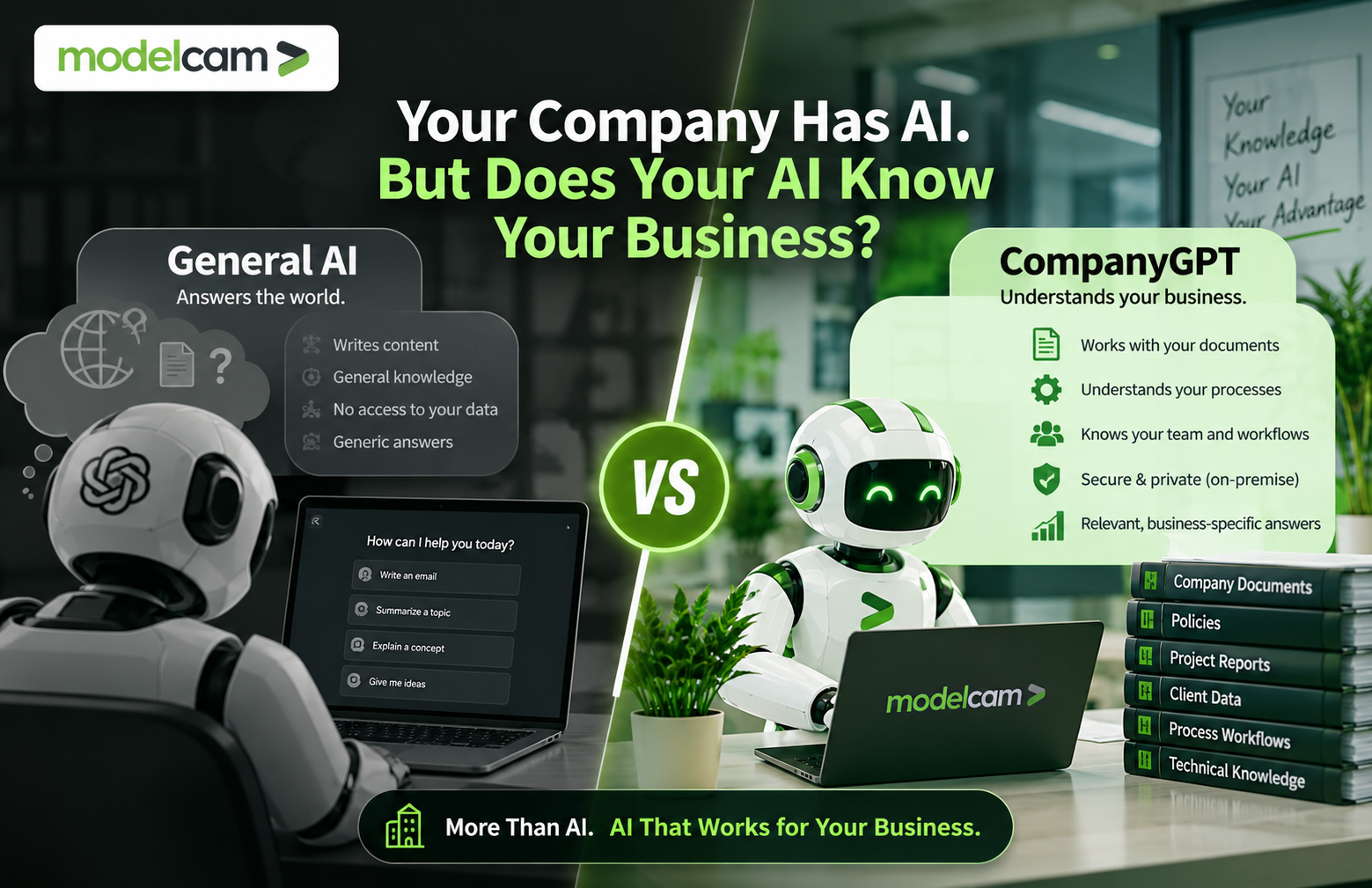
CompanyGPT can go beyond simply answering questions. When AI can work with your company's own documents, processes, and knowledge, it becomes much more relevant to the way your business actually operates.
Think about a typical AI tool. You can ask it a question and get a quick, well-written response. But what if you ask something that only your organization can answer?
This is where the difference between general-purpose AI and AI for business becomes clear.
To get more understanding about what CompanyGPT is, check out our blog post, “What is CompanyGPT? A Complete Guide to AI for Modern Businesses”.
General AI tools are designed to answer questions and handle tasks across many different subjects. They can be useful for writing, research, summarization, and everyday productivity. They can create content, summarize information, answer questions, and support employees with a wide range of everyday tasks.
However, every business has its own knowledge and way of working.
Your organization may have years of contracts, reports, technical documents, product details, customer records, internal policies, and operational information. A general AI tool does not automatically have access to or understand this business-specific knowledge.
This is why more businesses are exploring business AI that can work with their own information, processes, and workflows.
The goal is not simply to add another chatbot to the workplace. It is to build an AI system that can understand and work with the information employees already rely on.
For AI to provide real value across an organization, it needs access to the right business knowledge.
This may include:
An AI company knowledge base can bring important business information into one place, making it easier for employees to find the answers they need.
For instance, rather than checking multiple folders to locate a specific business document, an employee can simply ask an AI system a question and get a response based on the information available within the company.
This is where AI for company documents and AI document intelligence can make everyday work more efficient.
There is a clear difference between using general AI tools for business and using an AI system built around your company's specific needs.
Generic AI tools can be useful for tasks such as writing, brainstorming, summarizing information, and research. However, business-specific AI can work with the documents, knowledge, processes, and workflows that are directly relevant to your organization.
This approach can support AI for business operations, AI for business workflows, and business process automation.
For example, an employee may have to go through a large number of documents before creating a report. Instead of checking each file manually, an AI system can help find the relevant information, summarize key points, and organize the results.
The employee can then review the AI-generated output and make the final decisions, while reducing the amount of repetitive work involved.
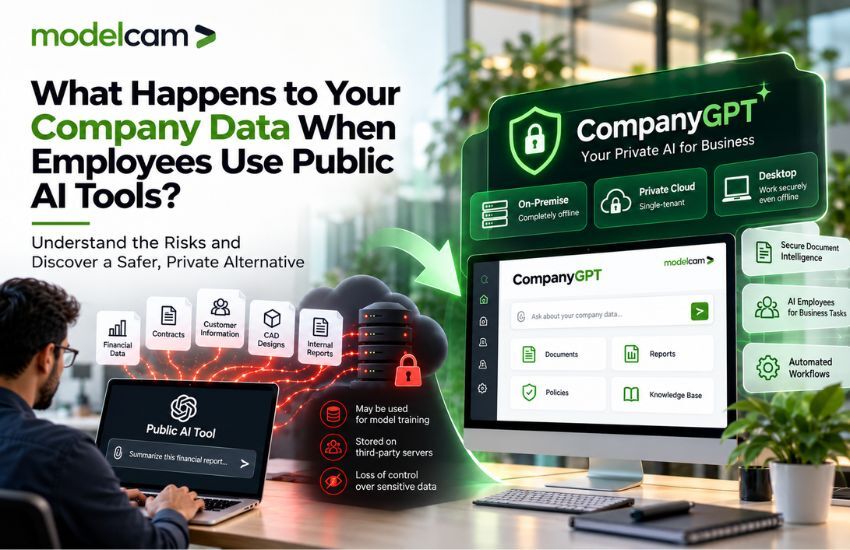
As businesses start using AI with their internal data, privacy and security become increasingly important.
Organizations may work with confidential contracts, engineering drawings, financial records, customer information, product details, and other sensitive business documents. Sharing this information with a public AI service may not always align with the company's security policies, data governance practices, or compliance requirements.
This is why private AI for business and private enterprise AI are receiving more attention from organizations that want greater control over their business data.
Based on their specific needs, companies may also explore on-premise AI for business or other deployment options that offer more control over data access, storage, and infrastructure.
A secure AI for business strategy should also look at who can access business information, how that data is processed and managed, and how the AI system fits into the organization's existing security policies.
CompanyGPT is designed as a business-focused AI solution that helps organizations work with their own information, documents, and requirements.
Rather than using AI as a separate tool, the approach is to connect it with the company's existing knowledge and workflows.
This can help with tasks such as understanding documents, finding information, analyzing data, and supporting employees.
For organizations exploring enterprise AI solutions, this approach can help bring AI capabilities closer to real business needs and day-to-day operations.
Modelcam Technologies also works on customized AI-driven solutions for manufacturing and engineering businesses, with AI applications developed around specific business requirements and workflows.
Consider the addition of a new worker to your company.
They must comprehend internal policies, documentation, product details, and business procedures. Typically, they might have to look through several files or question coworkers.
An additional information assistant may be an AI employee.
AI could be used by employees to:
This does not include hiring new staff. AI employees for businesses, on the other hand, can assist people in spending more time on activities requiring human judgment and less time looking up information.
Customer-facing operations can also benefit from business AI.
Sales teams may work with client data, find helpful patterns, and assist follow-ups with the use of Sales Automation Tools and Customer Relationship Management (CRM) AI.
Customer data analysis can help teams that interact with customers find patterns and enhance the customer experience.
AI can also be used by operations teams to facilitate decision-making, automate tedious activities, and organize data.
These uses demonstrate how AI in business can transcend content creation and become integrated into routine tasks.
Integrating AI with business procedures is the next stage.
For instance:
An employee poses a query → AI looks up pertinent information in the company's database → Relevant information is identified → AI responds → Employee acts.
Documents, business applications, and approval procedures might all be connected in a more sophisticated workflow.
This is where broader AI business automation can be supported by AI automation for business.
Organizations can progressively develop connected AI-driven solutions across departments rather than automating a single isolated operation.
Selecting an enterprise AI platform involves more than just determining the AI model it employs.
Companies should also think about:
Instead of requiring the company to fundamentally alter its operations, the appropriate enterprise AI software should be tailored to the organization's real needs.
Having access to an AI tool is no longer the only factor in AI adoption.
The question that is more helpful is:
Does your AI comprehend your business?
One of your company's most significant assets is its knowledge. AI can go beyond being a general-purpose assistant once it can use such information safely and contextually.
It can help firms use information more effectively, automate tedious tasks, support staff, enhance workflows, and help with data analysis.
The greater potential of CompanyGPT is to bring AI closer to the expertise and procedures that distinguish each company.
Because employing more AI tools may not be the future of AI for businesses.
It might involve employing AI that truly comprehends the business.
Let’s connect: www.modelcamtechnologies.com
Email: sales@modelcamtechnologies.com
Mobile no : +91 8237016167
Modelcam Technologies provides a wide variety of Services from ART to PART from Concept Design to Industrial Modeling and Analysis for final Manufacturing.
©Copyright 2026. All rights reserved by Modelcam Technologies Private Limited PUNE.